
MELU-317 · Lesson 8 of 12 · 19 min
Contractor licensing, insurance and bonding
▶ Video coming soon A video version of this lesson is on the way.
Renee Coleman keeps a binder on the corner of her desk labeled "the paper that lets us work." It holds the state contractor's license, the Memphis and Shelby County registration, the Metro Nashville local licenses, the general liability and auto policies, the workers' compensation policy, the umbrella policy, two current performance bonds and a letter from the surety stating how much bonded work the company can carry. When a general contractor asks for proof of something, the answer is in that binder. When something in the binder expires, Duck River stops being able to bid somewhere.
This lesson walks through that binder: the license and local registrations as a business system, the insurance a Tennessee contractor carries and why, workers' compensation and the exemption registry, and the bonds that support licenses and jobs. Insurance and bonding requirements change, and the board's requirements depend on the monetary limit and the license type, so read the board's current instructions before relying on any number here.
The license as a set of documents
The state contractor's license is only the center of the set. Around it sit the local licenses and registrations that cities require, the business license from the city or county where the company operates, and registration with the Secretary of State for a corporation or limited liability company. Each has its own renewal date. Renee lists every one of them, with its expiration date and the person responsible, on the first page of the binder, and she enters the dates in the office calendar with a reminder sixty days ahead.
Local registrations deserve particular attention because they are easy to forget. The Memphis and Shelby County Office of Construction Code Enforcement requires state-licensed contractors to register with it annually before pulling permits, and its system checks the registration and the insurance on file. Metro Nashville keeps its own license records. Smaller cities may ask for a copy of the state license and insurance certificates once a year. A lapsed local registration does not affect the state license, but it stops permits in that city until it is renewed.
General liability insurance
The board requires a licensed contractor to carry general liability insurance and to provide proof of it with the application and at renewal. The required amount depends on the monetary limit. An older board booklet set out minimum coverage in tiers that rose from 100,000 dollars for smaller limits to 1,000,000 dollars for the largest, and the board's current instructions should be checked for the amounts in force today. The insurer usually sends the certificate directly to the board, which prevents questions about altered copies.
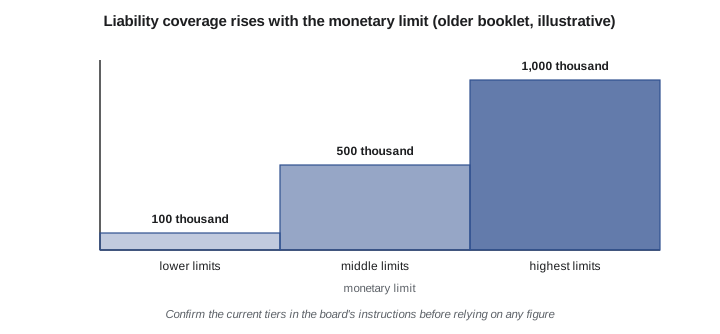
General liability covers claims that the company's work or operations caused bodily injury or property damage to others. For an electrical contractor, the typical claim is a fire or water damage traced to the company's work, or an injury to someone on a job site who is not a Duck River employee. Many owners and general contractors require higher limits than the board's minimum, and an umbrella policy above the general liability policy is common for commercial work. Contracts often require the company to name the owner or general contractor as an additional insured, which the insurer handles by endorsement.
Completed operations coverage is especially important for electricians. A fire caused by a loose lug can happen years after the job is finished, and the claim is made under the policy in force when the claim is made or when the damage occurs, depending on the policy form. Keeping coverage continuous, without gaps between policies, protects the company against claims for old work.
| Coverage | What it covers | Who usually requires it |
|---|---|---|
| General liability | Injury and property damage to others from operations and completed work | The board, owners and general contractors |
| Commercial auto | Vehicles used for the business | State law for vehicles; owners and general contractors for limits |
| Workers' compensation | Employee injuries on the job | State law for employers with one or more employees in construction |
| Umbrella | Additional limits above the primary policies | Larger owners and general contractors |
| Inland marine or equipment | Tools, equipment and materials in transit or stored | The contractor's own risk decision |
Workers' compensation in construction
Tennessee's workers' compensation law treats construction differently from most industries. Most employers must carry coverage once they have five or more employees, but employers in the construction industry must carry it with one or more employees. That rule covers electrical contractors, so Duck River has carried workers' compensation since Carl hired his first helper. The board requires proof of coverage, or of a valid exemption, with the license application and at renewal.
Owners of construction businesses are a special case. Sole proprietors, partners and members of limited liability companies in construction must either be covered by a workers' compensation policy or register for an exemption with the Bureau of Workers' Compensation through its construction services provider exemption registry. The registry lets general contractors confirm that a small subcontractor's owner is properly exempt rather than simply uninsured. The exemption covers the owner only, never employees, and the registry's rules set limits on how and where it can be used, so read them before relying on an exemption.
General contractors in Tennessee can become responsible for the workers' compensation claims of an uninsured subcontractor's employees. For that reason, Duck River's general contractor customers ask for its certificate on every job, and Duck River asks the same of any subcontractor it hires for trenching, boring or fire alarm work. A certificate that shows coverage in force for the right entity, with the right dates, is the minimum.
# Checking a subcontractor's paperwork before it starts on a Duck River job.
subs = [
    {"name": "Trenching sub", "employees": 3, "wc_policy": True,  "exempt_owner": False},
    {"name": "Fire alarm sub", "employees": 0, "wc_policy": False, "exempt_owner": True},
    {"name": "Boring sub",     "employees": 2, "wc_policy": False, "exempt_owner": True},
]
for s in subs:
    if s["employees"] >= 1 and not s["wc_policy"]:
        result = "STOP: employees need a workers' compensation policy"
    elif s["employees"] == 0 and not (s["wc_policy"] or s["exempt_owner"]):
        result = "STOP: owner needs coverage or a registered exemption"
    else:
        result = "ok"
print(f"{s['name']}: {result}")Trenching sub: ok Fire alarm sub: ok Boring sub: STOP: employees need a workers' compensation policy
The boring subcontractor's owner is exempt, but the company has two employees, and an owner's exemption never covers employees. That sub cannot start until it shows a policy.
Bonds that support the license
Bonds appear in Tennessee contractor licensing in two ways. First, as lesson 2 explained, a business that cannot support the monetary limit it wants with its financial statement can use a line of credit, a guaranty or a bond in the forms the board accepts. The board's materials have described a bond of 500,000 dollars, or 1,000,000 dollars for an unlimited monetary limit, as one alternative. Second, from July 1, 2026, the board's guidance describes a surety bond of at least half the requested monetary limit as an alternative to submitting a financial statement. Both options cost premiums and require the surety to underwrite the company, so they are not free substitutes for a strong balance sheet.
A surety bond is a three-party promise. The surety, usually an insurance company, promises the obligee, here the board or the public, that the principal, the contractor, will meet its obligations. If the contractor fails and the surety pays, the contractor must repay the surety. That repayment duty is why sureties look closely at financial statements, work in progress and the owners' personal finances before they write bonds.
Bonds on jobs
Public owners and many private owners require performance and payment bonds on larger jobs. A performance bond protects the owner if the contractor fails to finish the work. A payment bond protects subcontractors and suppliers if the contractor fails to pay them, which matters on public work because liens generally cannot be filed against public property. Tennessee law generally requires payment and performance security on state and local public construction contracts, and the specific amounts and thresholds appear in the statutes for each type of public owner.
For Duck River, bonds matter most as a subcontractor. School renovations and county work often require the prime contractor to bond the whole job and to require bonds from major subcontractors, including the electrician. Renee's surety letter states the single-job and total bonded work the surety will support, and Hector checks that letter before Duck River bids any bonded job.
Worked example: assembling the binder for a new job
Worked problem
Paperwork for the Memphis warehouse
The general contractor on the Memphis warehouse sends a subcontract requiring general liability of 1,000,000 dollars per occurrence with an umbrella of 2,000,000 dollars, the general contractor named as additional insured, workers' compensation, a performance and payment bond for the full subcontract value and current Memphis and Shelby County registration. What does Renee check?
Show solution
- Compare the liability and umbrella limits with Duck River's policies and ask the agent for the additional insured endorsement.
- Confirm the workers' compensation policy dates cover the whole job.
- Ask the surety for the bonds and confirm the job fits within the surety letter's limits.
- Confirm the annual Memphis and Shelby County registration is current and the insurance on file there is up to date.
Answer: If every item is in order, Renee sends the certificates, bonds and registration number together, and notes the expiration dates in the job file.
Doing all four checks before signing the subcontract matters, because a missing item discovered later can delay the first permit or the first payment. General contractors often withhold payment until they have every insurance and bond document their contract requires.
Reading an insurance clause
Subcontracts usually contain a long insurance clause, and reading it carefully before signing avoids surprises. Look for the required limits for each coverage, whether the general contractor and owner must be additional insureds and on which policies, whether coverage must be primary and noncontributory, whether a waiver of subrogation is required, how long completed operations coverage must be maintained after the job, and how much notice the insurer must give before cancellation. Send the clause to the insurance agent before signing, because some requirements need endorsements that take time to issue and may add premium.
Renee keeps a short summary of Duck River's coverages, with limits and the endorsements already on the policies, so that she can compare a new clause against it in minutes. When a clause asks for something the policies do not include, she asks the agent for a price and either adds it to the bid or negotiates the clause with the general contractor. Signing first and asking later is how contractors end up in breach of contract before they start work.
Insurance also affects the license directly. If a policy is canceled or not renewed, the board's records may show the lapse, and the business is out of compliance until new coverage is in place and proof is filed. Asking the agent to notify the office well before any change in coverage gives the company time to replace a policy without a gap.
Common mistakes
MistakeAssuming the board's minimum liability coverage satisfies every contract.
InsteadOwners and general contractors often require higher limits, umbrellas and additional insured endorsements.
MistakeTreating an owner's workers' compensation exemption as covering employees.
InsteadThe exemption covers the registered owner only.
MistakeUsing the five-employee threshold for a construction business.
InsteadConstruction employers need coverage with one or more employees.
MistakeForgetting annual local registrations.
InsteadA lapsed Memphis and Shelby County registration stops permits there until renewed.
Summary and key terms
- The state license sits inside a set of local registrations, business licenses and entity filings, each with its own renewal date.
- The board requires general liability insurance in amounts tied to the monetary limit; check the current tiers.
- Construction employers with one or more employees must carry workers' compensation.
- Construction business owners must be covered or register an exemption with the Bureau of Workers' Compensation.
- Bonds can support a monetary limit and are often required on jobs; from July 1, 2026, a surety bond of at least half the limit is an alternative to a financial statement.
- General liability
- Insurance for injury or property damage to others caused by the business's operations or completed work.
- Additional insured
- A party added to the contractor's policy by endorsement, often the owner or general contractor.
- Exemption registry
- The Bureau of Workers' Compensation registry for construction business owners exempt from coverage.
- Surety bond
- A promise by a surety that the contractor will meet its obligations to the obligee.
- Payment bond
- A bond protecting subcontractors and suppliers against nonpayment, common on public work.
Practice problems
Work each problem on paper first, then reveal the answer to check.
At how many employees must a Tennessee construction employer carry workers' compensation?
Show answer
One or more.
Does an owner's registered exemption cover the owner's employees?
Show answer
No. It covers the owner only.
Which annual local registration does the Memphis and Shelby County codes office require?
Show answer
Annual registration of state-licensed contractors before pulling permits.
Who repays a surety that pays a claim on a contractor's bond?
Show answer
The contractor, as the principal.
Lesson quiz · 5 questions
Score 60% or more to complete this lesson.
Create a free account to save your progress, take quizzes and earn a certificate.