
MELU-317 · Lesson 6 of 12 · 19 min
Permits, inspections and the inspection authority
▶ Video coming soon A video version of this lesson is on the way.
On a Tuesday in April, Duck River had three jobs starting: a farm shop outside Millers Bend, a dental office fit-out in Nashville and a pole barn just inside the limits of a small city south of Columbia. Alicia pulled three permits that morning from three different offices, and each permit came with its own inspector, its own scheduling system and its own list of required inspections. None of that is unusual in Tennessee. It is simply what happens in a state where the inspection authority depends on where the job sits.
This lesson explains who holds that authority, how a permit is obtained, what inspections a typical job needs, what happens when work fails, and how a contractor keeps track of it all across several jurisdictions. The details of fees and online systems change often, so the lesson concentrates on the structure, which has been stable for many years, and points to where the current details are published.
Who holds the inspection authority
Tennessee law gives the State Fire Marshal's Office, within the Department of Commerce and Insurance, responsibility for electrical inspections across the state. The same law allows the Commissioner of Commerce and Insurance to authorize a municipality or county to perform electrical inspections itself, in place of the state, if the local program meets the state's standards. The authorizing provision appears in the state's electrical inspection statute, section 68-102-143 of the Tennessee Code, and the State Fire Marshal's Office published a list of thirty-five authorized municipal programs as of September 2023. The list changes as cities join or give up their programs, so check the current version before assuming who inspects a particular address.
Within an authorized city, the city issues electrical permits and its inspectors perform the inspections. Outside any authorized program, which covers most rural areas and many small towns, the State Fire Marshal's Office issues the permit and assigns a deputy electrical inspector. The big four cities, Nashville, Memphis, Knoxville and Chattanooga, run their own programs, as do many suburbs and county seats. Davidson County is a single metropolitan government, so Metro Codes covers nearly all of it, while Shelby County's joint office covers Memphis and much of the surrounding county.
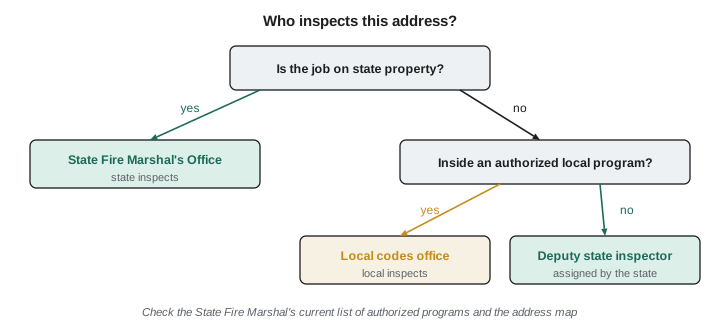
The state keeps a check on the local programs. According to the State Fire Marshal's guidance on authorized programs, the office reviews each program at least once every three years, and a program found deficient has thirty days to submit a corrective plan. The local program must use inspectors who meet the state's qualifications, enforce an adopted electrical code and report to the state. If a program fails to correct its problems, the authorization can be withdrawn and the state takes back the inspections.
State permits
On a state-inspected job, the electrical permit is bought from the State Fire Marshal's Office before work starts. The office sells permits online, and the permit is tied to the licensed contractor or Limited Licensed Electrician doing the work. The fee depends on the type and size of the work, under a fee schedule in the state's electrical rules. When the permit is issued, the job is assigned to a deputy electrical inspector for that area, and the contractor calls or schedules the inspections with that inspector.
State rules also allow a homeowner, under conditions set in the rules, to obtain a permit for electrical work on the home they live in. A homeowner permit does not let anyone else do the work for pay without the proper license, and a contractor who does the work under a homeowner's permit to avoid the licensing rules risks discipline. When an owner asks Duck River to "just do it under my permit", Alicia explains that the company pulls its own permits for its own work.
| Item | State-inspected job | Job in an authorized city |
|---|---|---|
| Who issues the permit | State Fire Marshal's Office | The city's codes or building department |
| Who inspects | A deputy electrical inspector assigned by the state | The city's electrical inspectors |
| Code enforced | The state's adopted NEC with its optional provisions | The city's adopted edition and local amendments |
| Who may pull the permit | A licensed contractor or LLE, or a qualifying homeowner | As set by the city, often a locally licensed electrician or contractor |
| Where fees are set | The state's electrical rules | The city's fee ordinance |
Local permits
Each authorized city runs its permits its own way. Many require the permit holder to hold a local license or registration in addition to the state contractor's license. Metro Nashville, for example, licenses electricians and electrical contractors locally and expects permits to be pulled under the appropriate local license. The Memphis and Shelby County Office of Construction Code Enforcement requires contractors to register with it each year, and its permit system checks that registration. Smaller cities often accept the state license alone but still require a business license and a local registration form. Before bidding in a new city, call the codes office and ask three questions: what license or registration do we need to pull a permit, what code edition do you enforce, and how do we schedule inspections.
Local permits are increasingly issued through online portals where the contractor applies, uploads plans when required, pays and schedules inspections. Plans review is common for commercial work. A city may require an electrical plan, a load calculation, a panel schedule and the one-line diagram for a service before it issues the permit, and the plans reviewer's comments must be resolved before work starts. On the Nashville dental office, Metro's plans review asked Duck River to show the available fault current at the new panel, a rule the city's adopted edition requires and the state's adoption makes optional.
The inspection sequence
Most jobs follow the same basic sequence. A temporary service, if one is needed, is inspected before the utility energizes it. Underground work, such as conduit in a trench or under a slab, is inspected before it is covered. Rough-in inspection covers boxes, raceways, cables and grounding inside walls and ceilings before insulation and drywall. Service inspection covers the service equipment, grounding electrode system and bonding. Final inspection happens when the devices, fixtures and equipment are installed and the system is ready for use. Large or phased jobs may have several rough-in and partial inspections.
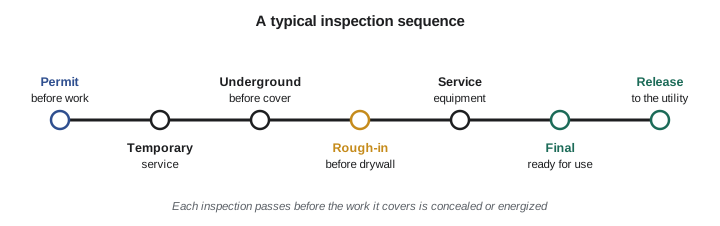
The order matters because each inspection must happen before the work is hidden. A crew that drywalls before the rough-in passes has created a problem only drywall removal can solve, and an inspector who cannot see the work can refuse to approve it. Alicia's rule for her crews is simple: no cover without a green tag, and no green tag without a look at the inspection record.
The utility is the last gate. Power companies and the municipal and cooperative utilities that distribute Tennessee Valley Authority power generally will not connect a new or upgraded service until the inspection authority releases it. On a state job, the deputy inspector notifies the utility or issues the release the utility needs; in an authorized city, the city does. A missed release is one of the most common reasons a finished job sits dark for days.
# A simple job board Alicia uses to see what blocks each job.
jobs = {
    "Farm shop (state)":        ["permit", "underground", "rough-in", "service"],
    "Dental office (Metro)":    ["permit", "plans review", "rough-in"],
    "Pole barn (city program)": ["permit"],
}
sequence = ["permit", "plans review", "underground", "rough-in", "service", "final", "utility release"]

for job, done in jobs.items():
    steps = [s for s in sequence if s != "plans review" or "Metro" in job]
    remaining = [s for s in steps if s not in done]
print(f"{job}: next is {remaining[0]}, then {len(remaining) - 1} more steps")Farm shop (state): next is final, then 1 more steps Dental office (Metro): next is underground, then 3 more steps Pole barn (city program): next is underground, then 4 more steps
The script is a stand-in for the whiteboard in Duck River's shop, where each job has a row and each inspection a column. The point is the habit: before the crew moves to the next stage, someone confirms the previous inspection passed, and the next one is scheduled.
When work fails
A failed inspection produces a correction notice listing what must be fixed. The contractor fixes the items and schedules a reinspection, which may carry a fee. Inspectors generally explain the reason for each item and cite the code section. If the contractor disagrees with the inspector's reading of the code, the first step is a conversation, often with the code book open, and the second is to ask the inspector's supervisor. Tennessee's electrical rules and each local program provide for appeals beyond that, usually to a board of appeals for the local program or to the State Fire Marshal's Office for state inspections. Appeals take time, so most disagreements are settled at the job site.
Earl Pruitt, the deputy inspector introduced in the last lesson, says the contractors who get the fewest correction notices are not the ones who know the most code. They are the ones who call before an inspection when they are unsure, who leave the work open and clean for him to see, and who have the permit card posted and the plans on site. An inspector's time is limited, and a job that is easy to inspect gets a faster and fairer inspection.
Worked example: which office for which job
Worked problem
Three jobs, three permits
Duck River has a farm shop in unincorporated Maury County, a dental office in Nashville and a pole barn inside a small city that appears on the State Fire Marshal's list of authorized programs. Where does each permit come from?
Show solution
- The farm shop is outside any city; check that the county itself does not run an authorized program. If not, the permit comes from the State Fire Marshal's Office.
- The dental office is in Davidson County, where Metro Nashville's codes department issues permits and inspects.
- The pole barn is inside a city on the authorized list, so the city issues the permit and inspects.
- For each, confirm the code edition the issuing office enforces.
Answer: State permit for the farm shop, Metro permit for the dental office and a city permit for the pole barn. Each job is inspected by the office that issued its permit.
The example looks simple, but the most common mistake in practice is the third case: a job just inside a small city's limits that the crew assumes is a state job because the area looks rural. Address lookups on the city's or county's mapping site settle the question in a minute, and that minute is worth taking before the permit is bought from the wrong office.
Records and posting
Keep the permit card posted at the job where the inspector can see it, keep the approved plans on site for commercial work, and keep copies of every inspection result in the job file. When a dispute arises later, whether with an owner about payment or with an inspector about a reinspection, those records show what was inspected and when. For a qualifying agent, the job file is also evidence that the company supervises its work, which matters if a complaint ever reaches the board.
Unpermitted work is the problem that turns a small mistake into a large one. Doing electrical work that requires a permit without obtaining one can lead to stop-work orders, penalties from the inspection authority and, for licensed contractors, a complaint to the licensing board. It also leaves the owner with work that was never inspected, which can affect insurance and resale. Duck River's policy is that no crew starts work until the permit number is written on the job ticket.
Common mistakes
MistakeAssuming every job outside a big city is inspected by the state.
InsteadMany smaller cities and some counties run authorized programs; check the current list and the address.
MistakeCovering work before the rough-in inspection passes.
InsteadEach inspection must happen before the work is concealed.
MistakeDoing a customer's job under the customer's homeowner permit.
InsteadContractors pull their own permits for their own work.
MistakeForgetting the utility release.
InsteadThe utility generally connects only after the inspection authority releases the service.
Summary and key terms
- The State Fire Marshal's Office is responsible for electrical inspections statewide, except where the Commissioner has authorized a local program under section 68-102-143.
- The State Fire Marshal's list showed thirty-five authorized municipal programs as of September 2023; check the current list.
- The state reviews each local program at least every three years, with thirty days to submit a corrective plan if deficient.
- Typical inspections are temporary service, underground, rough-in, service and final, each before the work is covered or energized.
- Local permits often require local licensing or registration, such as Memphis and Shelby County's annual contractor registration.
- Inspection authority
- The office responsible for permits and inspections at a given address.
- Authorized program
- A local electrical inspection program approved by the Commissioner of Commerce and Insurance.
- Deputy electrical inspector
- An inspector who performs state electrical inspections in an assigned area.
- Correction notice
- A list of items that must be fixed before an inspection passes.
- Utility release
- A notice from the inspection authority that allows the utility to connect a service.
Practice problems
Work each problem on paper first, then reveal the answer to check.
Who performs electrical inspections in an area with no authorized local program?
Show answer
The State Fire Marshal's Office, through a deputy electrical inspector.
How often does the state review authorized local programs?
Show answer
At least once every three years.
Which inspection must pass before insulation and drywall go up?
Show answer
The rough-in inspection.
What should a contractor ask a new city's codes office before bidding?
Show answer
What license or registration is needed to pull a permit, what code edition is enforced and how inspections are scheduled.
Lesson quiz · 5 questions
Score 60% or more to complete this lesson.
Create a free account to save your progress, take quizzes and earn a certificate.