
MELU-317 · Lesson 5 of 12 · 19 min
The NEC as adopted in Tennessee and state amendments
▶ Video coming soon A video version of this lesson is on the way.
Earl Pruitt has been a deputy electrical inspector with the State Fire Marshal's Office for nineteen years, and he inspects most of Duck River's rural jobs. When Alicia asked him which code edition he enforced, he laughed. "Depends where you're standing," he said. "Out here, it's the edition the state adopted. Cross the line into a city that runs its own program, and it's whatever they adopted. On your contractor exam, it's whatever the bulletin says. Three different answers to one question, and every one of them is right in its own place."
This lesson sorts out those answers. It explains how the State Fire Marshal's Office adopts the National Electrical Code, which edition it enforces as of late 2026 and the optional provisions it has written into its rules, how authorized local programs choose their own editions, and how a contractor decides which code applies to a given job. Code adoption in Tennessee has moved slowly at the state level and quickly in some cities, so the gap between editions can be large.
How the state adopts the code
The State Fire Marshal's Office, part of the Department of Commerce and Insurance, adopts the electrical code by rule. Its electrical rules sit in the 0780-02-01 chapter of the state's administrative rules, which also cover electrical permits, fees and the authorization of local inspection programs. When the state moves to a new NEC edition, it publishes proposed rules, takes public comment at a rulemaking hearing and then files the final rule, which states the edition adopted and any changes the state makes to it.
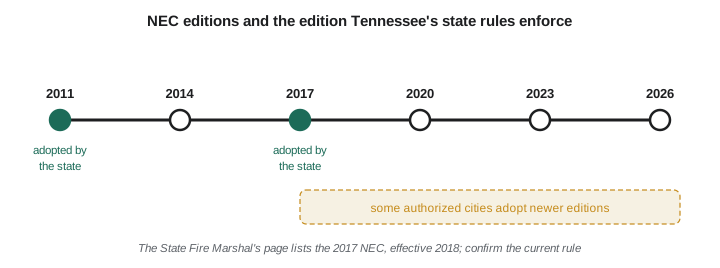
The State Fire Marshal's code adoption page lists the electrical code currently adopted for state inspections as the 2017 edition of NFPA 70, the National Electrical Code, published by the National Fire Protection Association, and shows it taking effect in 2018. Code adoption trackers report the same edition. That makes Tennessee one of the states enforcing an older edition at the state level in 2026, while the national code has since gone through its 2020, 2023 and 2026 editions. Before you rely on that, check the State Fire Marshal's page, because a newer adoption could be in rulemaking when you read this.
Tennessee's changes to the 2017 NEC
The state adopted the 2017 NEC with exceptions written into the rule. According to the State Fire Marshal's adoption page, two provisions are made optional: section 110.24 on marking the available fault current at service equipment, and certain arc-fault circuit interrupter requirements. Making a requirement optional means the state inspector will not cite its absence, but an installer may still follow it, and a designer or owner may specify it in the contract documents.
Tennessee has a history of these optional provisions. The state's earlier rulemaking that adopted the 2011 NEC also made section 110.24 optional and made certain weather-resistant receptacle requirements optional. Each new adoption is a chance for the state to add, keep or drop such exceptions, so a contractor should read the adopting rule itself rather than assume last cycle's list still applies.
| Item | State rule as published | What it means on a state-inspected job |
|---|---|---|
| Base code | NFPA 70, National Electrical Code, 2017 edition | Install to the 2017 NEC unless the rule says otherwise |
| Available fault current marking (110.24) | Optional | Not cited if absent; may still be required by the plans or owner |
| Certain arc-fault requirements | Optional | Read the rule for exactly which requirements; follow the plans |
| Effective date | 2018, per the State Fire Marshal's adoption page | Jobs permitted after that date follow the 2017 edition |
Local adoptions
A municipality authorized to perform electrical inspections tells the State Fire Marshal which electrical code and edition it will enforce. Larger cities often move to newer editions faster than the state, and some adopt their own amendments by ordinance. A city might be enforcing the 2020 or 2023 NEC with local changes while the state enforces the 2017 edition a few miles away. Metro Nashville, Memphis and Shelby County, Knoxville and Chattanooga each publish the codes they enforce on their codes department websites, and smaller authorized cities do the same, usually in their municipal code.
For a contractor working across those lines, the practical result is that the same installation can be correct in one place and wrong in another. A rule added in a newer edition, such as a change to ground-fault protection requirements or a new labeling rule, applies inside a city that adopted that edition and not on a state-inspected job outside it. Duck River keeps a one-page sheet in each truck listing the edition and major local amendments for each jurisdiction where it regularly works, and Alicia updates it whenever a city announces an adoption.
| Where the job is | Who decides the code | Where to look |
|---|---|---|
| Area with no authorized local program | State Fire Marshal's Office rules | The state's code adoption page and rule 0780-02-01 |
| City authorized to perform electrical inspections | The city, by ordinance, as reported to the State Fire Marshal | The city's codes department or municipal code |
| State-owned property | State rules (authorized cities do not inspect state property) | State Fire Marshal's Office |
| Any job with engineered plans | The adopted code sets the minimum; the plans may require more | Contract documents and the permit |
Which edition governs a job
When a jurisdiction changes editions, the usual rule is that the code in effect when the permit is applied for or issued governs the job, even if a newer edition takes effect while the work is underway. Jurisdictions write their own transition rules, so the safe approach is to ask the permit office which edition applies to a permit applied for on a given date, and to note the answer in the job file. On a long project that straddles an adoption date, the difference between editions can affect material orders, so that question belongs in the estimate, not halfway through rough-in.
# Illustrative lookup Duck River keeps for its regular jurisdictions.
# Editions here are placeholders for the course; confirm each one locally.
editions = {
    "state-inspected areas": 2017,
    "City A (authorized program)": 2020,
    "City B (authorized program)": 2023,
}

def check(job, place, needs_newer_rule_from):
    adopted = editions[place]
    applies = adopted >= needs_newer_rule_from
    print(f"{job} in {place}: code edition {adopted}")
    print(f"  rule first added in {needs_newer_rule_from}: {'applies' if applies else 'not required'}")

check("Dwelling service", "state-inspected areas", 2020)
check("Dwelling service", "City A (authorized program)", 2020)
check("Restaurant kitchen", "City B (authorized program)", 2023)Dwelling service in state-inspected areas: code edition 2017 rule first added in 2020: not required Dwelling service in City A (authorized program): code edition 2020 rule first added in 2020: applies Restaurant kitchen in City B (authorized program): code edition 2023 rule first added in 2023: applies
The script uses placeholder editions for two cities to make the point without claiming what any particular city has adopted. The structure is what matters: for each jurisdiction, record the edition and the date it took effect, and check new rules against that record before quoting a job.
The code on the exam versus the code on the job
As lesson 4 explained, the CE exam is written on the edition listed in the candidate bulletin, which in PSI's April 2026 bulletin happens to match the state's adopted 2017 edition. That match is convenient, but it is a coincidence of timing, not a rule. If the state adopts a newer edition, the bulletin may change on a different schedule, and if the vendor change to Prov brings a new reference list, it may name a different edition. Keep the two questions separate: the bulletin answers what is on the exam, and the adopting rule answers what is enforced on the job.
Other codes on electrical jobs
The electrical code is not the only code that touches an electrician's work. Tennessee adopts building, residential, fire and energy codes, and those codes contain rules that matter to electricians: fire-resistance-rated penetrations, emergency lighting and exit signs, smoke alarm locations, lighting power limits and controls, and access to equipment. The CE exam's reference list includes the 2021 International Building Code for that reason. On the job, the building or fire inspector may enforce those rules even when the electrical inspector has signed off.
Alicia learned this on a church addition when the building inspector flagged an unsealed penetration in a rated corridor wall that the electrical inspection had passed. The fix took twenty minutes with the right firestop product, but the reinspection cost a day. She now walks rated walls with the plans before cover inspections.
Worked example: one job, two jurisdictions
Worked problem
A service upgrade on each side of the line
Duck River has two similar 200-ampere dwelling service upgrades the same week: one in a rural area inspected by the state, the other in a city with its own authorized program that has adopted a newer NEC edition. The owner of the rural house asks whether the crew can use the same material list and labeling for both.
Show solution
- Check the rural job against the 2017 NEC as adopted by the state, including the optional provisions.
- Check the city job against the city's adopted edition and any local amendments, which may include rules added after 2017.
- Compare the two lists and note any extra devices, labels or clearances the newer edition requires.
- Price each job from its own list and record the edition in each job file.
Answer: The crew may use one list only if it meets the stricter of the two codes; otherwise each job gets its own list. Using the newer requirements on the rural job is allowed but may cost the owner more than the state code requires.
That last point is a business decision, not a code question. Some contractors standardize on the newest edition for every job because it simplifies training and material stocking, and they explain the small cost difference to owners. Others price each job to the minimum the local code requires to stay competitive in rural bids. Either approach is lawful, as long as every job meets the code that applies at its address.
Keeping up with adoptions
Code adoptions are announced through rulemaking notices, city council agendas and codes department websites, and a busy contractor can easily miss them. Practical ways to stay current include signing up for notices from the State Fire Marshal's Office and the codes departments of the cities where you work, attending code update classes offered by trade associations and supply houses, and asking inspectors at the end of a job whether any changes are coming. Inspectors generally know months ahead and are glad to tell contractors, because it saves everyone failed inspections later.
Alicia keeps the adoption sheet in the trucks current by checking those sources each quarter. When a city adopts a new edition, she schedules a short crew meeting on the changes that matter most for Duck River's typical work in that city, rather than trying to teach every change at once.
Common mistakes
MistakeAssuming the state enforces the newest NEC.
InsteadThe State Fire Marshal's adoption page lists the 2017 NEC for state inspections; confirm whether a newer adoption has taken effect.
MistakeTreating optional state provisions as prohibited.
InsteadOptional means not required by the state; plans, specs or local codes may still require them.
MistakeUsing the state edition inside a city with its own program.
InsteadAuthorized cities enforce the edition they adopted, often newer than the state's.
MistakeConfusing the exam edition with the enforced edition.
InsteadThe bulletin controls the exam; the adopting rule controls the job.
Summary and key terms
- The State Fire Marshal's Office adopts the electrical code by rule in chapter 0780-02-01.
- Its adoption page lists the 2017 NEC for state inspections, taking effect in 2018.
- Section 110.24 and certain arc-fault requirements are optional under the state's adoption.
- Authorized municipalities enforce the code edition they adopt and report to the State Fire Marshal, often newer than the state's.
- The code in effect at permit application or issue usually governs a job; confirm the transition rule with the permit office.
- Adopting rule
- The administrative rule that names the code edition and any state changes.
- Optional provision
- A code requirement the state rule makes optional rather than mandatory.
- Authority having jurisdiction
- The office that enforces the code at a particular address.
- Authorized municipality
- A city the Commissioner of Commerce and Insurance has authorized to perform electrical inspections.
- Transition rule
- The rule deciding which edition applies to work permitted around an adoption date.
Practice problems
Work each problem on paper first, then reveal the answer to check.
Which NEC edition does the State Fire Marshal's adoption page list for state inspections?
Show answer
The 2017 edition.
Name one provision the state's 2017 adoption makes optional.
Show answer
Section 110.24 on available fault current marking, or certain arc-fault requirements.
A city authorized to inspect has adopted a newer NEC. Which edition applies inside the city?
Show answer
The city's adopted edition.
Where should a contractor confirm which edition governs a permit issued near an adoption date?
Show answer
With the permit office for that jurisdiction.
Lesson quiz · 5 questions
Score 60% or more to complete this lesson.
Create a free account to save your progress, take quizzes and earn a certificate.