
MELU-317 · Lesson 4 of 12 · 18 min
The exam format and the references allowed
▶ Video coming soon A video version of this lesson is on the way.
Alicia's study shelf filled up fast. Duck River's office had a 2008 code book left over from Carl's exam, a newer code book from the company's last code update class, and a pile of handbooks and pocket references the crew had collected over the years. Before buying anything, she sat down with the testing vendor's candidate bulletin and made a list of exactly which books, in exactly which editions, the bulletin allowed in the testing room. That list turned out to be the most important page in her study plan, because Tennessee's contractor exams are open book, and an open-book exam rewards the candidate who knows where things are in the right books.
This lesson describes the two exams a CE qualifying agent takes, using PSI's Tennessee candidate bulletin revised in April 2026. The board's move to Prov as its exam vendor starting July 1, 2026 may bring changes to formats, reference lists and test-day rules, so treat every number here as something to confirm in the bulletin that applies to your exam date.
The Business and Law Management exam
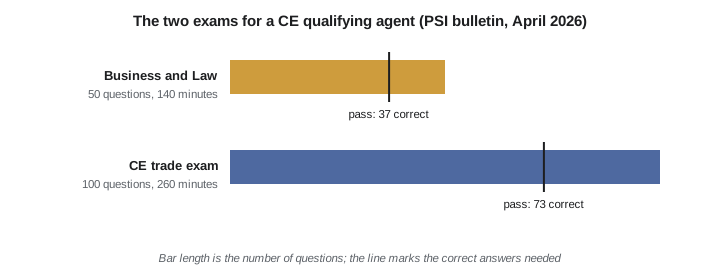
Every qualifying agent, in every classification, passes the Business and Law Management exam. PSI's 2026 bulletin describes it as 50 questions in 140 minutes, with a passing score of 73, which means 37 correct answers. The exam is open book, and the single reference is the Contractors' Guide to Business, Law and Project Management, Tennessee Edition, published by NASCLA, in the edition the bulletin lists; the April 2026 bulletin names the fourth edition.
The content areas cover the business side of contracting: licensing requirements, estimating and bidding, business organization and financial management, tax law, labor law, project management and lien law, contracts, risk management, and environmental and safety rules. The core course on business and law for master electricians covered most of these topics in general terms. The Tennessee exam asks about them as they apply in Tennessee, and the NASCLA guide's Tennessee edition includes chapters on the state licensing law and the state lien law that do not appear in other states' editions.
The CE trade exam
The CE trade exam is the electrical exam. PSI's 2026 bulletin lists 100 questions in 260 minutes, with a passing score of 73, or 73 correct answers. That is about two minutes and thirty-six seconds per question, more generous than many states' master exams, but the questions draw on several books, and a candidate who has to hunt through each one runs out of time anyway.
Earlier versions of the bulletin grouped the questions into content areas such as general knowledge and installation requirements, building code requirements, services, feeders and branch circuits, overcurrent protection, grounding and bonding, conductors and cables, raceways and boxes, hazardous locations and special occupancies, low voltage and signaling systems, lighting and general use equipment, OSHA and NFPA 70E safety, and motors, transformers and generators. Read the current bulletin for the current list and the number of questions in each area, and use those weights to decide where your study time goes.
| Exam | Questions | Time | Passing score | Open book |
|---|---|---|---|---|
| Business and Law Management | 50 | 140 minutes | 73 (37 correct) | Yes, NASCLA Tennessee edition |
| CE Electrical trade exam | 100 | 260 minutes | 73 (73 correct) | Yes, references listed in the bulletin |
The CE reference list
The CE reference list is longer than most candidates expect, and the editions matter. PSI's April 2026 bulletin lists the 2017 edition of NFPA 70, the National Electrical Code, along with the 2017 NEC Handbook; the 2017 NFPA 70E standard and its handbook; the 2021 International Building Code; OSHA's construction standards in 29 CFR Part 1926; and Ugly's Electrical References in the 2011, 2014 or 2020 editions. The bulletin states that questions about a code are based only on the edition of that code listed, so a candidate who studies from a newer NEC can answer some questions differently from the key.
That point deserves emphasis. A Tennessee electrician working in Nashville may use a newer NEC every day if Metro has adopted it. On the state CE exam, however, the listed edition controls. A section number that moved between editions, a table that was renumbered, or a rule that changed its threshold can all produce a wrong answer for a candidate who reads the wrong book. Alicia bought a used 2017 code book for the exam and kept it separate from the newer book she uses on the job.
| Reference | Edition in PSI's April 2026 bulletin | Typical use on the exam |
|---|---|---|
| National Electrical Code (NFPA 70) | 2017 | Most installation questions |
| NEC Handbook | 2017 | Explanations and illustrations of code rules |
| NFPA 70E standard and handbook | 2017 | Electrical safety in the workplace |
| International Building Code | 2021 | Building code questions |
| OSHA 29 CFR Part 1926 | As published or PSI's selections | Construction safety |
| Ugly's Electrical References | 2011, 2014 or 2020 | Formulas and quick tables |
Book rules
Open book does not mean anything goes. The bulletin's rules say references may be highlighted, underlined or indexed with permanent tabs, but may not contain handwritten notes, loose papers or removable sticky notes. Proctors inspect the books before the exam and can refuse a book that breaks the rules. A silent, non-programmable calculator is allowed. Phones, smart watches and other electronics stay outside the testing room. Each vendor sets its own details, so reread the rules when the vendor changes.
Tabs are where open-book exams are won and lost. Alicia used commercially printed tabs for the major code articles and added her own permanent tabs for the tables she kept looking up: conductor ampacities, conduit fill, box fill, grounding conductor sizes and motor full-load currents. She tabbed the NASCLA guide by chapter and flagged the lien law and licensing chapters in a different color. She practiced with only those tabbed books, so that by exam day her hands knew where to go.
Pacing
On a timed open-book exam, the main risk is spending eight minutes on a question worth the same as one that takes forty seconds. A simple pacing plan sets checkpoints. On the CE exam, 260 minutes for 100 questions means a candidate should be past question 25 at about the 65-minute mark, past question 50 at about 130 minutes and past question 75 at about 195 minutes, leaving time to return to flagged questions.
def checkpoints(questions, minutes, marks=(0.25, 0.5, 0.75)):
    per_q = minutes / questions
    print(f"{questions} questions in {minutes} minutes: {per_q:.2f} minutes each")
    for m in marks:
        q = round(questions * m)
        print(f"  be past question {q} at about minute {round(q * per_q)}")

checkpoints(100, 260)   # CE trade exam
checkpoints(50, 140)    # Business and Law
need_ce = round(100 * 0.73)
need_bl = round(50 * 0.73)
print("Correct answers needed: CE", need_ce, "and Business and Law", need_bl)100 questions in 260 minutes: 2.60 minutes each be past question 25 at about minute 65 be past question 50 at about minute 130 be past question 75 at about minute 195 50 questions in 140 minutes: 2.80 minutes each be past question 12 at about minute 34 be past question 25 at about minute 70 be past question 38 at about minute 106 Correct answers needed: CE 73 and Business and Law 36
The script produces the checkpoints Alicia wrote on the inside cover of her practice notebook. On test day she did not carry the notebook into the room, but she had practiced with the checkpoints so often that she knew whether she was ahead or behind without doing arithmetic.
Question styles
Most questions on both exams are multiple choice with four options. Some ask for a direct lookup: which article covers a topic, what the minimum or maximum is for a given installation. Others are calculations: a conductor size after adjustment, a box size, a demand load. A third group describes a situation and asks what is required or permitted, which means reading every word of the question and finding the rule that matches the specific conditions. The Business and Law exam leans toward the third type, with questions about lien deadlines, payroll records, contract clauses and licensing rules framed as short scenarios.
A good habit for both exams is to underline, in your mind, the words that change the answer: dwelling or commercial, indoor or outdoor, minimum or maximum, copper or aluminum, prime contractor or remote contractor. Many wrong answers on these exams are correct answers to a slightly different question.
What the exams do not test
Neither exam tests local amendments, local licensing rules or the code edition a particular city enforces. Those matter on the job and in local exams, but the state exams test the books in the bulletin. Similarly, the CE exam tests the code as written in the listed edition, not the State Fire Marshal's optional provisions or any later adoption. Lesson 5 explains the code the state actually enforces, which is a separate question from the code the exam is written on.
Worked example: a lookup under time pressure
Worked problem
Planning one hard question
Alicia reaches question 41 of the CE exam at minute 98. The question asks about a requirement she knows is in a particular article but cannot remember the section. She estimates the lookup will take five minutes. Should she do it now?
Show solution
- Her checkpoint for question 50 is minute 130, so she has 32 minutes for 10 questions, or 3.2 minutes each.
- A five-minute lookup now leaves 27 minutes for the next 9 questions, exactly 3 minutes each.
- That is still above the average pace of 2.6 minutes, so she is not behind.
- But if the next questions are also slow, the margin disappears.
Answer: She can afford the lookup, but the better habit is to flag it, answer the quicker questions first and return to it, because a flagged question costs nothing if time runs short.
The example shows how a pacing plan turns a stressful moment into a simple decision. Without checkpoints, a candidate who finds a hard question tends to keep digging, because each minute already spent feels like an investment. With checkpoints, the candidate can see whether there is room for the lookup and decide in seconds.
Building an index you can trust
Commercial tab sets get a candidate to the right article. Finding the right section within an article is a second skill, and the code book's own index is the tool for it. Practice looking up a term in the index, noting the section, and turning straight to it. When the index uses a word you would not have chosen, write that down in your study notes, not in the book, and practice the lookup again a few days later. Over a few weeks, the index becomes familiar and the lookups get faster.
For the Business and Law exam, the NASCLA guide's table of contents and its chapter on Tennessee law are the main navigation tools. Alicia found that most of her Business and Law time went to reading questions carefully rather than looking things up, so her practice there focused on working through scenario questions at a steady pace. She also practiced the guide's financial ratio and payroll calculations until she could do them without looking up the formulas.
Common mistakes
MistakeStudying from the newest NEC because it is the one used on the job.
InsteadUse the edition listed in the bulletin; the exam key follows that edition.
MistakeWriting notes in the margins of a reference book.
InsteadHighlighting, underlining and permanent tabs are allowed; handwritten notes and loose papers are not.
MistakeAssuming the reference list never changes when the vendor changes.
InsteadRead the current vendor's bulletin; the move to Prov in 2026 may change details.
MistakeSpending too long on a single lookup.
InsteadUse checkpoints, flag hard questions and come back after a first pass.
Summary and key terms
- The Business and Law exam has 50 questions in 140 minutes, open book with the NASCLA Tennessee edition, and a passing score of 73 in PSI's 2026 bulletin.
- The CE trade exam has 100 questions in 260 minutes with a passing score of 73 in the same bulletin.
- CE references in the April 2026 bulletin include the 2017 NEC and Handbook, 2017 NFPA 70E, the 2021 IBC, OSHA Part 1926 and Ugly's.
- Questions are based only on the edition of each code listed in the bulletin.
- Books may be highlighted, underlined and permanently tabbed but not written in; a silent non-programmable calculator is allowed.
- Open book
- An exam that allows specific approved reference books in the testing room.
- Reference list
- The books and editions a bulletin allows for an exam.
- Permanent tab
- A tab fixed to a page that cannot be removed and moved during the exam.
- NASCLA guide
- The Contractors' Guide to Business, Law and Project Management, Tennessee Edition, the Business and Law reference.
- Checkpoint
- A planned question number to reach by a given time during the exam.
Practice problems
Work each problem on paper first, then reveal the answer to check.
How many correct answers are needed to pass the CE exam described in PSI's 2026 bulletin?
Show answer
73 of 100.
How many minutes per question does the CE exam allow on average?
Show answer
2.6 minutes, or about 2 minutes 36 seconds.
Which NEC edition does PSI's April 2026 bulletin list for the CE exam?
Show answer
The 2017 edition.
May a candidate bring removable sticky notes in a code book?
Show answer
No. Only permanent tabs, highlighting and underlining are allowed.
Lesson quiz · 5 questions
Score 60% or more to complete this lesson.
Create a free account to save your progress, take quizzes and earn a certificate.