
MELU-315 · Lesson 9 of 12 · 19 min
Contracts and mechanics' liens in South Carolina
▶ Video coming soon A video version of this lesson is on the way.
Congaree finished the electrical work on a medical office building in Lexington for Saluda Shoals Builders in early August. The last pay application, 46,500 dollars including retainage, was approved by the GC's project manager, and then nothing happened. September went by. In October, the project manager stopped returning calls, and Ben Alvarez heard from a supplier that the owner and the GC were fighting over a delay claim. Wade called Tamika and Joyce into his office and drew a line on the whiteboard. "Our last day on that job was August 6," he said. "That starts a clock. If we don't serve and file a lien within ninety days, we lose the strongest tool we have to get paid." Joyce counted the days on the calendar. They had less than three weeks.
This lesson covers contracts and mechanics' liens for an electrical contractor in South Carolina: the contract terms that matter most, who has lien rights under Title 29, Chapter 5, the notices that protect those rights, the deadlines to serve, file and sue, and how payment bonds replace liens on public work. It is a study summary, not legal advice. Lien law is strict and technical, and a lawyer who handles construction cases should review any real lien before it is filed.
Contracts first
Most payment disputes are decided by the contract long before anyone thinks about a lien. A subcontract with a general contractor usually says how the sub is paid, when, and on what conditions. It may include a pay-when-paid or pay-if-paid clause, retainage, a schedule of values, change order procedures, notice requirements for claims and delays, insurance and indemnity terms, and a dispute resolution clause. Reading these terms before signing, and pushing back on the ones that shift too much risk, protects the company more than any lien.
South Carolina also has prompt payment rules for private and public construction, which set expectations for how quickly owners and contractors pass payments down the chain and allow interest on late payments in some cases. They do not replace the contract, and they have their own conditions. A qualifying party should know they exist and ask a lawyer how they apply when a payment is late.
| Contract term | What it does | What to watch for |
|---|---|---|
| Pay-when-paid | Sets the timing of the sub's payment after the GC is paid | Whether it shifts the risk of owner nonpayment to the sub |
| Retainage | Holds back part of each payment until completion | When and how it is released |
| Change orders | Sets how extra work is approved and priced | Whether written approval is required before work |
| Claims notices | Sets deadlines to give notice of claims and delays | Short deadlines that can waive a claim |
| Lien waivers | Releases lien rights in exchange for payment | Waivers given before payment is received |
| Dispute resolution | Mediation, arbitration or court | Location and who pays fees |
Who has lien rights
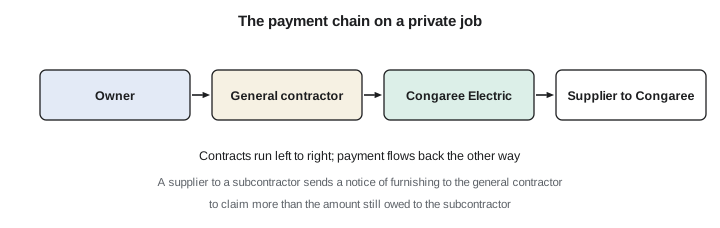
South Carolina's mechanics' lien statute gives a lien on the improved property to people who furnish labor or materials to improve real estate under a contract with the owner or with someone in the contract chain. A prime contractor, who contracts with the owner, has lien rights. So does a first-tier subcontractor, like Congaree on the Saluda Shoals job, and a supplier who sells to the GC. Lower-tier subcontractors and suppliers also have rights, but the statute limits what they can recover unless they give the right notice, as the next section explains.
A licensed contractor's lien must show its license number. South Carolina law also makes it hard for an unlicensed contractor to claim a lien for work that required a license. That is one more reason the license matters on every job, and why the license number belongs on every contract and invoice.
Notices that protect the claim
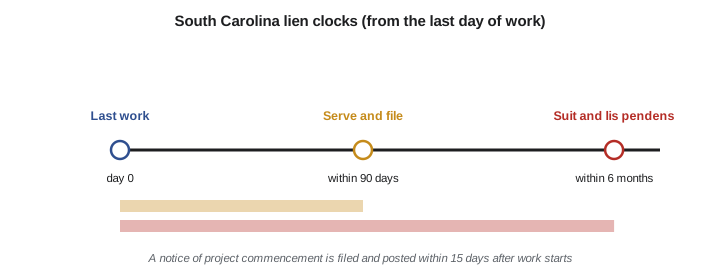
Two notices matter most. The first is the notice of project commencement. On many private projects, the owner or the owner's designee files a notice of project commencement in the county records and posts it at the site within fifteen days after work starts. It identifies the owner, the property and the general contractor, so that subcontractors and suppliers know whom to notify.
The second is the notice of furnishing. A subcontractor or supplier that does not have a contract with the general contractor, such as Congaree's supplier, a sub-subcontractor, serves a notice of furnishing on the owner or the contractor named in the notice of project commencement. Without it, a lower-tier claimant's lien may be limited to what the owner still owes up the chain. With it, the claimant protects its right to the amount it is owed, within the statute's limits. Deadlines for the notice of furnishing are tied to the notice of project commencement and the start of work, so lower-tier suppliers should send it early on every project where one is filed.
Serving, filing and suing
To claim a lien, the claimant must serve a statement of the lien on the owner and file it in the office of the register of deeds or clerk of court in the county where the property is located, within ninety days after the claimant last furnished labor or materials to the project. The statement identifies the claimant and its license number, the owner, the property, the amount due and the work furnished. Service and filing are both required; filing alone is not enough.
A filed lien does not last forever. The claimant must start a suit to foreclose the lien and file a notice of pending action, called a lis pendens, within six months after the claimant last furnished labor or materials. If no suit is filed in time, the lien is dissolved. These two deadlines are counted from the last day of work, so warranty work or punch-list visits after substantial completion may not extend them. Whether a later visit counts is a question for a lawyer, not a guess.
from datetime import date, timedelta

last_work = date(2026, 8, 6)
today = date(2026, 10, 19)

file_by = last_work + timedelta(days=90)
# six months after the last day of work, counted by calendar month
extra_years, month_index = divmod(last_work.month - 1 + 6, 12)
suit_by = date(last_work.year + extra_years, month_index + 1, last_work.day)

print("last work:          ", last_work)
print("serve and file by:  ", file_by, f"({(file_by - today).days} days left)")
print("suit and lis pendens by:", suit_by)last work: 2026-08-06 serve and file by: 2026-11-04 (16 days left) suit and lis pendens by: 2027-02-06
The output gave Congaree a filing deadline of November 4, 2026 and a suit deadline of February 6, 2027. With sixteen days left, Wade called the company's construction lawyer that afternoon. The lawyer prepared the statement of lien with Congaree's license number, served it on the owner and filed it in the Lexington County records the following week.
Worked problem
Congaree's lien
Congaree, a first-tier sub, last furnished labor on August 6. It is owed 46,500 dollars. What must it do, and by when?
Show solution
- Count ninety days from August 6: November 4, 2026.
- Serve a statement of lien on the owner and file it in the county by November 4, showing the license number and the amount due.
- Count six months from August 6: February 6, 2027.
- If not paid, start a foreclosure suit and file a lis pendens by February 6, 2027.
Answer: Serve and file by November 4, 2026; sue and file a lis pendens by February 6, 2027 if still unpaid.
Lien waivers
Owners and GCs ask for lien waivers with pay applications. A conditional waiver releases lien rights only when the stated payment is actually received. An unconditional waiver releases them immediately. Signing an unconditional waiver for money not yet received gives away the lien before the check clears. Joyce's rule is simple: conditional waivers with every pay application, unconditional waivers only after the funds are in the bank.
Public projects and payment bonds
Liens generally cannot be placed on public property such as a state building, a school or a county road. Instead, South Carolina's procurement laws require prime contractors on public construction above certain values to provide payment bonds, which guarantee payment to subcontractors and suppliers. A claimant on a public project must follow the bond's notice and suit deadlines, which differ from the lien deadlines. Before starting work on any public job, Congaree gets a copy of the payment bond and calendars its claim deadlines.
Residential projects
On residential work, the homeowner may already have paid the general contractor in full when a sub or supplier goes unpaid. South Carolina's statute includes protections for owners in some of those situations, and it limits recovery against an owner who has paid. A residential subcontractor should be especially careful about notices and should talk with a lawyer early when payment stalls.
Before a dispute starts
The best lien is the one you never need. Several habits reduce payment risk. Before signing a subcontract, find out who the owner is and whether a notice of project commencement has been filed. Ask the GC about the project's financing. Keep daily reports that show who worked on site and what was installed, because those records prove the last day of work. Submit pay applications on time with the documents the contract requires, and follow up the day a payment is late rather than a month later. Track retainage separately so that it is not forgotten at the end of the job.
When payment stalls, act in order. First, ask why, in writing. Second, check the contract for notice requirements and give any required notice of claim. Third, count the lien deadlines and talk to a lawyer while there is still time. Fourth, consider whether to stop work under the contract and the prompt payment rules, which has risks of its own and needs legal advice. Wade's experience on the Saluda Shoals job is common: the GC was not refusing to pay out of malice, but because of its own dispute with the owner. The lien gave Congaree a seat at the table when that dispute settled, and it was paid in full in January.
Retainage and final payment
Retainage is often the last money a subcontractor collects and the easiest to lose track of. Contracts usually release it after substantial completion, final completion or acceptance by the owner, sometimes only after the GC is paid its own retainage. Track the release conditions from the start of the job. When the work is finished, submit the closeout documents the contract requires, such as as-built drawings, warranties, operation manuals and final lien waivers, promptly, because missing paperwork is the most common excuse for holding retainage. If retainage is still unpaid as the lien deadline approaches, it is part of the amount the lien can claim, so the same ninety-day clock applies. Waiting for retainage to be released voluntarily while the deadline passes is a mistake that costs contractors real money every year.
Common mistakes
MistakeWaiting to see if payment arrives before counting lien deadlines.
InsteadWrite down the last day of work and count the ninety-day and six-month deadlines right away.
MistakeFiling the lien but not serving the owner.
InsteadThe statement of lien must be both served on the owner and filed in the county.
MistakeSigning an unconditional waiver before payment clears.
InsteadUse conditional waivers until the funds are received.
MistakeTrying to lien a public school.
InsteadLiens generally do not attach to public property; claim on the payment bond instead.
Summary and key terms
- Contract terms on payment, retainage, change orders and notices decide most disputes.
- Prime contractors, subcontractors and suppliers in the contract chain can have lien rights.
- A notice of project commencement is filed and posted within fifteen days after work starts, and lower-tier claimants protect themselves with a notice of furnishing.
- Serve and file the statement of lien within ninety days after last furnishing, with the license number.
- Sue and file a lis pendens within six months after last furnishing; public projects use payment bonds instead of liens.
- Mechanics' lien
- A claim against improved property for unpaid labor or materials.
- notice of project commencement
- A notice filed and posted early in a project identifying the owner, property and GC.
- notice of furnishing
- A notice from a lower-tier sub or supplier that protects its lien rights.
- Lis pendens
- A recorded notice that a suit affecting the property is pending.
- Conditional waiver
- A waiver of lien rights that takes effect only when payment is received.
Practice problems
Work each problem on paper first, then reveal the answer to check.
Within how many days after last furnishing must a South Carolina lien be served and filed?
Show answer
Ninety days.
Within what period must the suit to foreclose be filed?
Show answer
Six months after last furnishing, with a lis pendens.
What must a licensed contractor include on its lien?
Show answer
Its license number.
Who usually serves a notice of furnishing?
Show answer
A lower-tier sub or supplier without a contract with the general contractor.
Lesson quiz · 5 questions
Score 60% or more to complete this lesson.
Create a free account to save your progress, take quizzes and earn a certificate.