
MELU-315 · Lesson 7 of 12 · 19 min
Duties and responsibilities of the Electrical Contractor License holder
▶ Video coming soon A video version of this lesson is on the way.
In October, a man Wade had known for twenty years called with a favor. He ran a small handyman business without a mechanical license and had landed a 38,000-dollar job rewiring a strip of storefronts in Cayce. "All I need is for you to pull the permit," he told Wade. "My guys will do the work. I'll pay you a fee for the paperwork." Wade said no, politely and quickly, and then walked out to the shop to find Tamika. "That's the kind of call you're going to get once your name is on the license," he said. "It sounds like a favor. What it really is, is lending out the license. That can cost the company everything." He spent the next hour going through what the license holder and the qualifying party actually owe the board, the public and each other.
This lesson covers the duties that come with a South Carolina mechanical contractor license and the role of qualifying party: staying within the classification and group, supervising the work, not lending the license, identifying the license in bids and contracts, reporting changes to the board, handling the departure of a qualifying party, and the conduct that leads to discipline. It also covers what the law says about unlicensed contracting and why it matters to a licensed company.
Two parties, two sets of duties
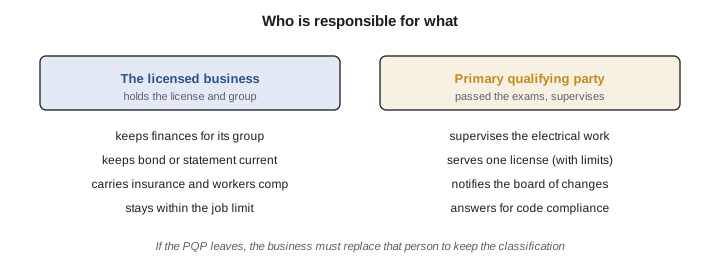
A mechanical license involves two parties with overlapping duties: the licensed business and its qualifying party. The business holds the license. It must keep its finances or bond sufficient for its group, carry the insurance and workers' compensation the law requires, stay within its classifications and group, and keep its information current with the board. The qualifying party supports the classification with his or her exams and experience, and is expected to supervise the work performed under it. Both can face consequences when things go wrong.
Staying within the classification and group
The license allows the business to contract only for the classifications it holds and only up to its group limit for a single job. Congaree's license carries the electrical classification. It may not contract for plumbing or air conditioning work above the threshold because it does not hold those classifications, even if it subcontracts the work. If an electrical job includes some incidental work in another trade, the question of whether that work requires its own classification is worth asking the board, not guessing.
The group limit applies to the value of a single job, and the law does not let a contractor split a job into pieces to fit under the limit. On a job that grows by change order, the qualifying party should watch the running value. If a 380,000-dollar job grows toward 400,000 dollars, a Group 4 contractor needs to talk with the owner and the board before it crosses the limit, not after.
Supervising the work
The qualifying party is expected to supervise the electrical work done under the license. That does not mean standing on every job site all day. It means having real authority over how the work is done, being reachable to the crews, reviewing plans and changes, and making sure the work meets the code and the contract. A qualifying party who works full time somewhere else and only lends a name to the license is not supervising, and the board treats that arrangement seriously.
Tamika set up a weekly routine: a Monday review of every open job's schedule and inspections, a Wednesday site walk on the jobs with upcoming inspections, and a Friday review of correction notices and change orders. The routine is not required by any rule. It is how she can say, honestly, that she supervises the work done under her qualification.
Serving more than one license
The board limits how many businesses one person may qualify. The general rule is that a qualifying party serves one licensee, with limited exceptions that the law and regulations describe, such as related businesses with common ownership. A master electrician who wants to qualify a second, unrelated company on the side should read the rule carefully and ask the board before agreeing. The limit exists to keep qualifying parties from becoming names for hire.
Not lending the license
Wade's friend was asking Congaree to lend its license: to pull a permit for work Congaree would not supervise, performed by a business that is not licensed. That is prohibited. A licensee who aids an unlicensed person to evade the licensing law can be disciplined, and the qualifying party can face consequences too. The permit would also make Congaree answerable to the building department for work it does not control. The only clean way to help would be for Congaree to contract for the job itself, supervise it and use its own employees or properly licensed subcontractors.
| Situation | Allowed? | Why |
|---|---|---|
| Congaree contracts the job, supervises it and uses its own crew | Yes | Normal licensed work |
| Congaree subcontracts part of the electrical work to another licensed electrical contractor | Generally yes | The sub holds its own license and group |
| Congaree pulls a permit for work an unlicensed company performs | No | Aiding unlicensed contracting |
| An employee uses Congaree's license number on his own side jobs | No | Unlicensed contracting and misuse of the license |
| Congaree bids a job above its group limit | No | Exceeds the group |
Identifying the license
South Carolina law and board rules expect a licensed contractor to identify its license in its dealings, such as on bids, contracts and certain advertising, and the mechanics' lien law requires the license number on a lien filed by a licensed contractor. The safe habit is to put the license number on every proposal, contract and invoice, and to keep the company name on bids exactly as it appears on the license. Joyce added the license number to Congaree's proposal template and email signature years ago.
Reporting changes
The board needs to know when the facts behind the license change. Changes that usually require notice include a change in the qualifying party, a change in the business's name, address, ownership or form, and changes affecting the bond or financial standing. The law and the board's forms describe the deadlines. A change in legal form, such as converting a sole proprietorship into a corporation, may require a new license rather than an amendment, because the license belongs to a specific legal entity.
When the qualifying party leaves
If the qualifying party dies, retires or leaves the company, the business has a problem: it no longer has someone qualified for the classification. The law gives the business a limited time to notify the board and to replace the qualifying party, and the business may not take on new electrical work beyond what the law allows in the meantime. That is why Wade is planning his exit a year ahead. When Tamika is approved as qualifying party, the change will be seamless, and Wade can stay on as an employee or owner without being the person who supports the classification.
from datetime import date, timedelta

pqp_leaves = date(2027, 5, 31)
notify_within = timedelta(days=30)    # illustrative; read the current rule
replace_within = timedelta(days=60)   # illustrative; read the current rule
tamika_approved = date(2027, 4, 18)

if tamika_approved <= pqp_leaves:
    print("Replacement approved before Wade steps down: no gap")
else:
    print("Gap in qualification - notify by", pqp_leaves + notify_within,
          "and replace by", pqp_leaves + replace_within)
print("lead time:", (pqp_leaves - tamika_approved).days, "days")Replacement approved before Wade steps down: no gap lead time: 43 days
Grounds for discipline
The licensing law lists conduct that can lead to discipline, which can include a fine, probation, suspension or revocation. The list includes contracting beyond the classification or group, aiding unlicensed contracting, fraud or deceit in getting a license, misconduct in the practice of contracting, abandoning a job without cause, failing to pay for materials or labor when paid by the owner, willful code violations, and failing to keep the required finances, bond or insurance. Discipline is usually public on LLR's lookup, where owners and general contractors check before awarding work.
Worked problem
Abandoned work
A homeowner pays a contractor a 12,000-dollar deposit on a 30,000-dollar rewiring job. The contractor does a week of work and stops answering calls. What can the homeowner do with the board?
Show solution
- The homeowner can file a complaint with the board through LLR.
- The board investigates and may hold a hearing.
- Abandoning a job without cause and failing to complete work are grounds for discipline.
- The homeowner should also talk with a lawyer about recovering the money, which is a separate matter from discipline.
Answer: File a complaint with the board, and pursue recovery of the money separately.
Unlicensed contracting
Contracting without a required license is a violation of the law, and the board and LLR can pursue it. South Carolina law also makes it difficult for an unlicensed contractor to enforce a contract or claim a lien for the unlicensed work. For a licensed company, unlicensed competitors are a real problem: they underbid because they skip the costs of finances, bonds, insurance and permits. Reporting them is not petty; it protects owners and the trade.
Honest dealing with owners
Beyond the specific rules, the licensing law expects honest dealing. Misrepresenting the license, the group or the company's insurance to win a job, taking a deposit without intending to start work, or failing to pay suppliers and subcontractors after being paid by the owner can all lead to complaints and discipline. Most complaints the board sees start with a payment dispute or an unfinished job, and many could have been avoided with a clear written contract, a realistic schedule and prompt communication when something goes wrong. Tamika uses a short written proposal even on small service jobs, listing the scope, the price, the payment terms and what is excluded.
When a customer complains, respond quickly and in writing. A complaint that reaches the board will be investigated, and the investigator will look at the contract, the permits, the inspections and the communication between the parties. A contractor who can show a clear contract, passed inspections and reasonable efforts to resolve the problem is in a far stronger position than one who stopped answering the phone.
Keeping the qualifying party informed
Supervision depends on information. A qualifying party who does not know which jobs the company has signed, which permits are open or which change orders are pending cannot supervise the work in any real sense. Congaree's solution is simple: every new contract, permit and change order goes into a shared job list that Tamika reviews each Monday. Estimators check the group limit before submitting any bid above 300,000 dollars, and no permit is pulled under the company's license without her knowing about it. The routine takes less than an hour a week and gives her an honest answer when anyone, including the board, asks what work is being done under her qualification.
Common mistakes
MistakePulling a permit for a friend's unlicensed crew.
InsteadThat aids unlicensed contracting; contract and supervise the work yourself or decline.
MistakeTreating supervision as a name on the license.
InsteadThe qualifying party needs real authority over and involvement in the work.
MistakeWaiting until the qualifying party retires to plan a replacement.
InsteadPlan ahead so the replacement is approved before the departure, with no gap.
MistakeLeaving the license number off proposals and liens.
InsteadPut the license number on bids, contracts, invoices and any lien.
Summary and key terms
- The business holds the license; the qualifying party supports the classification and supervises the work.
- The license allows only the classifications held and single jobs within the group limit.
- A qualifying party generally serves one licensee, with limited exceptions.
- Lending a license or pulling permits for unlicensed work is prohibited and can lead to discipline.
- Report changes to the board and plan qualifying party changes so there is no gap.
- Discipline
- Board action such as a fine, probation, suspension or revocation.
- Aiding unlicensed contracting
- Helping an unlicensed person evade the licensing law, such as by pulling a permit for them.
- Supervision
- Real authority over and involvement in the work done under the license.
- Change in legal form
- Converting the business to a different type of entity, which may need a new license.
- Complaint
- A report to LLR that starts a board investigation.
Practice problems
Work each problem on paper first, then reveal the answer to check.
Can Congaree subcontract part of an electrical job to another licensed electrical contractor?
Show answer
Generally yes, since the sub holds its own license; Congaree stays responsible under its contract.
Why plan a qualifying party change in advance?
Show answer
So the replacement is approved before the departure and the business has no gap in qualification.
Name three grounds for discipline.
Show answer
Contracting beyond the group, aiding unlicensed contracting and abandoning a job without cause, among others.
Where must a licensed contractor's license number appear in the lien process?
Show answer
On the lien itself.
Lesson quiz · 5 questions
Score 60% or more to complete this lesson.
Create a free account to save your progress, take quizzes and earn a certificate.