
MELU-315 · Lesson 4 of 12 · 18 min
The exam format and the references allowed
▶ Video coming soon A video version of this lesson is on the way.
The box of books arrived at Congaree on a Tuesday: a 2023 National Electrical Code, the American Electricians' Handbook, NFPA 72, a bound copy of the federal construction safety standards, the South Carolina 811 manual and the NASCLA business and law guide for South Carolina. Caleb Simmons, the second-year apprentice, helped Tamika carry it in from the truck. "You get to bring all of these into the test?" he asked. "All of them," Tamika said, "and I'm still going to run out of time if I don't know where things are." Wade, walking past, laughed. "Open book is the hardest kind of test," he said. "It's not about knowing the answer. It's about finding it before the clock does."
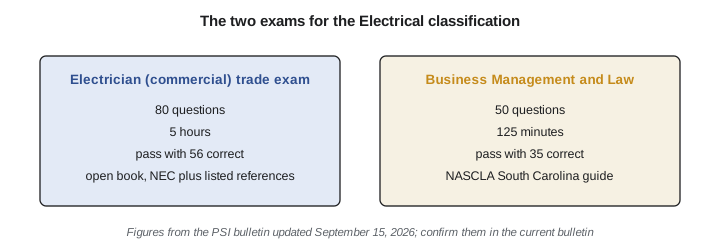
This lesson covers the two exams Tamika will sit: the electrician trade exam for the electrical classification and the Business Management and Law exam. For each, it describes the number of questions, the time allowed, the passing score and the references listed in the PSI bulletin, then turns to how to prepare the books and pace yourself. The figures come from PSI's South Carolina contractor bulletin updated September 15, 2026.
The electrician trade exam
The trade exam for the electrical classification is an open-book exam of 80 scored questions. Candidates have five hours, and a passing score is 56 correct, which is seventy out of each hundred questions. The bulletin lists the fee at 78 dollars. The questions are multiple choice and draw on the NEC and the other listed references, covering the topics in the bulletin's content outline: general requirements and definitions, wiring methods and materials, services and feeders, branch circuits and load calculations, overcurrent protection, grounding and bonding, motors and controls, special occupancies and equipment, fire alarm systems, safety and the use of the reference handbook.
Five hours sounds generous for 80 questions, and it is more time per question than many states allow. But open-book questions take longer than closed-book ones. A load calculation question might need two or three tables and a few minutes of arithmetic. A question about a specific occupancy might need a search through the index and then through an article. Lesson 12 covers pacing in detail. The short version: 300 minutes for 80 questions is 3.75 minutes per question, and a good target is about three and a half minutes, which leaves around twenty minutes to return to marked questions.
The trade exam references
The bulletin lists the references allowed in the exam room. For the electrical trade exam they include the National Electrical Code, NFPA 72 on fire alarm and signaling systems in the 2019 edition, the American Electricians' Handbook in its 17th edition, the federal construction safety standards in 29 CFR Part 1926, a key word index to the code that the bulletin names, and the South Carolina 811 manual on underground facility damage prevention. Candidates bring their own copies.
The code edition is in transition. Under the September 2026 bulletin, from November 1, 2026 a candidate may use either the 2020 or the 2023 NEC, and questions are written so that either edition supports the answer. From July 1, 2027 only the 2023 edition is listed. That matters for Tamika's timing. If her exam falls before July 2027, she may bring either edition. If it falls after, she needs the 2023 book. Because South Carolina currently enforces the 2020 NEC on jobs, as Lesson 5 explains, she may end up studying one edition for the exam while working from another on the job.
| Reference | Why it is on the list | How Tamika will tab it |
|---|---|---|
| National Electrical Code (2020 or 2023, then 2023 only) | Most questions | Each chapter, key articles and the Chapter 9 tables |
| NFPA 72, 2019 edition | Fire alarm and signaling questions | Chapters on fundamentals, circuits and inspection |
| American Electricians' Handbook, 17th edition | Practical and theory questions | Index, motors, transformers and lighting |
| 29 CFR Part 1926 | Construction safety questions | Subparts on electrical work, ladders and excavation |
| South Carolina 811 manual | Excavation and locate questions | Call-ahead times and marking colors |
| Key word index named in the bulletin | Faster code searches | No tabs needed; keep it on top |
The Business Management and Law exam
The business exam has 50 scored questions in 125 minutes, and a passing score is 35 correct. It is also open book. The reference is the NASCLA Contractor's Guide to Business, Law and Project Management for South Carolina, in the ninth edition listed in the bulletin. The questions cover business organization, licensing law, estimating and bidding, contracts, project management, risk and insurance, lien law, tax and payroll, employment law and workplace safety recordkeeping. Many of the answers are in the guide's South Carolina chapters, so tabbing those chapters is time well spent.
The business exam has less time per question than the trade exam: two and a half minutes. Many questions are short and factual, such as a form number, a filing deadline or a definition, and can be answered in under a minute with good tabs. Others are calculation questions on markup, depreciation, payroll taxes or break-even points. The balance means a candidate who knows the guide's layout can bank time on the quick questions and spend it on the calculations.
exams = {
    "Electrician trade": {"questions": 80, "minutes": 300, "pass": 56},
    "Business and law": {"questions": 50, "minutes": 125, "pass": 35},
}
for name, e in exams.items():
    per_q = e["minutes"] / e["questions"]
    share = e["pass"] / e["questions"]
    can_miss = e["questions"] - e["pass"]
    print(f"{name}: {per_q:.2f} minutes a question, pass with {e['pass']} "
f"({share:.2f} of the questions), can miss {can_miss}")Electrician trade: 3.75 minutes a question, pass with 56 (0.70 of the questions), can miss 24 Business and law: 2.50 minutes a question, pass with 35 (0.70 of the questions), can miss 15
The output shows a useful fact: Tamika can miss 24 questions on the trade exam and 15 on the business exam and still pass. Nobody needs a perfect score. A candidate who spends twenty minutes chasing one stubborn question is trading away time that could earn three or four easier points.
Preparing the books
The bulletin's rules on books are strict and are enforced at check-in. Bound references are allowed with tabs and highlighting. Loose papers, sticky notes with written answers and handwritten pages inside the books are generally not. Permanent tabs with article numbers or topic names are the safe choice. If a book has handwritten notes in the margins, check the bulletin's wording on notes before you bring it; when in doubt, use a clean copy. A proctor who finds prohibited material may refuse the book, and a candidate without the NEC has little chance of passing.
Tamika tabbed her NEC by chapter and then by the articles she used most: 90, 100, 110, 210, 215, 220, 230, 240, 250, 300, 310, 314, 430, 450, 500 and 700, plus the Chapter 9 tables. She tabbed the business guide by chapter, with extra tabs on the South Carolina licensing and lien chapters and the payroll tax tables. She practiced finding answers with only those tabs, and moved a tab when she kept missing a section.
Worked problem
Which edition to bring
Tamika's trade exam is scheduled for June 10, 2027. She owns a 2020 NEC from work and a new 2023 NEC. Which may she bring, and which should she study from?
Show solution
- Under the September 2026 bulletin, from November 1, 2026 either the 2020 or the 2023 edition is accepted.
- From July 1, 2027 only the 2023 edition is listed.
- June 10, 2027 falls in the window where either edition is accepted.
- If the exam is rescheduled after July 1, 2027, only the 2023 book will be accepted.
Answer: She may bring either, but studying from the 2023 edition protects her if the date slips past July 1, 2027.
Calculators and test-center rules
The bulletin describes the calculators allowed, generally a silent, non-programmable calculator without a printing tape or alphabetic keyboard. Phones, smart watches and bags stay in a locker. Candidates sign in, show identification that matches the registration name exactly, and may be photographed. The exam is delivered on a computer, which lets candidates mark questions to review later. Read the bulletin's section on test-day rules before the exam rather than in the parking lot.
What the content outline tells you
The bulletin's content outline lists each topic area and, usually, the number of questions drawn from it. Use it to set priorities. A topic with ten or more questions deserves more study time than one with two. For the electrical trade exam, load calculations, wiring methods and grounding usually carry a large share. Fire alarm questions come from NFPA 72 rather than the NEC, and safety questions come from 29 CFR Part 1926 and the 811 manual, so a candidate who studies only the NEC leaves points on the table.
How the questions are written
Exam questions on open-book tests are usually built so that the answer can be found in a reference, but finding it requires knowing the right word to look up. A question might describe an installation in plain terms, such as a pool pump, a feeder to a detached garage or a fire alarm circuit in a hospital, and expect the candidate to translate that description into the code's vocabulary. That is why the key word index is on the reference list. When the obvious word fails in the index, try the code's term for the same thing: a swimming pool is a pool, but a hot tub may be a spa or hot tub, and a detached garage is a separate building or structure.
Many questions include extra details that do not affect the answer, and a few include one detail that changes it completely. Read the last sentence first to see what is being asked, then read the whole question for conditions such as the voltage, the occupancy, whether a conductor is copper or aluminum and whether the installation is indoors or outdoors. Those conditions decide which table or section applies.
Practicing with the references
Practice with the same books you will bring. Every lookup builds familiarity with where things are on the page, and that speed is worth more on test day than any memorized fact. Tamika set herself a drill: twenty random questions from a practice book, a timer and only her tabbed references. She tracked how long each lookup took and which book she reached for first. In three weeks her average fell from more than five minutes a question to under three. The drill also showed her which tabs she never used, and she removed them, because extra tabs slow down the search for the ones that matter.
One last point about the references: bring every book on the list, even the ones you expect to use least. A single fire alarm question answered from NFPA 72, or a single excavation question answered from the 811 manual, can be the point that separates a pass from a near miss.
Common mistakes
MistakeBringing the wrong edition of the NEC.
InsteadCheck the bulletin's edition rules for the exam date; from July 1, 2027 only the 2023 edition is listed.
MistakeStudying only the NEC for the trade exam.
InsteadNFPA 72, the handbook, 29 CFR Part 1926 and the 811 manual are also tested.
MistakeTreating five hours as plenty of time.
InsteadOpen-book questions take longer; pace to about three and a half minutes a question.
MistakeWriting notes inside the reference books.
InsteadUse permanent tabs and highlighting; handwritten notes or loose pages can get a book refused.
Summary and key terms
- The electrician trade exam has 80 questions in five hours, and 56 correct passes.
- Trade references include the NEC, NFPA 72 (2019), the American Electricians' Handbook (17th edition), 29 CFR Part 1926, a key word index and the SC 811 manual.
- From November 1, 2026 the 2020 or 2023 NEC is accepted; from July 1, 2027 only the 2023 edition is listed.
- The Business Management and Law exam has 50 questions in 125 minutes, and 35 correct passes, using the NASCLA South Carolina guide.
- Tab books with permanent tabs, follow the bulletin's rules and use the content outline to set study priorities.
- Open book
- An exam in which approved references may be used.
- Content outline
- The bulletin's list of topic areas and question counts for an exam.
- NASCLA
- The National Association of State Contractors Licensing Agencies, which publishes the business and law guide.
- NFPA 72
- The National Fire Alarm and Signaling Code.
- 29 CFR Part 1926
- The federal OSHA safety and health standards for construction.
Practice problems
Work each problem on paper first, then reveal the answer to check.
How many correct answers pass the trade exam?
Show answer
56 out of 80.
How long is the business and law exam?
Show answer
125 minutes for 50 questions.
Which edition of NFPA 72 is listed for the trade exam?
Show answer
The 2019 edition.
How many questions can a candidate miss and still pass the business exam?
Show answer
15.
Lesson quiz · 5 questions
Score 60% or more to complete this lesson.
Create a free account to save your progress, take quizzes and earn a certificate.