
MELU-315 · Lesson 2 of 12 · 18 min
Eligibility for the Electrical Contractor License
▶ Video coming soon A video version of this lesson is on the way.
On the Monday after Wade's offer, Tamika and Joyce Pinckney spread the company's paperwork across the conference table: the current license certificate, last year's financial statement from the company's accountant, the bond file and a copy of the board's licensure page. Tamika had expected the eligibility question to be about her: her years in the trade, her exams. It turned out to be about two things at once. "The board needs to know you're qualified," Joyce said, "and it needs to know the company can carry the group we're asking for. Wade's always kept us in Group 4. If you want that warehouse in West Columbia, we're talking about Group 5, and that's a different conversation with the accountant." Ben Alvarez, the estimator, leaned in the doorway. "And a different set of jobs we can bid," he added.
This lesson covers the two halves of eligibility for the electrical classification on a South Carolina mechanical contractor license. The first half is the qualifying party: the experience the board asks for, the exams, and the ways the exam requirement can be met. The second half is the business: the group it wants, the net worth or working capital it must show, the type of financial statement for that group and the surety bond option. A short section at the end compares the residential electrician route through the Residential Builders Commission.
Who can be a qualifying party
The board qualifies a business for a mechanical classification through a qualifying party, and the business must have a primary qualifying party, or PQP, for each classification it holds. The PQP is an individual. The board's licensure page says a PQP needs at least two years of experience in the classification within the five years before applying. That experience can come as an employee, a supervisor or an owner; what matters is that it was real work in electrical contracting, and that someone can verify it on the board's experience forms.
Tamika has seventeen years in the trade and eight years running Congaree's commercial crews, so the experience rule is not a problem for her. It can be for younger candidates, and for people who moved into estimating or sales for several years. The five-year window is a lookback, not a lifetime count. A master electrician who has spent the last four years teaching or managing outside the trade may need to show recent field experience before the board will accept the application.
The PQP must also pass the exams the board requires for the classification, or show that the requirement is met another way. Lesson 4 covers exam content. The routes the board recognizes, as described on its licensure page, include passing the PSI exams, passing the NASCLA-accredited trade exam where the board accepts it, holding the Master Electrician certification from the program formerly run by the Municipal Association of South Carolina and now administered by Carolinas AGC, or qualifying for a waiver in limited situations. Each route has its own conditions, so check the current page for the one you plan to use.
The business and law exam
Every mechanical PQP also deals with the business side. The board requires the Business Management and Law exam for South Carolina, given by PSI and based on the NASCLA South Carolina business and law reference. A candidate who already holds a South Carolina license through another classification may already have passed it; the board's records show which exams each person has on file. Tamika has never sat it, so she will take both the trade exam and the business and law exam.
The five groups
The group on a mechanical license sets the largest single job the business may undertake. It is chosen by the business and backed by its finances. The board's licensure page lists five groups, each with a job limit and the financial figures needed to support it. A business shows either the net worth figure or the working capital figure for its group; it does not need both. Instead of a financial statement, a business may file a surety bond, and since the 2023 update the bond amount equals the net worth amount for the group.
| Group | Largest single job | Working capital | Net worth | Bond instead |
|---|---|---|---|---|
| 1 | 35,000 dollars | 3,500 dollars | 7,000 dollars | 7,000 dollars |
| 2 | 100,000 dollars | 10,000 dollars | 15,000 dollars | 15,000 dollars |
| 3 | 200,000 dollars | 20,000 dollars | 30,000 dollars | 30,000 dollars |
| 4 | 400,000 dollars | 40,000 dollars | 60,000 dollars | 60,000 dollars |
| 5 | Unlimited | 200,000 dollars | 300,000 dollars | 300,000 dollars |
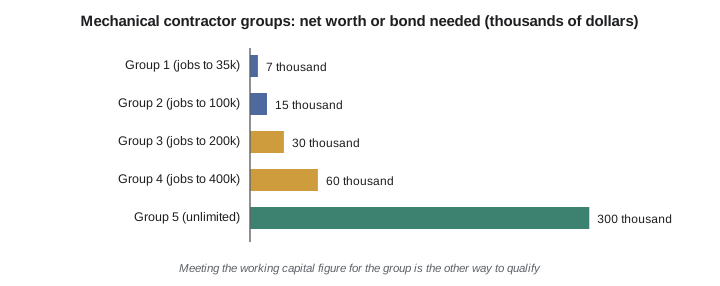
Look at the jump from Group 4 to Group 5. Every group up to 4 doubles the job limit for roughly double the money. Group 5 removes the job limit entirely, but the net worth figure jumps from 60,000 to 300,000 dollars and the working capital figure from 40,000 to 200,000 dollars. That is the conversation Joyce warned Tamika about. Congaree has a solid balance sheet for a company its size, but whether it clears the Group 5 bar is a question for the accountant, not for a guess at the conference table.
Net worth, working capital and statements
Net worth is what the business owns minus what it owes. Working capital is current assets minus current liabilities: cash, receivables and other assets that turn into cash within a year, less bills and debts due within a year. A business can have a healthy net worth tied up in a building and trucks and still have thin working capital. The board accepts either figure for the group, which helps companies that own their buildings and companies that run lean but liquid.
The board also says what kind of financial statement it accepts for each group. Lower groups can generally qualify with a less formal statement, and higher groups need more accountant involvement, up to a reviewed or audited statement for the top group. The exact type and the age limit for the statement are on the board's licensure page and application instructions. Joyce noted that an audited statement costs real money and takes time, and that the date on the statement matters: a statement that is too old will not be accepted.
GROUPS = {1: (35_000, 3_500, 7_000), 2: (100_000, 10_000, 15_000),
          3: (200_000, 20_000, 30_000), 4: (400_000, 40_000, 60_000),
          5: (None, 200_000, 300_000)}

current_assets, current_liabilities = 412_000, 248_000
total_assets, total_liabilities = 905_000, 641_000

working_capital = current_assets - current_liabilities
net_worth = total_assets - total_liabilities
print(f"working capital: {working_capital:,}   net worth: {net_worth:,}")

best = 0
for g, (limit, wc_need, nw_need) in GROUPS.items():
    if working_capital >= wc_need or net_worth >= nw_need:
        best = g
lim = GROUPS[best][0]
print(f"highest group supported: {best} (job limit {'unlimited' if lim is None else f'{lim:,}'})")
gap = GROUPS[5][2] - net_worth
print(f"net worth short of Group 5 by: {max(gap, 0):,}")working capital: 164,000 net worth: 264,000 highest group supported: 4 (job limit 400,000) net worth short of Group 5 by: 36,000
With these illustrative numbers, Congaree's working capital of 164,000 dollars and net worth of 264,000 dollars both clear Group 4 easily but fall short of Group 5. The company could close that gap by retaining earnings, adding capital or filing a 300,000-dollar surety bond instead of relying on the statement. A bond is not free money: the surety underwrites the company, charges a premium and expects to be repaid if it ever pays a claim. But for a growing contractor, a bond can be the quickest path to a higher group.
Worked problem
Choosing a group
A small contractor has working capital of 22,000 dollars and net worth of 19,000 dollars. It wants to bid a 150,000-dollar job. Which group can it support, and does the job fit?
Show solution
- Group 3 needs working capital of 20,000 dollars or net worth of 30,000 dollars.
- The working capital of 22,000 dollars clears the Group 3 working capital figure, even though net worth does not.
- Group 4 needs 40,000 or 60,000 dollars, which it does not have.
- Group 3 allows single jobs up to 200,000 dollars.
Answer: It supports Group 3 on working capital, and the 150,000-dollar job fits.
Other conditions for the business
Beyond the group, the business has to be properly formed and in good standing. A corporation or limited liability company should be registered with the Secretary of State, and an out-of-state company that wants to work in South Carolina usually needs to register there before it applies. The board asks about prior discipline, judgments and unpaid claims. It also expects the business to carry workers' compensation where the law requires it, which Lesson 8 covers.
One business can hold several classifications on one mechanical license, each with its own qualifying party. Congaree holds only the electrical classification. If it ever added fire alarm or low-voltage work that the board treats as a separate classification or subclassification, it would need a qualifying party who meets the requirements for that one too.
The residential route
The Residential Builders Commission's residential electrician license is a separate credential for individuals who work on residential buildings. Its application package, as checked for this course, lists one year of experience, two PSI exams, an application fee of 135 dollars and a surety bond of 10,000 dollars for a licensee who takes on work above 5,000 dollars. A candidate gets three attempts within twelve months at the exams before having to start over. The residential license does not let a business contract for commercial electrical work above the mechanical threshold.
| Point | Commercial electrical classification | Residential electrician |
|---|---|---|
| Board | Contractors' Licensing Board | Residential Builders Commission |
| Who is licensed | The business, through a qualifying party | The individual |
| Experience | Two years within five | One year |
| Financial backing | Statement or bond by group | A 10,000-dollar bond above 5,000 dollars of work |
| Work allowed | Commercial and other electrical work within the group | Residential electrical work |
Out-of-state candidates and reciprocity
Electricians moving to South Carolina from another state often ask whether their existing license carries over. South Carolina licenses the business, not the individual electrician, so there is no direct transfer of a master electrician license from another state. What can carry over is an exam. The board has recognized certain exams taken elsewhere, and the NASCLA-accredited trade exam is designed to be accepted by more than one state, where each state agrees. A candidate who passed an accepted exam elsewhere should check the board's current list before sitting the South Carolina exam again. The business and law exam is specific to South Carolina law, so it is generally still required.
Out-of-state companies also need to think about registration with the Secretary of State, local business licenses and South Carolina workers' compensation coverage before their first job. The license application is only one of the steps, and an out-of-state company that bids before it is licensed may find itself unable to sign the contract when it wins.
Common mistakes
MistakeThinking the business must show both net worth and working capital.
InsteadEither the net worth figure or the working capital figure for the group is enough.
MistakeCounting all of a candidate's career years toward the experience rule.
InsteadThe board looks for two years of experience within the five years before applying.
MistakeAssuming a bond is just a fee.
InsteadA surety bond is underwritten credit; the surety expects repayment if it pays a claim.
MistakeUsing a residential electrician license for a commercial fit-out.
InsteadCommercial work above the threshold needs the mechanical license with the electrical classification.
Summary and key terms
- Eligibility has two halves: a qualified PQP and a business whose finances support its group.
- A PQP needs two years of experience in the classification within the last five years and must meet the exam requirement.
- Exam routes include the PSI exams, an accepted NASCLA trade exam, the Master Electrician certification now run by Carolinas AGC, and limited waivers.
- The five groups run from a 35,000-dollar job limit in Group 1 to unlimited in Group 5.
- A business qualifies for a group with either net worth or working capital, or with a surety bond equal to the net worth figure.
- Net worth
- Total assets minus total liabilities.
- Working capital
- Current assets minus current liabilities.
- Surety bond
- A bond in which a surety guarantees the contractor's obligations and expects repayment for any claim it pays.
- Lookback
- The five-year window in which the board counts a PQP's two years of experience.
- Residential electrician
- An individual license from the Residential Builders Commission for residential electrical work.
Practice problems
Work each problem on paper first, then reveal the answer to check.
What figure must a Group 4 business show?
Show answer
Working capital of 40,000 dollars or net worth of 60,000 dollars, or a 60,000-dollar bond.
Can a candidate with eight years of experience that ended six years ago qualify on that experience?
Show answer
Not on that experience alone; the board looks for two years within the five years before applying.
Since the 2023 update, how is the bond amount set?
Show answer
It equals the net worth figure for the group.
Which board issues the residential electrician license?
Show answer
The Residential Builders Commission.
Lesson quiz · 5 questions
Score 60% or more to complete this lesson.
Create a free account to save your progress, take quizzes and earn a certificate.