
MELU-315 · Lesson 3 of 12 · 18 min
Applying, approval and booking the exam
▶ Video coming soon A video version of this lesson is on the way.
Tamika wanted to book the exams the same week. Joyce slowed her down. "Every time we've changed anything on the license, it's taken longer than we thought," she said, pulling out a manila folder labeled with the year Wade first applied. Inside were copies of an old application, a letter from the board asking for a corrected financial statement and a note in Wade's handwriting: "Bond rider took 3 weeks." Joyce laid out a sheet of paper and drew three columns. "The exams are on you. The financials and the bond are on me and the accountant. The board paperwork is on both of us. Let's put dates on all three before we book anything." Tamika realized that the sequence mattered as much as the studying.
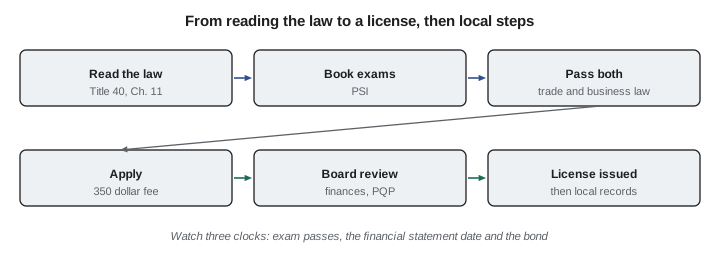
This lesson follows the path from reading the law to holding an updated license, and then the local steps that follow. It covers how to book the PSI exams, what to expect on test day logistics, how the application and its supporting documents fit together, what happens in board review and how to update local records once the license is issued. It also introduces three clocks that run during the process: the exam results, the date on the financial statement and the effective date of any bond.
Step one: read the law and the bulletin
Before booking anything, read three things: the contractor licensing law in Title 40, Chapter 11, the board's licensure page and the PSI candidate bulletin for South Carolina. The law tells you what the license allows and forbids. The licensure page tells you the current groups, fees and forms. The bulletin tells you exactly which exams exist for the electrical classification, what each one covers, which references you may bring and how to register. The current bulletin for South Carolina contractors was updated on September 15, 2026, and it is the version Tamika printed.
Reading the bulletin first also prevents a common mistake: booking the wrong exam. The bulletin lists separate exams for many mechanical classifications and subclassifications. The one Tamika needs is the electrician exam for the electrical classification, plus the Business Management and Law exam. A residential electrician candidate under the Residential Builders Commission sits different exams listed in a different section.
Step two: book the exams with PSI
PSI administers the South Carolina contractor exams. Candidates register online or by phone, pay the exam fee and pick a test center and date. The bulletin lists the electrician exam at 78 dollars. Both exams are given at PSI test centers, and the bulletin describes identification requirements, arrival times and the rules for bringing reference books. Some candidates choose to schedule both exams on the same day; others split them to focus on one at a time. With five hours for the trade exam and about two hours for business and law, Tamika decided to split them across two weeks.
Booking early gives you a fixed date to study toward and the best choice of test center. Columbia has a PSI center, which saved Tamika a drive to Charlotte or Greenville. Read the rescheduling and cancellation rules in the bulletin before you book; missing the deadline to reschedule usually means losing the fee.
Bringing your books
The trade and business exams are open book, and the bulletin lists the exact editions allowed. On test day, the proctor inspects each book. The usual rule is that books may be tabbed and highlighted, but not loaded with loose notes, inserted pages or written answers. Lesson 4 covers the reference list and how to prepare tabs that pass inspection. For now, the booking point is simple: order the books early, because the correct edition of a code book or business guide can take a week or more to arrive.
Step three: pass both exams
PSI scores the exams at the test center and reports the result. A passing score is good for a limited period for licensing purposes, which the bulletin and the board describe. That is the first clock. If you pass the trade exam in January and the business exam in March, the application has to reach the board while both scores are still valid. If you fail, the bulletin explains how soon you may retake and whether you pay again. Plan for the possibility of a retake when you set your timeline.
Step four: assemble the application
The board's mechanical application asks for information about the business, its owners and officers, the classification and group requested, and the qualifying party. It asks about prior licenses, discipline and judgments. It asks for supporting documents: proof of the exams or other qualification, verification of the PQP's experience, the financial statement or bond for the group, proof of workers' compensation coverage or an explanation of why it is not required, and registration with the Secretary of State where applicable. The application fee for a mechanical contractor license is 350 dollars.
Because Congaree already holds a license, its paperwork is a change rather than a new license: replacing the PQP for the electrical classification and, if the finances support it, raising the group. The board has forms for both kinds of change. Joyce called the board's office to confirm which ones applied before filling anything in. A call like that can save weeks.
| Document | Who prepares it | Clock to watch |
|---|---|---|
| Exam score reports | Tamika, through PSI | Validity period after the exam date |
| Experience verification | Tamika, verified by Wade | Two years within the last five |
| Financial statement | Accountant and Joyce | Age of the statement when filed |
| Surety bond, if used | Surety agent and Joyce | Effective date and continuous coverage |
| Workers' compensation certificate | Insurance agent | Policy period |
| Application and fee | Joyce and Tamika | Complete before scores or statement go stale |
The three clocks
Joyce's three columns turned into three clocks. The exam clock starts when each score is issued. The statement clock starts on the date of the financial statement; the board will not accept one that is too old. The bond clock starts on the bond's effective date, and the bond must stay in force continuously. The goal is to file when all three are current. If the accountant finishes the year-end statement in March, Tamika should aim to pass both exams in the first quarter, so the scores and the statement line up.
from datetime import date, timedelta

trade_pass = date(2027, 1, 14)
business_pass = date(2027, 1, 28)
statement_date = date(2026, 12, 31)
filing_target = date(2027, 3, 15)

score_valid = timedelta(days=365)        # illustrative; confirm the real period
statement_max_age = timedelta(days=365)  # illustrative; confirm the real limit

checks = {
    "trade score still valid": filing_target <= trade_pass + score_valid,
    "business score still valid": filing_target <= business_pass + score_valid,
    "statement young enough": filing_target <= statement_date + statement_max_age,
}
for name, ok in checks.items():
    print(f"{name:28} {'ok' if ok else 'PROBLEM'}")
print("days from first pass to filing:", (filing_target - trade_pass).days)trade score still valid ok business score still valid ok statement young enough ok days from first pass to filing: 60
The script uses placeholder periods because the exact limits should come from the current board and PSI documents. The habit matters more than the numbers: write down every date, add the validity period, and file before the earliest one expires.
Step five: board review
The board's staff reviews each application. If something is missing or unclear, the staff writes or emails asking for it, and the clock on the application pauses until the answer arrives. Common holdups include an unsigned experience form, a financial statement that does not show the figure the group requires, a bond form with the wrong business name or license number, and owners or officers left off the application. The board may refer applications with discipline or judgments to a board meeting for a decision.
Worked problem
A rejected bond rider
Joyce files a 300,000-dollar bond for Group 5, but the bond names "Congaree Electric" instead of the licensed entity, "Congaree Electric Co., Inc." What happens, and how should she fix it?
Show solution
- The board compares the bond to the license record and sees a different legal name.
- It will ask for a corrected bond or a rider that names the licensed entity.
- Joyce asks the surety agent for a rider with the exact legal name and license number.
- She files the rider and confirms the board has updated the group.
Answer: The bond must match the licensed entity's legal name exactly; a corrected rider fixes it.
Step six: after the license is updated
When the board approves the change, the license record shows the new PQP details, group and dates on LLR's public lookup. That is not the end. Local building departments often keep their own contractor registrations, and many require the license number and the qualifying party's name on file before they issue permits. Owners and general contractors may ask for a fresh copy of the license for prequalification. Joyce keeps a list of every office that holds a copy of Congaree's license, and updates each one after any change.
Planning around the company calendar
Application timing is easier when it follows the company's own calendar. Congaree's accountant closes the books in January and finishes the financial statement by early March. The surety renews the bond in April. The insurance policies renew on July 1. Working backward from those dates, Tamika and Joyce set a target to pass both exams by the end of January, so the application could go in the week the March statement arrived, with the bond and insurance certificates already current. If the exams slipped, the fallback was to file with the bond instead of the statement, since the bond does not depend on the year-end close.
The plan also allowed for a retake. If Tamika failed one exam in January, she could retake it in February or early March and still file in March. Building in that margin took the pressure off the first attempt, which Wade said was the point. "People who think they only get one shot study scared," he told her. "Give yourself room and you'll study better."
Common reasons applications stall
Board staff see the same problems again and again. The business name on the application does not match the Secretary of State's records. An owner or officer is left off. The experience form is unsigned, or signed by someone who cannot verify the work. The financial statement is the wrong type for the group, or shows figures that do not reach the group's requirement. The bond names the wrong entity or the wrong amount. The workers' compensation certificate has expired or names a different business. Every one of these is preventable with a careful review before filing. Joyce now uses a one-page checklist and has a second person read the whole application before it goes out.
Common mistakes
MistakeBooking the exams before reading the bulletin.
InsteadRead the bulletin first to confirm the right exams, the references and the registration rules.
MistakeFiling with an old financial statement.
InsteadThe board limits the age of the statement; time the exams so scores and statement are current together.
MistakeAssuming board approval updates every local office automatically.
InsteadLocal registrations and permit offices may need the new information filed with them.
MistakeLetting a name mismatch slip through.
InsteadThe bond, statement and application must show the exact legal name of the licensed entity.
Summary and key terms
- Read the licensing law, the board's licensure page and the PSI bulletin before booking anything.
- PSI schedules both exams; the electrician exam fee in the September 2026 bulletin is 78 dollars.
- The mechanical application fee is 350 dollars and the application needs exams, experience, finances or a bond and workers' compensation proof.
- Three clocks run: score validity, financial statement age and bond coverage.
- After approval, update local registrations and anyone who keeps a copy of the license.
- Candidate bulletin
- PSI's document describing the exams, references, fees and registration rules.
- Board review
- The staff check of an application, which pauses while missing items are requested.
- Rider
- A document that changes the terms or names on an existing bond.
- License lookup
- LLR's public search showing a license's status, classifications, group and qualifying parties.
- Score validity
- The period during which a passing exam score can be used to apply.
Practice problems
Work each problem on paper first, then reveal the answer to check.
Who schedules the South Carolina contractor exams?
Show answer
PSI.
Name two documents whose dates can make an application stale.
Show answer
Exam score reports and the financial statement.
What should Joyce do after the board updates the license?
Show answer
Update local registrations and send the new license copy to owners and GCs that keep one.
Why might board review pause?
Show answer
Because staff asked for a missing or corrected item and are waiting for it.
Lesson quiz · 5 questions
Score 60% or more to complete this lesson.
Create a free account to save your progress, take quizzes and earn a certificate.