
MELU-315 · Lesson 1 of 12 · 17 min
How electrical licensing works in South Carolina
▶ Video coming soon A video version of this lesson is on the way.
Wade Holloway opened Congaree Electric Co. in 1996 in a rented bay behind a tire shop in Lexington, South Carolina. He had one van, a part-time bookkeeper and a mechanical contractor license with the electrical classification that he had earned the year before. Thirty years later the company has its own building off Highway 378, eleven electricians and apprentices, an office manager named Joyce Pinckney, an estimator named Ben Alvarez and a steady stream of dental offices, churches, small warehouses and residential service calls across the Midlands. One Friday in September, Wade asked his project foreman, Tamika Brooks, to sit down in his office. "I'm going to be sixty-four next spring," he said. "The license on the wall says Congaree Electric, but the board knows me as the primary qualifying party. When I step away, the company needs somebody who has passed the exams and can stand behind the work. I want that to be you." He slid a printout of the board's licensure page and the testing company's candidate bulletin across the desk.
Tamika started as a helper with a Columbia contractor in 2009, ran service calls for five years and has been Congaree's lead on commercial work since 2018. She has studied the master electrician core material on the National Electrical Code, load calculations, grounding and bonding, motors, special occupancies and business law. This course takes that preparation and applies it to South Carolina: which state boards license electrical contractors, how the financial groups work, which exams you take and with what references, which code is enforced, how permits and inspections are handled, and the South Carolina law on liens, workplace safety, workers' compensation and renewal that a qualifying party needs to know.
A license for the business, not just the person
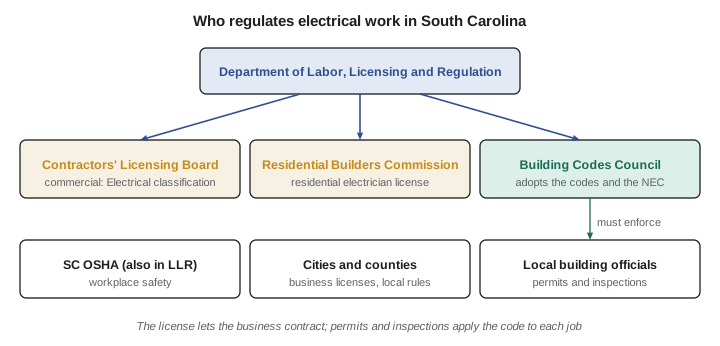
Electricians who have worked in other states often expect a state electrical board that licenses master and journeyman electricians and inspects their work. South Carolina is different. There is no statewide journeyman or master electrician license for commercial work. Instead, the state licenses the business that contracts for electrical work. Commercial electrical contracting falls under the Contractors' Licensing Board, which is part of the Department of Labor, Licensing and Regulation, usually shortened to LLR. The board issues two broad kinds of licenses: general contractor licenses and mechanical contractor licenses. Electrical work is one of the classifications on a mechanical contractor license.
So when people say "South Carolina electrical contractor license," what they usually mean is a mechanical contractor license carrying the electrical classification. The license is issued to the business, whether that is a sole proprietor, a partnership, a corporation or a limited liability company. The business qualifies for the classification through a person, called the qualifying party, who has passed the required exams. On Congaree's license, Wade is the primary qualifying party for the electrical classification. When Tamika passes the exams and the board approves her, she will take his place in that role, and the license will stay with the company.
The license also carries a group number, from Group 1 to Group 5. The group sets the largest single job the business may take on, and it is tied to the company's finances. Lesson 2 covers the groups in detail. For now, remember that a South Carolina mechanical contractor license answers three questions at once: which business is licensed, which kinds of work it may do and how large a job it may take.
When a license is required
The mechanical contractor licensing law applies once the value of the work crosses a threshold. The board's 2023 legislative update raised that threshold, so a mechanical contractor license is now required when the total cost of the electrical work, including labor and materials, is greater than 10,000 dollars. Below that amount, state contractor licensing does not apply, although a city or county may still require a business license, a permit and inspections. A job cannot be divided into smaller contracts to stay under the threshold; the board looks at the whole undertaking.
This threshold matters on service work. A residential panel upgrade might cost 4,800 dollars. A small office tenant finish might be 14,000. A church fellowship hall might be 95,000. Every one of those jobs still needs a permit where the local jurisdiction requires one, but only the jobs above the threshold require the business to hold the mechanical contractor license with the electrical classification. Most real electrical contractors cross the line on almost every job, so for practical purposes Congaree treats the license as required for everything it does.
Residential work and the Residential Builders Commission
Residential work has its own board. The Residential Builders Commission, also part of LLR, licenses residential builders and registers or licenses residential specialty contractors, including residential electricians. A residential electrician license lets an individual perform electrical work on residential buildings without a commercial mechanical license. The commission's application package describes two PSI exams, a year of experience and a surety bond when the individual takes on work above a stated dollar amount. Lesson 2 compares the residential route with the commercial classification.
For a company like Congaree, which does both commercial fit-outs and residential service, the commercial mechanical license with the electrical classification is the core credential. Wade has also kept an eye on residential rules because the company's service department rewires older homes in West Columbia and Cayce. Whether a particular residential job falls under the commission or the board can depend on the building type and the size of the job, so Joyce keeps the commission's current guidance in the office binder.
Who adopts and enforces the code
The license says who may contract. A different body decides what the installation has to look like. The South Carolina Building Codes Council, also within LLR, adopts the building codes that apply statewide, including the National Electrical Code with any South Carolina modifications. Local jurisdictions are required to enforce the adopted codes; they do not get to pick an older edition or skip the electrical code. Lesson 5 covers the current edition and how modifications work.
Enforcement happens locally. Counties and cities run building departments that issue permits, review plans and send inspectors to the job. A dental office inside the town of Lexington goes through the town's building department. A residential service change in unincorporated Lexington County goes through the county, where Ray Dupree is the building official. Lesson 6 covers how to find the right office for any address and how the inspection sequence runs.
Tamika's map of the work
Tamika started by mapping Congaree's current jobs against these layers. For each job she wrote down the value, whether the state license applies, which group the job needs and which local office will issue the permit. The West Columbia warehouse stood out right away. At 620,000 dollars it is larger than the Group 4 limit of 400,000 dollars on Congaree's license, so the company either needs to move up to Group 5 before bidding or stay off that job.
| Job | Value | State license | Group needed | Permit office |
|---|---|---|---|---|
| Residential panel upgrade, Cayce | 4,800 dollars | Below the threshold | None | City of Cayce |
| Church fellowship hall, Irmo | 95,000 dollars | Required | Group 2 or higher | Town of Irmo |
| Dental office fit-out, Lexington | 180,000 dollars | Required | Group 3 or higher | Town of Lexington |
| Warehouse, West Columbia | 620,000 dollars | Required | Group 5 | City of West Columbia |
THRESHOLD = 10_000
GROUP_LIMITS = [(1, 35_000), (2, 100_000), (3, 200_000), (4, 400_000), (5, None)]
OUR_GROUP = 4

jobs = [
    ("Panel upgrade, Cayce", 4_800),
    ("Fellowship hall, Irmo", 95_000),
    ("Dental office, Lexington", 180_000),
    ("Warehouse, West Columbia", 620_000),
]

def group_needed(value):
    for group, limit in GROUP_LIMITS:
        if limit is None or value <= limit:
            return group

for name, value in jobs:
    licensed = value > THRESHOLD
    g = group_needed(value)
    ok = g <= OUR_GROUP
    print(f"{name}: {value:,} dollars")
    print(f"  license required: {'yes' if licensed else 'no'}")
print(f" smallest group that covers it: {g} -> {'fits' if ok else 'ABOVE OUR GROUP'}")Panel upgrade, Cayce: 4,800 dollars license required: no smallest group that covers it: 1 -> fits Fellowship hall, Irmo: 95,000 dollars license required: yes smallest group that covers it: 2 -> fits Dental office, Lexington: 180,000 dollars license required: yes smallest group that covers it: 3 -> fits Warehouse, West Columbia: 620,000 dollars license required: yes smallest group that covers it: 5 -> ABOVE OUR GROUP
The script answers the two questions Tamika will ask on every bid as qualifying party: does this job cross the licensing threshold, and does it fit inside the company's group? Change orders matter too. A job that started at 380,000 dollars and grows past 400,000 dollars can push a Group 4 contractor past its limit, so the estimator and the qualifying party need to watch the running total, not just the original contract price.
The qualifying party
The board licenses the business and qualifies it through a person. The primary qualifying party, often shortened to PQP, has passed the trade exam for the classification and the business and law exam, and has the experience the board requires. The PQP is the person the board looks to for the technical side of the work. Lesson 7 covers the PQP's duties, what happens if the PQP leaves the company and the limits on serving more than one license.
A mechanical license also has financial requirements that an individual electrician license in many states does not. The group is backed by a financial statement showing net worth or working capital, or by a surety bond. Those requirements sit with the business, but the PQP has to understand them, because a lapse in the bond or a weak financial statement can shrink the group or stop the license, and that stops every job at once.
Layers of law
It helps to keep the layers of South Carolina law straight. The contractor licensing law and the board's regulations govern who may contract and in which group. The Building Codes Council's adoptions govern what the installation must meet. Local ordinances govern permits, fees, business licenses and inspection procedures. The mechanics' lien law governs payment security. The workers' compensation law and the SC OSHA standards govern the company as an employer. A qualifying party does not need to be a lawyer, but needs to know which layer a question belongs to and which office answers it.
That map also tells you who to call. A question about whether your financial statement supports Group 5 goes to your accountant and the board. A question about whether a circuit needs arc-fault protection goes to the inspector for that address. A question about whether you can still file a lien goes to a construction lawyer, quickly. A question about whether an apprentice needs a local card goes to the city or county building department.
Common mistakes
MistakeExpecting a statewide master electrician license for commercial work.
InsteadSouth Carolina licenses the contracting business; commercial electrical work is a classification on a mechanical contractor license from the Contractors' Licensing Board.
MistakeSplitting a job into smaller contracts to stay under the threshold.
InsteadThe board looks at the whole undertaking, and splitting a job does not avoid the license requirement.
MistakeTreating the group limit as a yearly total.
InsteadThe group caps the value of a single job, not the company's total annual volume.
MistakeAssuming the license replaces the local permit.
InsteadThe license lets the business contract; the local building department still issues permits and inspects each job.
Summary and key terms
- Commercial electrical contracting in South Carolina is a classification on a mechanical contractor license from the Contractors' Licensing Board in LLR.
- A mechanical license is required when the electrical work costs more than 10,000 dollars, counting labor and materials.
- The license belongs to the business and is qualified through a primary qualifying party who passed the exams.
- The group number, from 1 to 5, caps the size of a single job and is backed by finances or a bond.
- The Building Codes Council adopts the codes statewide, and local building departments issue permits and inspect.
- Contractors' Licensing Board
- The LLR board that licenses general and mechanical contractors in South Carolina.
- Mechanical contractor license
- The license that carries classifications such as electrical, plumbing and air conditioning.
- Group
- The license level, from 1 to 5, that sets the largest single job a business may take.
- Primary qualifying party
- The person whose exams and experience qualify the business for a classification.
- Building Codes Council
- The LLR council that adopts the building codes, including the NEC, for the state.
Practice problems
Work each problem on paper first, then reveal the answer to check.
At what job value does South Carolina require a mechanical contractor license for electrical work?
Show answer
When the total cost is greater than 10,000 dollars, counting labor and materials.
Who owns the license: Congaree Electric or Wade?
Show answer
Congaree Electric. Wade qualifies it as the primary qualifying party.
A Group 4 company wants to bid a 620,000-dollar warehouse. What must happen first?
Show answer
It must be licensed in Group 5, which has no job limit, before it bids.
Which body adopts the NEC for South Carolina?
Show answer
The South Carolina Building Codes Council, within LLR.
Lesson quiz · 5 questions
Score 60% or more to complete this lesson.
Create a free account to save your progress, take quizzes and earn a certificate.