
MELU-315 · Lesson 11 of 12 · 18 min
Renewal and continuing education
▶ Video coming soon A video version of this lesson is on the way.
In the fall of 2019, Congaree almost lost its license. The renewal notice went to an old email address, Wade was out with a knee replacement and Joyce was on vacation the last week of October. On November 4, a general contractor's project manager called to say that LLR's lookup showed Congaree's license as expired, and that the company could not return to the job until it was fixed. Wade renewed online that afternoon, paid the late charge and spent two days on the phone with the GC and two building departments. "We lost a week on two jobs and probably a client," he told Tamika. "For a form that takes twenty minutes. That's why the renewal date is on every calendar in this building now."
This lesson covers how a South Carolina mechanical contractor license is renewed, what the board checks at renewal, what happens if a license lapses, and the status of continuing education for mechanical contractors and residential electricians. It ends with a calendar for keeping every credential current, because the license is only one of the dates a qualifying party has to manage.
The renewal cycle
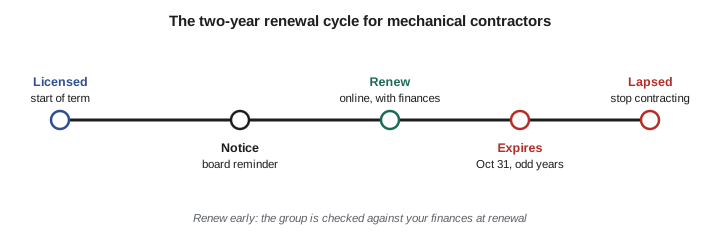
Mechanical contractor licenses issued by the Contractors' Licensing Board renew every two years. The board's licensure page lists the expiration date as October 31 of odd-numbered years, so the current licenses expire on October 31, 2027. A license issued partway through a cycle still expires on that date, which means a business licensed in 2026 has a shorter first term than two years. The board sends renewal notices ahead of the deadline, and renewal is done online through LLR's system.
What the board checks at renewal
Renewal is more than a fee. The renewal asks the business to confirm or update its information: the owners and officers, the address, the qualifying parties for each classification and the group. The business confirms that its financial backing still supports its group, whether by a current financial statement or a license bond in force, and that it carries workers' compensation where required. It answers questions about discipline, judgments and criminal history since the last renewal. The board may ask for supporting documents, especially when the group is being raised.
Because the group is tied to finances, renewal is a good moment to review it. If Congaree's finances grow enough to support Group 5, Joyce could request the higher group with the renewal, with the accountant's statement or a larger bond. If the finances have slipped, the business may need to lower its group or add a bond to keep the current one. Either way, the accountant's year-end work and the license renewal belong on the same calendar.
Late renewal and lapse
A license that is not renewed by the expiration date lapses. The board's rules allow late renewal within a set period after expiration, usually with a late charge, and after that period a business may need to apply as if it were new. During a lapse, the business may not contract for work that requires the license. Owners and general contractors check LLR's public lookup, and many do it automatically. A lapsed license can stop work on every job, delay pay applications and cause problems with permits and liens, because the lien law expects a licensed contractor to show its license number.
from datetime import date

def next_expiration(today):
    year = today.year if today.year & 1 else today.year + 1
    exp = date(year, 10, 31)
    if exp < today:
        exp = date(year + 2, 10, 31)
    return exp

for today in [date(2026, 11, 9), date(2027, 9, 1), date(2027, 11, 2)]:
    exp = next_expiration(today)
print(f"on {today}: next expiration {exp}, {(exp - today).days} days away")on 2026-11-09: next expiration 2027-10-31, 356 days away on 2027-09-01: next expiration 2027-10-31, 60 days away on 2027-11-02: next expiration 2029-10-31, 729 days away
The last line of output shows a trap. On November 2, 2027, the function looks ahead to October 31, 2029, because the 2027 expiration has passed. If Congaree had not renewed by then, its license would already be lapsed, and the next expiration date would be irrelevant until the late renewal was done.
Continuing education
The board's licensure and renewal pages, as checked for this course, do not describe a general continuing education requirement for mechanical contractors or their qualifying parties of the kind many states use for electricians. That can change through legislation or regulation, so check the board's renewal page each cycle for any new requirement. Residential licensees under the Residential Builders Commission have their own renewal rules, and the commission's pages describe any education required for residential builders and specialty licensees.
No state requirement does not mean no learning. A new NEC edition is published every three years, South Carolina adopts editions on its own schedule with its own modifications, and the exam itself changes editions in 2027. Owners increasingly require NFPA 70E training. Manufacturers change equipment and listings. Tamika set a goal of at least sixteen hours of code and safety training a year for herself and eight for each journeyman, using the Carolinas AGC programs, manufacturer seminars, local inspector association meetings and online code update courses.
| Credential | Issued by | Renewal | Education |
|---|---|---|---|
| Mechanical contractor license, electrical classification | Contractors' Licensing Board | Every two years, by October 31 of odd years | No general state requirement as of late 2026; check each cycle |
| Residential electrician license | Residential Builders Commission | On the commission's cycle | As the commission requires |
| Local business licenses | Each county or city | Usually yearly | None |
| Local contractor registrations | Building departments | Varies | None |
| NFPA 70E training | Employer program | Retraining at intervals the standard sets | Required by the employer's program |
The rest of the calendar
The license is one date among many. A complete calendar for an electrical contractor includes the license renewal, the bond renewal, the insurance policy renewals, the local business licenses, the building department registrations, the annual posting of the OSHA injury summary from February through April, the accountant's year-end statement, the workers' compensation audit and the training dates for each employee. Joyce keeps these in a shared calendar with reminders at ninety, sixty and thirty days.
Worked problem
Building the renewal calendar
Joyce wants reminders for the license renewal on October 31, 2027 at ninety, sixty and thirty days. What dates should she use?
Show solution
- Ninety days before October 31, 2027 is August 2, 2027.
- Sixty days before is September 1, 2027.
- Thirty days before is October 1, 2027.
- She also adds the bond renewal and checks that the financial statement will be current.
Answer: August 2, September 1 and October 1, 2027, with the bond and statement checks alongside.
Keeping the board's records accurate
Between renewals, the business must keep its information current with the board. A new address, a change in owners or officers, a new qualifying party or a change in the bond should be reported within the time the law and regulations set. Accurate records are also what owners see on LLR's lookup. Tamika checks the lookup each quarter to make sure Congaree's record shows the right classification, group, qualifying party and expiration date.
When a qualifying party changes at renewal
If the qualifying party changes close to renewal, file the change first and confirm it on the lookup before renewing, so that the renewal reflects the right person. Wade and Tamika plan to complete the change well before October 2027, so that her name is on the renewal and the record is clean for the next two-year term.
Renewing with a changed group
Renewal is the natural time to change the group, but it is not the only time. A business can ask the board to raise its group whenever its finances support it, with an updated statement or a larger bond, and it should not bid a job above its current group in the hope that the change will come through before award. Lowering a group happens when finances slip or when a business decides to replace a large bond with a smaller one. Either way, the license record on LLR's lookup should show the group the business actually holds, and owners and GCs will check it before awarding work.
Congaree's accountant reviewed the company's numbers in November 2026 and projected that, with another strong year and retained earnings, the company might reach the Group 5 net worth figure by the end of 2027. In the meantime, Joyce priced a 300,000-dollar license bond so that the company could move to Group 5 sooner if a large project came along. The surety asked for the last three years of financial statements, a schedule of work in progress and personal indemnity from Wade and the other owners.
Keeping records for the next renewal
A good renewal starts two years earlier. Keep a renewal folder with the current license certificate, the last renewal confirmation, the bond and any riders, the latest financial statement, the workers' compensation and liability certificates, and any correspondence with the board. Add to it as things change during the cycle: a new officer, a new address, a new qualifying party. When the renewal opens, everything needed is in one place, and the renewal itself takes the twenty minutes Wade remembers instead of a week of searching.
The folder also helps if the board asks questions after renewal or audits the business's information. A business that can produce its documents quickly shows that it takes its obligations seriously. Tamika added one more item to the folder: a one-page summary of every credential, its issuer, its expiration date and the person responsible for renewing it. If she is out sick in late October of an odd year, someone else can pick up the folder and finish the job.
Residential licenses on a different cycle
If a company or its employees also hold residential licenses from the Residential Builders Commission, those licenses renew on the commission's own cycle, which is different from the mechanical license cycle. Mixing up the two is a common way to let one lapse. Put each credential on the calendar separately, with its own reminders, even when the same person is responsible for both.
Changes in the law between renewals
Laws and regulations change between renewals, and the 2023 legislative update is a good example: it changed the licensing threshold and the bond amount rule for mechanical contractors. Changes like these can affect which jobs require a license, how a business backs its group and what the renewal asks for. Joyce signed up for LLR's email notices and reads the board's news page each quarter, and Tamika attends the Carolinas AGC legislative update each year. When a change affects Congaree, they write a short note in the renewal folder describing what changed and what the company did about it. That habit costs a few minutes a year and means the company is never surprised at renewal by a rule it should have known about.
The same habit applies to code adoptions. A new NEC edition adopted by the Building Codes Council affects every job, and its enforcement date is as important to the company's calendar as the license expiration.
Common mistakes
MistakeRelying on the renewal notice to arrive.
InsteadNot receiving a notice does not excuse a late renewal; calendar October 31 of odd years.
MistakeTreating renewal as only a fee.
InsteadRenewal confirms owners, qualifying parties, group finances, workers' compensation and discipline history.
MistakeAssuming no state education requirement means no training.
InsteadCode editions, safety standards and owner requirements change; plan training anyway.
MistakeWorking during a lapse because the renewal is on the way.
InsteadA lapsed license may not be used to contract; renew before working.
Summary and key terms
- Mechanical contractor licenses renew every two years and expire on October 31 of odd-numbered years.
- Renewal confirms owners, qualifying parties, group and its financial backing, workers' compensation and discipline history.
- A lapsed license may not be used to contract; late renewal is available only for a limited period.
- As of late 2026 there is no general state continuing education requirement for mechanical contractors; check each cycle.
- Keep a full calendar of license, bond, insurance, local licenses, OSHA posting and training dates.
- Renewal
- The two-year process that keeps a license active.
- Lapse
- The status of a license that was not renewed by its expiration date.
- Late renewal
- Renewal within a limited period after expiration, usually with a late charge.
- Continuing education
- Training required to renew some licenses; not generally required for South Carolina mechanical contractors as of late 2026.
- License lookup
- LLR's public search, which owners use to check license status.
Practice problems
Work each problem on paper first, then reveal the answer to check.
When do South Carolina mechanical contractor licenses expire?
Show answer
October 31 of odd-numbered years.
What is the next expiration after November 2026?
Show answer
October 31, 2027.
May a business contract while its license is lapsed?
Show answer
No. It must renew first.
Name three items besides the license on a contractor's renewal calendar.
Show answer
The bond, insurance policies and local business licenses, among others.
Lesson quiz · 5 questions
Score 60% or more to complete this lesson.
Create a free account to save your progress, take quizzes and earn a certificate.