
MELU-315 · Lesson 6 of 12 · 19 min
Permits, inspections and the inspection authority
▶ Video coming soon A video version of this lesson is on the way.
Ray Dupree has been the building official for unincorporated Lexington County for eleven years, and he has a rule he repeats at every contractor breakfast: "The permit comes before the wire." Tamika had heard it so often she could say it along with him. What she had not done until this fall was pull permits herself. Wade and Joyce had always handled the paperwork, and Tamika had met inspectors on site with the permit card already stapled to the wall. Now, with the qualifying party role coming, Wade asked her to pull every permit for a month. The first one was a 200-ampere service change on a house off Old Cherokee Road. Before she could start, she had to answer a question that sounded simple: whose permit is this?
This lesson covers how electrical permits and inspections work in South Carolina: who issues them, how to find the right office for an address, what a permit application usually needs, the typical inspection sequence, what happens when an inspection fails and how disputes with an inspector are handled. Because administration is local, the details vary from one jurisdiction to the next. The lesson describes common practice and points to what you should confirm with each office.
Who is the inspection authority
In South Carolina, the code is adopted at the state level and enforced locally. The building codes law requires local jurisdictions to enforce the adopted codes, and counties and municipalities do that through building departments led by a building official. The building official, and the inspectors working under that official, are the authority having jurisdiction for electrical permits and inspections on most private projects. The NEC uses that phrase, often shortened to AHJ, for the person or office that approves installations and interprets the code.
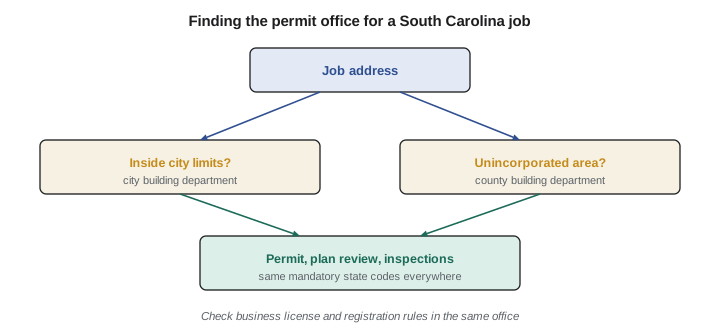
Some smaller towns contract with the county or with a private firm for inspections, and some share an inspector with neighboring towns. A few state-owned buildings and certain special facilities are reviewed by state agencies rather than local departments. For an ordinary commercial or residential job, though, the question is almost always: is the address inside a city or town that runs its own building department, or in the unincorporated county?
Finding the right office
Mailing addresses can mislead. A house with a Lexington mailing address may sit outside the town limits, in the county. A business on a road named for one town may be inside another. The reliable check is the county's parcel or GIS map, which shows whether a parcel is inside municipal limits. Many building departments also have an address lookup on their permit portal. Tamika checked the Old Cherokee Road house on the county map: unincorporated, so the permit came from Ray Dupree's office.
Once you know the office, read its permit requirements. Some departments take electrical permits online only. Some require the contractor to register with the department before applying, with a copy of the state license, proof of insurance and a local business license. Some issue electrical permits only to the licensed contractor, and others let a homeowner pull a permit for work on his own home under conditions they define. Knowing these rules in advance avoids a wasted trip.
| Item | Commonly required | Notes |
|---|---|---|
| Contractor registration | Often | License copy, insurance certificate and a local business license |
| Job address and parcel | Always | Confirm city limits first |
| Scope and value of the electrical work | Always | The value often sets the fee |
| Service size and voltage | For services and feeders | Utility coordination may be needed |
| Plans or one-line diagram | Commercial and larger jobs | May require a design professional's seal |
| Load calculation | Services, feeders and upgrades | Show the method used |
| Owner authorization | Sometimes | Especially for tenant work |
Plan review
Commercial projects usually go through plan review before the permit issues. The building department's plans examiner checks the electrical drawings against the adopted code: service and feeder sizing, panel schedules, the one-line diagram, emergency and standby systems, fire alarm, and coordination with the building and energy codes. Larger projects usually need drawings sealed by a South Carolina registered engineer, depending on the building's size and use. The contractor may be asked to respond to plan review comments, especially on design-build jobs where the contractor prepared the drawings.
Residential service changes and small alterations usually skip formal plan review. The permit is issued over the counter or online, with the scope and a simple load calculation where the service size changes. Tamika's service change on Old Cherokee Road was approved the same afternoon.
The inspection sequence
Inspections follow the construction, so that every part of the work is seen before it is covered. A typical sequence for a commercial job is an underground inspection before trenches are backfilled or slabs are poured, a rough-in inspection before walls and ceilings are closed, a service inspection before the utility connects permanent power, and a final inspection when the work is complete. Some departments add a temporary power inspection for a construction pole, a separate inspection for fire alarm or a ceiling cover inspection. Others combine steps on small jobs.
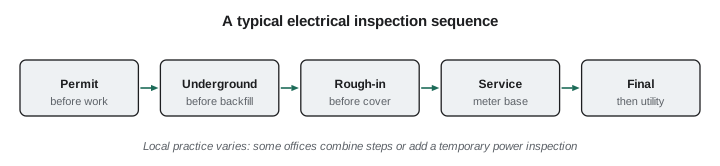
Inspections are requested by the permit holder through the department's portal or phone line, usually by a cutoff time the day before. The permit card or job number must be available on site. If the inspector arrives and the work is not ready, many departments charge a reinspection fee. Tamika learned to call for the inspection only when the work was truly ready, and to walk the job herself first with the inspection checklist the department publishes.
Release to the utility
For a new service or a service change, the utility will not set the meter or reconnect until the building department releases the service. In the Midlands, that may be Dominion Energy, a rural electric cooperative such as Mid-Carolina Electric Cooperative, or a municipal utility, depending on the address. The release usually goes from the building department to the utility electronically after the service inspection passes. A contractor who promises a homeowner power by Friday needs to know how long that handoff takes in the jurisdiction.
from datetime import date, timedelta

DAY = ["Mon", "Tue", "Wed", "Thu", "Fri", "Sat", "Sun"]
show = lambda d: f"{DAY[d.weekday()]} {d.isoformat()}"

steps = [("Permit issued", 0), ("Underground", 3), ("Rough-in", 18),
         ("Service", 26), ("Final", 41)]
lead_days = 1          # request by the cutoff the day before
release_days = 2       # building department to utility, illustrative
start = date(2026, 11, 2)

for name, day in steps:
    d = start + timedelta(days=day)
    req = d - timedelta(days=lead_days)
    print(f"{name:14} target {show(d)}   request by {show(req)}")
service_day = start + timedelta(days=26)
print("earliest utility release:", show(service_day + timedelta(days=release_days)))Permit issued target Mon 2026-11-02 request by Sun 2026-11-01 Underground target Thu 2026-11-05 request by Wed 2026-11-04 Rough-in target Fri 2026-11-20 request by Thu 2026-11-19 Service target Sat 2026-11-28 request by Fri 2026-11-27 Final target Sun 2026-12-13 request by Sat 2026-12-12 earliest utility release: Mon 2026-11-30
Failed inspections and corrections
When an inspection fails, the inspector leaves a correction notice listing what must be fixed. The contractor makes the corrections and requests a reinspection. Read the notice carefully and ask questions while the inspector is on site if anything is unclear; it is easier to agree on what is wanted in person than over the phone a week later. Keep every correction notice in the job file. Repeated failures for the same kind of problem are a training issue for the crew and a reputational issue for the company.
Worked problem
A failed rough-in
At the Lexington dental office, the rough-in inspection fails because several boxes in a fire-rated corridor wall are not protected as the rated assembly requires. What should Tamika do?
Show solution
- Read the correction notice and confirm with the inspector what protection the listed assembly calls for.
- Check the assembly's listing and the building drawings for the wall rating.
- Have the crew install the protection the listing requires and photograph it.
- Request a reinspection before the drywall crew closes the wall.
Answer: Correct the work to the listed assembly, document it and get the reinspection before cover.
When you disagree with an inspector
Inspectors are human and the code is open to interpretation in places. When you disagree with a call, start with a respectful conversation: ask which section the inspector is relying on, and explain your reading with the section in hand. If that does not settle it, ask to speak with the building official, who has authority to interpret the code for the jurisdiction. If the disagreement is still unresolved, South Carolina's building codes law provides for a local board of appeals, and further appeal routes exist beyond it. Appeals take time and money, so most contractors use them only for real questions with real cost.
Tamika keeps a habit Wade taught her: never argue a call in front of the customer. If she thinks an inspector is wrong, she asks for the section, writes it down and takes the question to the office. More often than not, a call to the building official the next morning clears it up in one direction or the other.
Permits and the license
A permit is tied to the licensed contractor who pulls it. Pulling a permit for work another company is doing, or letting an unlicensed person work under your permit, is a serious problem under the licensing law and with the local department. Lesson 7 covers this in more detail. The qualifying party should know which permits are open under the company's name at any time, and should close out each one with a final inspection. Open permits can block future permits at the same address and leave the company responsible for work it may not have finished.
Working with inspectors
Good relationships with inspectors save time on every job. Inspectors appreciate a site that is ready, a permit card that is easy to find, a crew member who can answer questions and work that has already been checked against the department's list. They also remember contractors who call for inspections that are not ready, argue every call or cover work before it is inspected. Tamika makes a point of meeting each inspector, learning their preferred way to request inspections and asking about local policies before the first job in a new jurisdiction. When she has a question about a tricky installation, she asks before building it, not after it fails.
Many South Carolina jurisdictions publish inspection checklists, policy memos and frequently asked questions on their websites. Reading them before the first inspection prevents surprises, and they often explain local practices such as when a separate fire alarm inspection is needed or how temporary power is handled on commercial sites.
Finally, keep a copy of every permit, inspection result and correction notice in the job file until well after the warranty period ends. Those records answer questions from owners, insurers and future buyers about what was inspected and when, and they protect the company if a dispute arises years later.
Common mistakes
MistakeUsing the mailing address to pick the permit office.
InsteadCheck the parcel map; the city limits, not the mailing address, decide the office.
MistakeCovering work before the inspection.
InsteadCall for the underground or rough-in inspection before backfill, slab or drywall.
MistakePromising power on a date without allowing for the utility release.
InsteadAllow time for the service inspection and the release from the building department to the utility.
MistakeArguing a call in front of the customer.
InsteadAsk for the section, then take the question to the building official.
Summary and key terms
- The code is adopted statewide and enforced by local building departments led by a building official.
- The parcel map, not the mailing address, shows whether a job is in a city or the unincorporated county.
- Commercial jobs usually need plan review; small residential work is often permitted over the counter.
- A typical sequence is underground, rough-in, service and final, each before the work is concealed.
- Disagreements go from the inspector to the building official and then to the board of appeals.
- Authority having jurisdiction
- The office or official that approves installations and interprets the code.
- Building official
- The head of a local building department.
- Correction notice
- The inspector's list of items that must be fixed after a failed inspection.
- Release
- The building department's notice to the utility that a service may be energized.
- Board of appeals
- The local body that hears appeals of a building official's decisions.
Practice problems
Work each problem on paper first, then reveal the answer to check.
How do you find out whether a job is in a city or the county?
Show answer
Check the county parcel or GIS map, or the department's address lookup.
What must pass before the utility sets the meter on a new service?
Show answer
The service inspection, followed by the building department's release.
When is a rough-in inspection requested?
Show answer
When the wiring is in place and before walls and ceilings are closed.
Where does an unresolved code dispute go after the building official?
Show answer
To the local board of appeals.
Lesson quiz · 5 questions
Score 60% or more to complete this lesson.
Create a free account to save your progress, take quizzes and earn a certificate.