
MELU-315 · Lesson 5 of 12 · 18 min
The NEC as adopted in South Carolina and state amendments
▶ Video coming soon A video version of this lesson is on the way.
The dental office in Lexington was halfway through rough-in when Ben Alvarez brought Tamika a question from the owner's designer. The designer worked out of Charlotte and had drawn the panel schedules to the 2023 NEC, because that is what North Carolina was moving toward. "Do we build it the way it's drawn," Ben asked, "or the way the inspector is going to look at it?" Tamika pulled up the Building Codes Council's list of codes in effect on her phone. "South Carolina enforces the 2020 NEC with the state modifications," she said. "Where the drawings ask for more than the 2020 code requires, we can build it that way if the owner wants to pay for it. Where they ask for less, the inspector is going to hold us to 2020. Let's go through the differences before we pull another wire."
This lesson explains how the National Electrical Code becomes law in South Carolina: who adopts it, which edition is in force, how state modifications work, whether local jurisdictions can change it, and how to handle a job where the drawings, the exam and the enforced code point to different editions. It does not reproduce code text or tables. When a section is mentioned, open your own copy to read it.
Who adopts the code
The South Carolina Building Codes Council is a council within LLR created by the building codes law in Title 6, Chapter 9 of the South Carolina Code. It adopts the building codes that apply across the state: the building, residential, fire, plumbing, mechanical, fuel gas, energy and electrical codes. The electrical code is the National Electrical Code published by the National Fire Protection Association. The council adopts a specific edition, decides on any South Carolina modifications and sets the date the edition takes effect.
South Carolina's approach is statewide and mandatory. The council's list of codes in effect says that the adopted codes are mandatory for all local jurisdictions. A county or city cannot keep enforcing an older electrical code or decide not to enforce one. That uniformity is useful to a contractor working across the Midlands: the code that applies in Lexington is the same edition that applies in Irmo, West Columbia and Cayce. What can differ from one jurisdiction to the next is the administration: permit fees, inspection scheduling, plan review practices and local policies on interpretation.
The edition in force
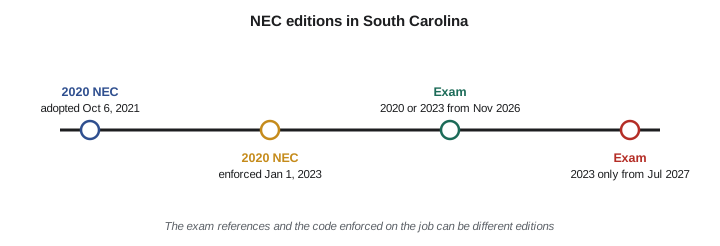
According to the council's list, the 2020 edition of the NEC, with South Carolina modifications, was adopted on October 6, 2021 and has been enforced since January 1, 2023. The gap between adoption and enforcement gave designers, contractors and inspectors time to buy the new books and learn the changes. During a transition, the rules on which edition applies to a project usually turn on the date of the permit application, so a job permitted before the enforcement date could still be built to the earlier edition.
The 2023 and 2026 editions of the NEC have been published, and South Carolina may adopt a newer edition after the date of this course. The council's adoption process includes public notice and a review of proposed modifications. When a new edition is adopted, check the effective date and the transition rule before bidding, because a job bid under one edition and permitted under another can change the cost of the electrical work.
What modifications are
A modification is a change the council makes to the model code for use in South Carolina. It can delete a requirement, change it, make it optional or add something the model code does not include. Modifications are published with the adoption, and the council's list of codes in effect links to them. Electrical modifications tend to focus on requirements that the council or its study committees decided were too costly for the safety benefit in South Carolina, or that needed clarification for local conditions.
When you read a modification, keep three things in mind. First, it applies only to the edition it was written for. A modification to the 2020 NEC does not automatically carry forward to a later edition. Second, a modification changes the minimum. An owner or engineer can still specify the model-code requirement or something stricter in the contract documents, and the contractor must build to the contract. Third, the inspector enforces the adopted code with its modifications, not the edition printed on the drawings. If the drawings ask for less than the adopted code, the adopted code wins.
Local modifications
Because the codes are mandatory statewide, a local jurisdiction cannot simply amend the electrical code on its own. The building codes law allows a local jurisdiction to seek approval for a local modification in limited circumstances, such as a physical or climatic condition peculiar to the area, and the council reviews those requests. In practice, local electrical modifications are rare, and most differences an electrician notices between jurisdictions are policies and interpretations rather than changes to the code. When an inspector cites a local requirement that is not in the adopted code, it is fair to ask, politely, where it comes from.
| Question | Where to look | Who decides |
|---|---|---|
| Which NEC edition applies to this job? | The council's list of codes in effect | Building Codes Council |
| Does a South Carolina modification change this section? | The modifications published with the adoption | Building Codes Council |
| Has this county approved a local modification? | The council's records and the county building department | Council approval of a local request |
| How will the inspector read this section? | A conversation with the building official | The local building official, subject to appeal |
| What does the contract require? | Drawings, specifications and the contract | The owner and the design professional |
Tamika's comparison
For the dental office, Tamika listed the places where the designer's 2023-based drawings differed from what the 2020 code with state modifications required. Some differences cost money and some did not. A few drawing notes asked for protection that the 2020 code with modifications did not require in that location. She flagged those for the owner as optional upgrades rather than leaving them out silently or adding them without a change order. The script below is the kind of quick list she kept, with placeholder items rather than code text.
items = [
    # (item, required by enforced code?, shown on drawings?, cost)
    ("Item A: added protection in break room", False, True, 640),
    ("Item B: surge protection at the service", True, True, 0),
    ("Item C: extra receptacles in operatory", False, True, 1_150),
    ("Item D: equipment disconnect labeling", True, False, 180),
]
upgrades = 0
for name, required, drawn, cost in items:
    if required and not drawn:
        action = "add (code requires it) - RFI to designer"
    elif drawn and not required:
        action = f"optional upgrade, price {cost:,} dollars"
        upgrades += cost
    else:
        action = "build as drawn"
    print(f"{name}: {action}")
print(f"total optional upgrades for owner decision: {upgrades:,} dollars")Item A: added protection in break room: optional upgrade, price 640 dollars Item B: surge protection at the service: build as drawn Item C: extra receptacles in operatory: optional upgrade, price 1,150 dollars Item D: equipment disconnect labeling: add (code requires it) - RFI to designer total optional upgrades for owner decision: 1,790 dollars
Item D is the one that matters most to an inspector: something the enforced code requires that the drawings left out. That is a request for information to the designer, and it is the contractor's responsibility to catch it before inspection, not after. Items A and C are owner decisions, priced as upgrades.
Worked problem
Drawings stricter than the code
The specifications for the Irmo fellowship hall require a feature that the 2020 NEC with South Carolina modifications does not require. Congaree's bid included it. During construction, the GC suggests leaving it out because "the inspector won't look for it." What should Tamika do?
Show solution
- The contract requires the feature, and Congaree bid it.
- The inspector enforces the minimum code, but the contract governs what the owner bought.
- Leaving it out without a change order would breach the contract.
- If the owner wants to delete it, the change should be documented with a credit.
Answer: Build it as specified unless the owner approves a written change with a credit.
The exam and the enforced code
Lesson 4 noted that the trade exam accepts the 2020 or 2023 NEC from November 2026 and only the 2023 edition from July 2027. The exam tests the model code, not South Carolina's modifications. So a candidate may need to answer exam questions from the 2023 model code while working every day under the 2020 code with modifications. Tamika handled this by studying from the 2023 book, reading a published summary of the changes from 2020 at home rather than inserting any pages into her exam copy, and by keeping her 2020 book in the truck for work.
Other codes that touch electrical work
The electrical code does not stand alone. The building code sets fire ratings for walls and floors that electrical penetrations must maintain. The energy code sets lighting power and control requirements that affect fixture selection and wiring. The fire code and NFPA 72, referenced through the building and fire codes, govern fire alarm systems. The residential code includes its own electrical chapters for one- and two-family dwellings, which some jurisdictions use for residential inspections. A qualifying party needs to know which of these apply on a given job and where the edition for each is listed.
Keeping up with changes
Code changes reach the field slowly. A contractor who learned the trade under an older edition can keep doing something the way it was always done long after the code changed. The best protection is a routine: when a new edition is adopted, read a change summary from the publisher or a training provider, attend a local update class, and walk through the changes with the crew at a toolbox talk. When inspectors start enforcing a new edition, their first few weeks of correction notices are a good guide to which changes matter most locally. Congaree's office keeps a binder of those notices, sorted by code section, and Tamika reviews it with each new hire.
Contractors also have a voice in adoption. The Building Codes Council's process includes public notice and opportunities to comment on proposed modifications, and trade associations often take part. A qualifying party who sees a requirement causing real problems in the field can raise it through those channels, with evidence, rather than ignoring it on the job.
Common mistakes
MistakeBuilding to the edition shown on the drawings.
InsteadThe inspector enforces the edition adopted by the Building Codes Council, currently the 2020 NEC with state modifications.
MistakeAssuming a county can choose its own NEC edition.
InsteadThe adopted codes are mandatory for all local jurisdictions; local modifications need council approval.
MistakeLeaving out a contract requirement because the code does not require it.
InsteadThe contract governs what the owner bought; deletions need a written change.
MistakeStudying the state modifications for the exam.
InsteadThe exam tests the model NEC edition listed in the bulletin, not South Carolina's modifications.
Summary and key terms
- The Building Codes Council adopts the NEC and other codes for South Carolina, and they are mandatory for all local jurisdictions.
- The 2020 NEC with South Carolina modifications was adopted October 6, 2021 and enforced from January 1, 2023.
- Modifications change the model code for South Carolina and apply only to the edition they were written for.
- Local modifications require council approval and are rare; most local differences are administrative.
- The exam tests the model code edition in the bulletin, which can differ from the code enforced on the job.
- Adoption
- The council's action making a code edition law in South Carolina.
- Modification
- A South Carolina change to a model code requirement.
- Enforcement date
- The date from which local officials enforce a newly adopted edition.
- Model code
- A code published by a private organization, such as the NEC from NFPA, before any state changes.
- Request for information
- A written question to the designer about a gap or conflict in the drawings.
Practice problems
Work each problem on paper first, then reveal the answer to check.
Which NEC edition is enforced in South Carolina as of late 2026?
Show answer
The 2020 edition with South Carolina modifications, enforced since January 1, 2023.
Can a city decide to keep enforcing an older edition?
Show answer
No. The adopted codes are mandatory for all local jurisdictions.
Does the trade exam test South Carolina's modifications?
Show answer
No. It tests the model NEC edition listed in the bulletin.
The drawings leave out something the enforced code requires. What should the contractor do?
Show answer
Send a request for information to the designer and resolve it before inspection.
Lesson quiz · 5 questions
Score 60% or more to complete this lesson.
Create a free account to save your progress, take quizzes and earn a certificate.