
MELU-315 · Lesson 10 of 12 · 18 min
Workplace safety law and OSHA for electrical contractors
▶ Video coming soon A video version of this lesson is on the way.
On a hot afternoon at the West Columbia warehouse site, which Congaree was wiring under a smaller first-phase contract, Caleb Simmons reached into a temporary panel to tighten a lug without checking whether it was dead. A journeyman named Luis caught his arm. Nobody was hurt. Tamika heard about it from Luis at the end of the day, not from Caleb, and she spent the drive home thinking about what would have happened if Luis had been on the other side of the building. The next morning she pulled the crew together before work. "I'm not going to yell," she said. "I'm going to tell you what the law requires, what our written program requires, and what I'm going to do differently as the person whose name will be on this license."
This lesson covers workplace safety law for a South Carolina electrical contractor: who enforces it, which standards apply to construction electrical work, what must be reported and recorded, training and program requirements, the role of NFPA 70E in setting up an electrically safe work condition and the South Carolina 811 rules for digging. It also connects these topics to the trade exam, which lists 29 CFR Part 1926 and the South Carolina 811 manual as references.
Who enforces safety in South Carolina
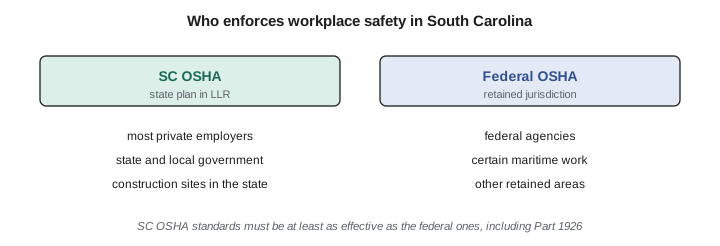
South Carolina runs a state plan approved by federal OSHA. The state program, called SC OSHA, is part of the Department of Labor, Licensing and Regulation. It covers most private employers in the state, including construction sites, and it also covers state and local government employers, which federal OSHA does not reach directly. Federal OSHA keeps jurisdiction over certain areas, such as federal agencies and some maritime work. State plan standards must be at least as effective as the federal ones, and SC OSHA has adopted the federal construction standards in 29 CFR Part 1926 along with the general industry standards in Part 1910.
The construction standards that matter most
Part 1926 is organized into subparts by topic. For an electrical contractor, the most important are the general safety and health provisions, personal protective equipment, the electrical subpart, ladders and stairways, scaffolds, fall protection, excavations, cranes and derricks where the work involves overhead lines, and the subparts on hand and power tools and fire protection. The electrical subpart covers installation safety, ground-fault protection or an assured equipment grounding conductor program for temporary power, lockout and tagging of circuits and work near energized equipment.
The trade exam lists Part 1926 as a reference, and safety questions usually test whether you can find the right subpart and the right paragraph quickly. Tamika tabbed her copy by subpart, with extra tabs on electrical, ladders, fall protection and excavations. She practiced looking up questions such as when fall protection is required, how far ladders must extend above a landing and what an excavation over a certain depth requires, without memorizing the answers.
| Subpart topic | Why it matters to electricians | Typical question |
|---|---|---|
| Electrical | Temporary power, GFCI or assured grounding, lockout of circuits | What protection temporary receptacles need |
| Ladders and stairways | Daily use on every job | How far a ladder must extend above a landing |
| Fall protection | Work on roofs, lifts and open edges | At what height protection is required |
| Scaffolds | Ceiling and high-bay work | Who must inspect a scaffold and when |
| Excavations | Underground conduit and services | When a protective system is required |
| Personal protective equipment | Eye, head, hand and arc-rated protection | Who provides and pays for PPE |
Reporting and recordkeeping
Employers must report serious events to SC OSHA within short deadlines. Following the federal rule that SC OSHA applies, a work-related fatality must be reported within eight hours, and an in-patient hospitalization, an amputation or the loss of an eye within twenty-four hours. Many employers with more than ten employees in most industries, including construction, must also keep injury and illness records on the OSHA forms, post the annual summary each year from February through April and keep the records for five years. Congaree has thirteen employees, so it keeps the logs.
events = [
    ("Electrician hospitalized overnight after arc flash", "hospitalization"),
    ("Apprentice cut, treated with first aid only", "first aid"),
    ("Laborer loses fingertip in a conduit bender", "amputation"),
]
deadlines = {"fatality": 8, "hospitalization": 24, "amputation": 24, "eye loss": 24}

for what, kind in events:
    hours = deadlines.get(kind)
    if hours:
        print(f"{what}: report to SC OSHA within {hours} hours, and record it")
    else:
print(f"{what}: no report; record only if it goes beyond first aid")Electrician hospitalized overnight after arc flash: report to SC OSHA within 24 hours, and record it Apprentice cut, treated with first aid only: no report; record only if it goes beyond first aid Laborer loses fingertip in a conduit bender: report to SC OSHA within 24 hours, and record it
Written programs and training
Several standards require written programs or documented training. A construction employer needs a hazard communication program for chemicals on site. Where workers use respirators, a respiratory protection program applies, and silica work brings its own exposure control plan. Fall protection training must be given by a competent person and certified in writing. Workers who use ladders and scaffolds need training. Electrical work brings training on the hazards of energized equipment and on lockout and tagging. A small contractor can meet these requirements with a well-organized safety manual, regular toolbox talks and records of who was trained on what and when.
Tamika reviewed Congaree's safety manual after the incident with Caleb. It had a lockout procedure, but it did not say who could approve work near energized parts or how to test for absence of voltage. She rewrote that section using NFPA 70E as the guide, and she scheduled a hands-on session in the shop with the company's meters and lockout kits.
NFPA 70E and an electrically safe work condition
NFPA 70E, the Standard for Electrical Safety in the Workplace, is a consensus standard rather than a law, but OSHA and SC OSHA use it to judge whether an employer has protected workers from electrical hazards, and many owners require it in their contracts. Its central idea is that energized work should be avoided whenever possible by putting equipment into an electrically safe work condition. That means identifying every source, disconnecting it, verifying visible open points where possible, applying locks and tags, testing for absence of voltage with a properly rated tester that is checked before and after use, and grounding where stored energy or induced voltage is possible.
When energized work is truly necessary, such as some testing and troubleshooting, NFPA 70E calls for a risk assessment, an energized work permit for many tasks, approach boundaries for shock and arc flash, and arc-rated clothing and other protective equipment chosen by the incident energy analysis or the tables in the standard. Tightening a lug in a temporary panel, as Caleb tried to do, is not a task that justifies energized work.
Worked problem
Setting up an electrically safe work condition
Luis needs to add a breaker in a 208Y/120-volt panel at the warehouse. How should he make it safe to work?
Show solution
- Identify every source that can energize the panel, using the drawings and labels.
- Disconnect the feeder at its source and confirm the open point where visible.
- Apply his own lock and tag under the company procedure.
- Check the tester on a known live source, test every phase to phase and phase to ground, then check the tester again.
- Only then begin work.
Answer: Disconnect, lock and tag, then verify absence of voltage with a checked tester before touching anything.
Digging and the 811 rules
Electrical contractors dig trenches for services, site lighting and underground conduit. South Carolina's underground facility damage prevention law requires anyone who excavates to notify SC 811 before digging, so that utility owners can mark their lines. The SC 811 manual, which is on the trade exam reference list, explains how far in advance to call, how long marks are valid, what the marking colors mean and what to do if a line is damaged. Red marks electric lines, and a careful excavator hand-digs near any mark within the tolerance zone the manual describes.
Inspections and citations
SC OSHA inspects workplaces in response to fatalities and serious events, complaints and referrals, and through programmed inspections focused on high-hazard industries such as construction. An inspector shows credentials, holds an opening conference, walks the site and holds a closing conference. Citations list the standard violated, the classification such as serious or willful, the penalty and the abatement date. Employers can contest citations within a set period. Many contractors also use SC OSHA's free consultation service, which is separate from enforcement and helps an employer find and fix hazards without penalties when the employer follows through.
Building a safety culture
Rules and programs matter, but the incident with Caleb happened in a company that had a lockout procedure. What was missing was the habit of using it on a small task, and the willingness of a second-year apprentice to tell the foreman about a near miss. Tamika's changes focused on both. She started a weekly toolbox talk led by a different crew member each week. She made near-miss reports anonymous and promised that nobody would be disciplined for reporting one. She bought a voltage tester for every apprentice and made testing before touching a rule with no exceptions for small jobs. She also began asking, at every site walk, what the most dangerous task of the day would be and how the crew planned to make it safe.
Safety also affects the business directly. A strong safety record lowers the experience modification rate that workers' compensation insurers use to price policies, and many owners and general contractors screen subcontractors by that rate and by their OSHA logs before inviting them to bid. A serious injury, on the other hand, can bring an SC OSHA inspection, higher premiums, lost bids and, most importantly, a person who does not go home whole.
Multi-employer job sites
Construction sites have several employers working side by side. OSHA's multi-employer citation policy, which SC OSHA follows in its own way, means more than one employer can be cited for a hazard: the employer who created it, the one whose workers were exposed, the one responsible for correcting it and the one with authority to control the site. An electrical subcontractor that leaves an open panel cover or an unprotected floor opening can be cited even if the workers exposed belong to another trade. Coordinate with the GC and other trades about energized equipment, temporary power and shared hazards.
Tamika closed her talk with the crew by thanking Luis in front of everyone and asking Caleb to lead the next week's toolbox talk on testing before touching. Caleb did it, nervously and well.
Common mistakes
MistakeThinking federal OSHA inspects most South Carolina construction sites.
InsteadSC OSHA, a state plan in LLR, covers most private employers and construction sites in the state.
MistakeReporting a hospitalization a few days later.
InsteadHospitalizations, amputations and eye losses are reported within twenty-four hours, and fatalities within eight.
MistakeTesting for absence of voltage with an unchecked meter.
InsteadCheck the tester on a known source before and after testing.
MistakeDigging without calling SC 811 because the trench is shallow.
InsteadThe damage prevention law requires notice before excavation, whatever the depth.
Summary and key terms
- SC OSHA, part of LLR, runs South Carolina's state plan and covers most private employers and construction sites.
- SC OSHA adopts the federal construction standards in 29 CFR Part 1926, which the trade exam lists as a reference.
- Report a fatality within eight hours and a hospitalization, amputation or eye loss within twenty-four hours.
- Written programs and documented training cover hazard communication, fall protection, ladders, scaffolds and electrical work.
- NFPA 70E guides an electrically safe work condition, and SC 811 must be notified before any excavation.
- State plan
- A state workplace safety program approved by federal OSHA.
- Electrically safe work condition
- Equipment disconnected, locked, tagged and tested for absence of voltage.
- Assured equipment grounding conductor program
- An inspection and testing program for cords and tools used instead of GFCI protection on temporary power.
- Competent person
- A person able to identify hazards and authorized to correct them.
- SC 811
- The one-call center that must be notified before excavation in South Carolina.
Practice problems
Work each problem on paper first, then reveal the answer to check.
Within how many hours must a work-related fatality be reported to SC OSHA?
Show answer
Eight hours.
Which part of the federal regulations covers construction safety?
Show answer
29 CFR Part 1926.
What color marks electric lines?
Show answer
Red.
What are the steps to an electrically safe work condition?
Show answer
Identify sources, disconnect, lock and tag, test for absence of voltage with a checked tester and ground where needed.
Lesson quiz · 5 questions
Score 60% or more to complete this lesson.
Create a free account to save your progress, take quizzes and earn a certificate.