
MELU-315 · Lesson 12 of 12 · 18 min
Practice exam review and test-day strategy
▶ Video coming soon A video version of this lesson is on the way.
Ten weeks before her trade exam, Tamika took her first full timed practice test at the kitchen table on a Saturday morning, with her tabbed books stacked beside her and her phone in another room. She scored 51 out of 80, five short of passing. Her first reaction was frustration. Her second, after a cup of coffee, was curiosity. She went through every miss and sorted it into a column: did not know where to look, found the section but misread it, arithmetic error, or ran out of time. Twelve of her twenty-nine misses were in the first column, eight in the second, four in the third and five in the last. "That's not a knowledge problem," Wade said when she showed him. "That's a finding-things problem and a reading problem. Those are the easiest kind to fix."
This lesson pulls the course together into a study and test plan. It covers how to build a schedule from the PSI bulletin, how to use timed practice tests to find weak areas, how to sort and fix misses, how to pace each exam, and a routine for the day before and the day of the exam. It also covers what to do after the exam, whether you pass or not.
Build the plan from the bulletin
The bulletin is the blueprint. Start with its content outline for each exam and list the topic areas with their question counts. Then list the references you will bring and how comfortable you are with each one. A candidate who has used the NEC every day for fifteen years may need little time on finding articles but a lot on NFPA 72, which many electricians rarely open. A candidate who has never run a business may need extra weeks on the NASCLA guide.
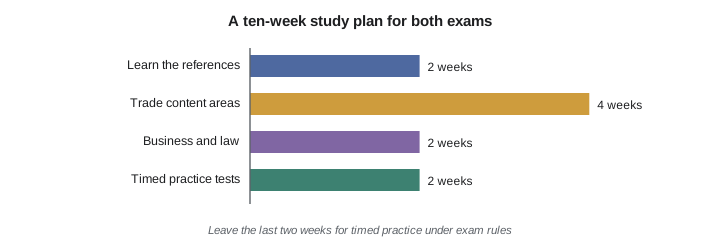
Tamika gave herself ten weeks and divided them into four blocks: two weeks learning the references and setting up tabs, four weeks on the trade content areas in order of their question counts, two weeks on the business and law guide, and two weeks of timed practice tests under exam rules. She studied about ten hours a week: three weeknight sessions of two hours and a four-hour Saturday session.
Using practice tests to diagnose
A practice test is a diagnostic tool, not a score to feel good or bad about. Take the first full test early, under real conditions: the same references, the same calculator, no phone and the real time limit. Then spend as long reviewing it as you spent taking it. For each miss, and for each correct answer you guessed, write down why. The four columns Tamika used cover most causes: location, reading, arithmetic and time.
Each cause has a different fix. Location misses mean the tabs or index habits need work; add or move tabs and practice lookups. Reading misses mean slowing down on key words such as except, not, minimum, maximum and the conditions in the question; underline them on scratch paper. Arithmetic misses mean showing the steps and checking units. Time misses mean pacing, covered below. Content misses, where you simply did not understand the topic, mean going back to the course material on that topic.
| Cause of miss | Tamika's first test | Fix |
|---|---|---|
| Could not find the answer | 12 | Add tabs, practice index lookups, learn the key word index |
| Found it but misread | 8 | Underline key words; reread the question before answering |
| Arithmetic error | 4 | Write each step; check units and rounding |
| Ran out of time | 5 | Use checkpoints; mark and move on |
| Did not know the topic | 0 | Review the course lesson |
misses = {"location": 12, "reading": 8, "arithmetic": 4, "time": 5}
total_questions, passing = 80, 56
score = total_questions - sum(misses.values())
print(f"score: {score}  needed: {passing}  short by: {passing - score}")

# if half of each fixable cause is fixed by the next test
for fix_share in (0.5, 0.75):
    gained = sum(round(n * fix_share) for n in misses.values())
    new = score + gained
print(f"fix {fix_share:.2f} of each cause -> about {new} ({'pass' if new >= passing else 'not yet'})")score: 51 needed: 56 short by: 5 fix 0.50 of each cause -> about 65 (pass) fix 0.75 of each cause -> about 73 (pass)
Fixing half of each cause would add about fourteen points, taking Tamika from 51 to around 65, comfortably past 56. The point of the estimate is not precision. It shows that a candidate five points short is usually a few habits away from passing, not months of new study.
Pacing the trade exam
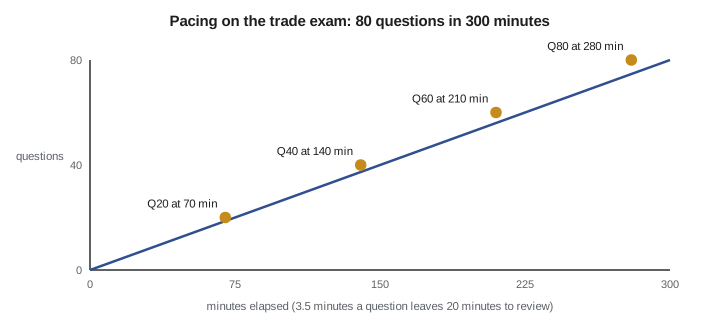
The trade exam gives 300 minutes for 80 questions. At a steady pace of three and a half minutes a question, a candidate reaches question 20 at 70 minutes, question 40 at 140, question 60 at 210 and question 80 at 280, leaving twenty minutes to return to marked questions. Write those checkpoints on the scratch paper at the start. If you are behind at a checkpoint, speed up by marking hard questions sooner, not by rushing the easy ones.
The most useful habit is the two-pass approach. On the first pass, answer every question you can find within a few minutes, and mark the rest. On the second pass, return to the marked questions with the time left. Never leave a question blank: there is no penalty for a wrong answer, so a guess on the last few marked questions can only help.
Pacing the business exam
The business exam gives 125 minutes for 50 questions, two and a half minutes each. Checkpoints at question 10 by 25 minutes, 20 by 50, 30 by 75, 40 by 100 and 50 by 120 leave a few minutes to review. Many business questions are quick lookups in the South Carolina chapters of the NASCLA guide, so a candidate with good tabs often finishes the first pass early and can spend the extra time on calculation questions such as markup, payroll taxes or depreciation.
Worked problem
Behind at a checkpoint
At 140 minutes into the trade exam, Tamika has worked through 33 questions, including 4 she marked and skipped. What should she do?
Show solution
- Her checkpoint is question 40 at 140 minutes, so she is seven questions behind.
- At three and a half minutes each, that is about twenty-five minutes behind pace, more than her review margin.
- She should mark any question that takes more than about three minutes and move on.
- She keeps a few minutes at the end to guess on every remaining marked question.
Answer: She is behind; she tightens her mark-and-move limit and saves time to answer every question.
The day before
The day before the exam is for logistics, not cramming. Confirm the test center address, the arrival time and the identification rules in the bulletin. Check that the name on your identification matches the registration exactly. Pack the approved references, checking that each book is the right edition and has nothing inside it that the bulletin prohibits. Pack an approved calculator with fresh batteries. Plan the drive, allowing for traffic on I-26 or I-20 if you are going to Columbia at rush hour. Then stop studying by early evening and sleep.
Test day
Arrive early. Check in, store your belongings and let the proctor inspect your books. When the exam starts, take a minute to write your checkpoints on the scratch paper. Read each question twice, once for the topic and once for the key words. Go to the index or your tabs before flipping pages at random. Mark and move when a question passes your time limit. Take a short break if the rules allow and you feel your focus slipping. In the last twenty minutes, return to marked questions, then make sure every question has an answer.
| Time | Action |
|---|---|
| Night before | Pack books, calculator and identification; stop studying early |
| Arrival | Check in early; books inspected; belongings in locker |
| Minute 1 | Write checkpoints on scratch paper |
| Each question | Read twice; key words; index or tabs; mark and move if stuck |
| Checkpoints | Compare progress; adjust the mark-and-move limit |
| Final 20 minutes | Return to marked questions; answer everything |
After the exam
PSI reports results at the test center. If you pass, keep the score report and move straight to the application, because the scores have a validity period for licensing and the other clocks from Lesson 3 are running. If you do not pass, the score report usually shows performance by content area. Use it the way you used the practice tests: sort the weak areas, fix the habits and book the retake as the bulletin allows. Many experienced electricians pass on the second try after fixing pacing and tabs.
Tamika passed the trade exam on her first attempt in January with 64 correct, and the business exam two weeks later with 41. She called Wade from the parking lot both times. The second call was short. "Now the paperwork," he said, and she could hear him smiling.
Studying the business exam
The business exam rewards familiarity with the NASCLA guide more than any other skill. Start by reading the table of contents and the index, then read the South Carolina chapters closely, because many questions on licensing, liens and state taxes come from them. Work every calculation example in the guide's chapters on estimating, financial management and payroll until the method is automatic. Then practice timed sets of twenty-five questions in sixty minutes, which is slightly faster than the real pace and builds a margin.
Tamika found the business material easier than she expected, partly because Joyce and Ben walked her through how Congaree actually estimates jobs, figures overhead and markup, runs payroll and tracks job costs. Seeing the guide's examples in the company's own numbers made them stick. For a candidate without that kind of help, a bookkeeper or accountant who works with contractors can explain the same concepts in an afternoon.
Staying steady under pressure
Even well-prepared candidates feel nerves on test day. A few habits help. Eat before the exam and bring water if the center allows it. If a run of hard questions shakes your confidence, remember that you can miss twenty-four on the trade exam and fifteen on the business exam and still pass, so a few misses mean nothing. Take a slow breath, mark the question and move to the next one. Most candidates find that the next few questions are easier, and their confidence returns.
Final review week
In the last week before each exam, stop learning new material. Take one final timed practice test early in the week and review it the same way as the others. Then spend the remaining sessions on quick lookup drills, a last check of the tabs and a reread of your own list of common reading traps. Confirm the references meet the bulletin's rules one more time. The goal for that week is confidence and rest, not cramming, so that you walk into the test center ready to work steadily for the full time.
Common mistakes
MistakeTaking practice tests without reviewing them.
InsteadSpend as long reviewing each test as taking it, and sort misses by cause.
MistakeStudying only from commercial question banks.
InsteadUse the bulletin's content outline and reference list as the authority.
MistakeSpending twenty minutes on one hard question.
InsteadMark it and move on; return in the review time.
MistakeLeaving questions blank.
InsteadThere is no penalty for a wrong answer, so answer every question.
Summary and key terms
- Build the study plan from the bulletin's content outline and reference list.
- Use timed practice tests to diagnose, sorting misses into location, reading, arithmetic, time and content.
- Pace the trade exam at about three and a half minutes a question, with checkpoints every twenty questions.
- Pace the business exam at two and a half minutes a question, banking time on quick lookups.
- Prepare logistics the day before, use a two-pass approach on test day and answer every question.
- Diagnostic test
- A practice test used to find weak areas rather than to predict a score.
- Checkpoint
- A planned point in the exam to compare progress against time.
- Two-pass approach
- Answering what you can find quickly, then returning to marked questions.
- Mark and move
- Flagging a question that passes your time limit and going on.
- Content outline
- The bulletin's list of topics and question counts for an exam.
Practice problems
Work each problem on paper first, then reveal the answer to check.
Where should Tamika be at 210 minutes into the trade exam?
Show answer
Around question 60.
What are the four main causes of misses on an open-book exam?
Show answer
Could not find it, misread it, arithmetic error and ran out of time.
Is there a penalty for a wrong answer?
Show answer
No, so every question should be answered.
What should the day before the exam be used for?
Show answer
Logistics, packing approved books and identification, and rest.
Lesson quiz · 5 questions
Score 60% or more to complete this lesson.
Create a free account to save your progress, take quizzes and earn a certificate.