
MELU-311 · Lesson 9 of 12 · 19 min
Contracts and mechanics' liens in Oklahoma
▶ Video coming soon A video version of this lesson is on the way.
The church fellowship hall in Noble finished in September, and by December Canadian River was still waiting on 38,000 dollars. The general contractor, a small Shawnee builder, said the church had not paid its last draw. The church's building committee said it had paid the builder in full. Patty pulled the job file and found the dates: Canadian River's last day of work was September 19, and the company had sent its pre-lien notice to the church and the builder on October 3. Dale looked at the calendar. "We've got until the middle of December to file," he said. "Renee, get the lawyer on the phone today."
This lesson covers the contract and lien law an Oklahoma electrical contractor needs to know: the basic contract terms that protect payment, who has lien rights under Title 42, the pre-lien notice and its exemptions, the deadlines for filing lien statements, enforcing a lien, owner-occupied homes, lien waivers and the payment bonds that replace liens on public work. Lien law is technical and its deadlines are strict, so the habits matter as much as the rules.
Contracts first
Most payment problems are prevented by a good contract, not solved by a lien. Before it starts work, Canadian River wants a written contract or subcontract that states the scope, the price, how change orders are priced and approved, the payment schedule, retainage, when final payment is due, what happens if the owner or general contractor does not pay, insurance and bond requirements, the schedule, warranty terms and how disputes are resolved. On subcontracts, Renee reads the pay-when-paid or pay-if-paid clause carefully, because it decides whether the general contractor can delay or refuse payment when the owner does not pay.
Change orders deserve their own discipline. Work added without a signed change order is one of the most common sources of unpaid balances. Canadian River's rule is that a foreman may not start extra work until the office has written authorization, even a text or email confirming the scope and price, followed by a formal change order. That rule also helps with liens, because the lien statement must show the amount owed, and documented change orders make that amount easy to prove.
Who has lien rights
Oklahoma's lien law gives a lien on the property to people who improve it under contract. A contractor who contracts directly with the owner, called an original contractor, has a lien under Section 141 for labor and materials furnished. Subcontractors and suppliers who furnish labor, materials or equipment under a contract with the original contractor or with a subcontractor have lien rights under the sections that follow. The lien attaches to the property and the improvement, and it secures the amount due.
The statute sets different deadlines for the two groups. As summarized by lien specialists, an original contractor generally must file its lien statement with the county clerk within four months after the last day it furnished labor or materials, and a subcontractor or supplier generally must file within 90 days after its last furnishing. The lien statement must describe the property, the amount claimed, the parties and the dates, and it must be verified. A copy must be sent to the owner as the statute requires.
The pre-lien notice
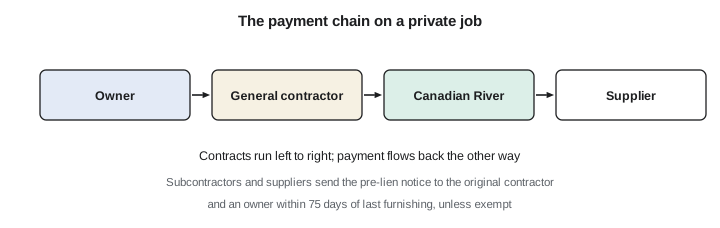
Section 142.6 adds a step for subcontractors and suppliers. A claimant other than the original contractor must send a written pre-lien notice to the original contractor and to an owner of the property before filing a lien statement and no later than 75 days after the claimant last furnished materials, services, labor or equipment. The notice must say it is a pre-lien notice and must include the claimant's name, address and phone number, the date of supply, a description of what was furnished, the name and address of the party who ordered it, the property's address or legal description, the amount furnished or to be furnished, and the claimant's signature.
The statute says how to send it. A notice sent by certified mail with return receipt requested, by hand delivery with a delivery confirmation, or by an automated transaction the statute allows creates a presumption that the notice was given, and certified mail is effective on the mailing date. If the claimant asks the original contractor in writing for the owner's name and address and the contractor does not answer within five days, the requirement to notify the owner cannot be enforced against the claimant. One notice per project covers later deliveries.
Failing to send the notice is costly. The statute says the part of the lien claim for which no notice was sent is invalid and unenforceable. When the claimant files the lien statement, it must also give the county clerk a notarized affidavit that it complied with the notice requirement, and a false affidavit is a crime.
| Rule | Pre-lien notice under Section 142.6 |
|---|---|
| Who sends it | Claimants other than the original contractor |
| Deadline | Before filing the lien statement and within 75 days after last furnishing |
| To whom | The original contractor and an owner of the property |
| Exempt | Aggregate claims under 10,000 dollars; residential projects of four or fewer units with no owner occupant; retainage held by agreement |
| If not sent | That part of the lien claim is invalid and unenforceable |
| At filing | A notarized affidavit of compliance to the county clerk |
Exemptions and owner-occupied homes
The statute exempts some claims from the pre-lien notice. A claimant whose aggregate claim is less than 10,000 dollars does not need to send it. No notice is needed for retainage held by agreement. Claimants on a residential project of four or fewer units are exempt, but only if no unit is occupied by an owner. If an owner lives in the home, the exemption does not apply, and a lien on a property occupied as a dwelling by an owner is invalid unless the notice was sent within 75 days of the last furnishing.
That owner-occupied rule matters for Canadian River's residential service department. On a whole-house rewire for a homeowner in Moore, Canadian River is usually the original contractor, so the pre-lien notice section does not apply to it. But if Canadian River ever works as a subcontractor to a remodeler on a home the owner lives in, it must send the notice within 75 days of its last work regardless of the claim's size, or it will have no lien at all.
from datetime import date, timedelta

last_work = date(2026, 9, 19)
role = "subcontractor"
claim = 38_000
owner_occupied = False

prelien_due = last_work + timedelta(days=75)
print("last furnishing:", last_work)
if role == "subcontractor":
    needs_notice = claim >= 10_000 or owner_occupied
    print("pre-lien notice required:", needs_notice)
    if needs_notice:
        print("  pre-lien notice due by:", prelien_due)
    print("lien statement due by:", last_work + timedelta(days=90))
else:
print("original contractor: lien statement within four months of last furnishing")last furnishing: 2026-09-19 pre-lien notice required: True pre-lien notice due by: 2026-12-03 lien statement due by: 2026-12-18
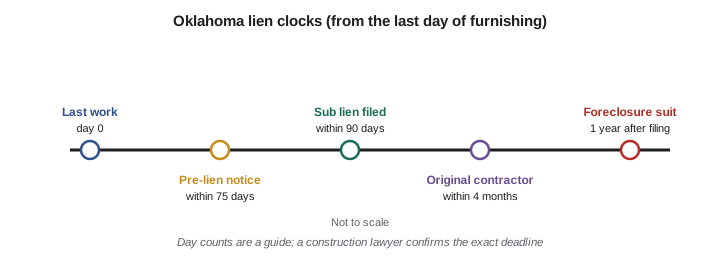
For the church job, the pre-lien notice was due within 75 days of September 19 and Canadian River had sent it on October 3, well inside the window. The lien statement was due within 90 days of September 19, which falls in mid-December. Day counting has traps, such as weekends, holidays and arguments over what counts as the last day of work, so Canadian River's lawyer confirmed the deadline and filed the statement with the Cleveland County clerk a week early.
Enforcing the lien
Filing a lien statement does not by itself produce payment. If the debt is not paid, the claimant must bring a lawsuit to foreclose the lien within the time the statute allows, which lien specialists summarize as one year from the date the lien statement was filed. If the claimant does not sue in time, the lien expires. The owner can also take steps to shorten or release the lien, such as posting a bond to release it, so a claimant should watch for notices from the owner or the county clerk.
In practice many liens are resolved without a full lawsuit. A filed lien clouds the owner's title, which makes refinancing or selling difficult, and lenders often hold back draws until liens are cleared. For the church, the filed lien prompted the building committee to review its records, and it discovered that the builder had been paid but had not passed the money down. The church's lawyer, the builder and Canadian River's lawyer worked out a payment within six weeks.
Lien waivers
Owners and general contractors often require lien waivers with each payment. A partial waiver releases lien rights for the amount paid through a stated date. A final waiver releases all rights once final payment is made. Read each waiver before signing. A waiver that releases rights for the full contract amount when only part has been paid, or a waiver signed before the check clears, can give away the only security the contractor has. Canadian River signs conditional waivers that take effect only when payment is actually received.
Public projects and payment bonds
Liens generally cannot be filed against public property such as public schools, state buildings and city facilities. Instead, Oklahoma's public works law requires the prime contractor on a public construction contract above a stated amount, which lien specialists list as 50,000 dollars, to furnish a payment bond that protects subcontractors and suppliers. A claimant who is not paid makes a claim against the bond. Specialists summarize the claim notice deadline as 90 days after the claimant's last furnishing for claimants who did not contract with the prime contractor, and the time to sue on the bond as one year. Check the current statute and the bond's own terms before relying on any of these figures.
Worked problem
A residential subcontract
Canadian River works as a subcontractor to a remodeler on a house the owner lives in. Its claim is 6,500 dollars, and its last work was on March 2. Does it need a pre-lien notice, and by when?
Show solution
- The under-10,000-dollar exemption is in the statute, but the owner-occupied rule is separate.
- A lien on a property occupied as a dwelling by an owner is invalid unless the notice was sent within 75 days of last furnishing.
- The safe course is to send the notice anyway.
- Seventy-five days after March 2 falls in mid-May.
Answer: Send the pre-lien notice within 75 days of March 2, by mid-May, to protect the lien on an owner-occupied home.
Keeping lien rights alive day to day
Most lien problems come from missed dates, not from complicated law. Canadian River's office keeps, for every job, the owner's name and address, the legal description or parcel number, the general contractor's name, the date of first work, the date of each delivery and the last day of work. When a job finishes, Patty marks the 75-day and 90-day dates on the calendar for subcontract work and the four-month date for owner contracts. She sends pre-lien notices as a routine on every subcontract job above the exemption threshold, not just on troubled ones.
Retainage needs its own attention. Many contracts hold back part of each payment until the job is finished, and retainage can be the largest single amount a subcontractor is owed at the end of a job. The pre-lien notice section excludes retainage held by agreement, but the lien statement still has to be filed on time to protect it, and the contract terms decide when retainage is due. Read the retainage clause before signing and track the release date as carefully as the lien dates.
Common mistakes
MistakeStarting extra work without a written change order.
InsteadGet written authorization first; it supports both payment and any lien.
MistakeWaiting past 75 days to send the pre-lien notice.
InsteadThe part of the claim with no notice is invalid and unenforceable.
MistakeAssuming a filed lien produces payment on its own.
InsteadThe claimant must sue to foreclose within the statutory period.
MistakeTrying to lien a public school.
InsteadPublic projects use payment bonds; claim against the bond.
Summary and key terms
- Original contractors generally file within four months of last furnishing; subcontractors and suppliers generally within 90 days.
- Claimants other than the original contractor send a pre-lien notice to the original contractor and an owner within 75 days of last furnishing.
- Claims under 10,000 dollars and some residential projects are exempt, but not when an owner occupies the home.
- A lien must be enforced by lawsuit within the statutory period, summarized as one year from filing.
- Public projects above a stated amount use payment bonds instead of liens.
- Original contractor
- A contractor who contracts directly with the owner.
- Pre-lien notice
- The notice under Section 142.6 that most subcontractors and suppliers must send.
- Lien statement
- The verified claim filed with the county clerk.
- Lien waiver
- A document releasing lien rights for a payment or for the whole job.
- Payment bond
- A bond that protects subcontractors and suppliers on public work.
Practice problems
Work each problem on paper first, then reveal the answer to check.
Within how many days after last furnishing must a subcontractor send the pre-lien notice?
Show answer
75 days.
To whom is the pre-lien notice sent?
Show answer
The original contractor and an owner of the property.
Which claims are exempt from the pre-lien notice?
Show answer
Aggregate claims under 10,000 dollars, retainage held by agreement and residential projects of four or fewer units with no owner occupant.
What replaces lien rights on a public school project?
Show answer
The prime contractor's payment bond.
Lesson quiz · 5 questions
Score 60% or more to complete this lesson.
Create a free account to save your progress, take quizzes and earn a certificate.