
MELU-311 · Lesson 8 of 12 · 19 min
Contractor licensing, insurance and bonding
▶ Video coming soon A video version of this lesson is on the way.
Canadian River's insurance agent, Mitch Ellery, came by the shop in late November with a folder of renewals and a question. "When Renee becomes your contractor," he asked Dale, "do you want me to reissue the bond and the certificate now or the day you retire?" Dale turned to Renee. "You tell him," he said. "From April on, if the bond lapses or the certificate falls off the Board's file, the license goes inactive, and every permit we pull is in trouble. You need to know these papers as well as you know the code."
This lesson covers the financial requirements that keep an Oklahoma electrical contractor license active: the license bond, general liability insurance, the workers' compensation requirement, what happens when any of them lapses, the employee exception, the special rules for some categories and how they relate to city requirements. It also covers the insurance and bonds that owners and general contractors ask for beyond the state minimum.
The license bond
Each active electrical contractor must furnish a license bond in the amount of 5,000 dollars. The bond is a continuous surety bond, filed with the Board's bonds and insurance unit, and it stays in force until canceled. The surety must give the Board 30 days' notice before canceling it. The bond guarantees that the contractor will perform electrical work in Oklahoma faithfully and lawfully, and the Board can use it to collect unpaid penalty orders and court fines for violating city ordinances.
A surety bond is not insurance for the contractor. If the surety pays a claim on the bond, it will expect the contractor to repay it, usually under an indemnity agreement the owners signed when the bond was issued. A contractor who lets claims reach the bond will find it harder and more expensive to get a bond later. The bond also replaces any license bond a city might otherwise require; the Electrical License Act says the Board sets bond and insurance requirements that take the place of municipal ones.
General liability insurance
Each active contractor must also carry a comprehensive general liability policy that covers manufacturers' and contractors' operations, completed operations and independent contractors. The rule sets the minimum limit at 50,000 dollars combined single limit for bodily injury and property damage. The Board must be listed as a certificate holder, not as an additional insured, at no extra cost, so that it receives notice if the policy is canceled or lapses for nonpayment.
Fifty thousand dollars is a minimum for licensing, not a sensible amount for real work. A single electrical fire in a commercial building can cause damage many times that figure. Owners, general contractors and public agencies routinely require much higher limits, often a million dollars per occurrence and two million in the aggregate, plus umbrella coverage, and they may require the contractor to name them as additional insureds. Canadian River carries limits well above the state minimum because its customers demand it.
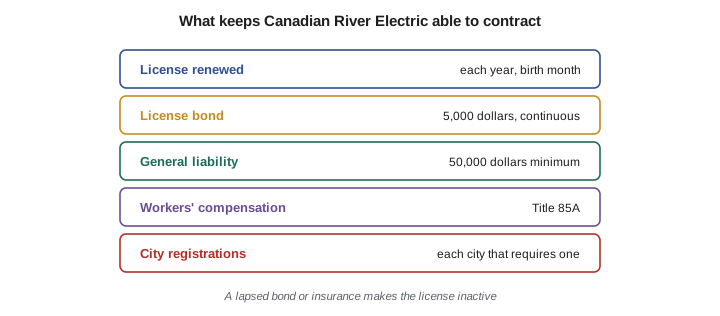
| Requirement | Minimum in the Board's rules | Notes |
|---|---|---|
| License bond | 5,000 dollars, continuous | 30 days' notice to the Board before cancellation |
| General liability | 50,000 dollars combined single limit | Board listed as certificate holder |
| Workers' compensation | Comply with Titles 85 and 85A | Indicate compliance on the application |
| Lapse | License becomes inactive | Until the requirement is met again |
When something lapses
The rule is blunt: if the bond and insurance information is missing or incomplete, or the coverage lapses, the license becomes inactive until the requirements are met. An inactive contractor may not offer electrical services to the public. That means a lapse affects every job the firm is running, not just the one that triggered the problem. A canceled insurance policy because a premium payment bounced can stop permits across several cities the same week.
Patty's defense is a calendar. She tracks the bond, the liability policy and the workers' compensation policy expiration dates, asks Mitch for renewals sixty days ahead and checks the CIB's online license lookup after each renewal to confirm the license still shows as active. Lesson 11 builds the full calendar.
from datetime import date

today = date(2026, 11, 10)
items = {
    "license bond (continuous)": None,
    "general liability policy": date(2027, 2, 1),
    "workers' compensation policy": date(2027, 2, 1),
    "umbrella policy": date(2027, 2, 1),
    "City of Norman registration": date(2026, 12, 31),
}

for name, expires in items.items():
    if expires is None:
        print(f"{name}: in force until canceled (surety gives 30 days' notice)")
        continue
    days = (expires - today).days
    flag = "REQUEST RENEWAL NOW" if days <= 60 else "ok"
print(f"{name}: expires {expires} ({days} days) {flag}")license bond (continuous): in force until canceled (surety gives 30 days' notice) general liability policy: expires 2027-02-01 (83 days) ok workers' compensation policy: expires 2027-02-01 (83 days) ok umbrella policy: expires 2027-02-01 (83 days) ok City of Norman registration: expires 2026-12-31 (51 days) REQUEST RENEWAL NOW
The employee exception
The rule includes an exception for contractors who work only for their employer. An employee of a corporation, partnership or public entity can have the bond and insurance waived if the employer files an affidavit stating that the employee will do electrical work only on the employer's own property and that the employer assumes all financial responsibility for the work. The Board must be told if the employee leaves or the employer withdraws. This exception is meant for plant electricians, school district electricians and similar in-house roles, not for contracting firms.
Special categories
The Act and the rules set different figures for a few special categories. The Act provides for a poultry house electrical contractor license for work on poultry houses, with a higher liability insurance figure stated in the Act. Other categories have their own conditions in the rules. A candidate for the Business and Law exam should be able to find these figures quickly in the Act and the rules, because questions may ask about a category other than the one the candidate is seeking.
Workers' compensation
Oklahoma's workers' compensation law is the Administrative Workers' Compensation Act in Title 85A of the Oklahoma Statutes, administered by the Workers' Compensation Commission. The Act requires most employers with employees to secure compensation for them, either by buying insurance or by qualifying to self-insure, and it lists narrow exemptions. The Board's rule asks every contractor to know the requirements of Titles 85 and 85A and to state compliance on the license application.
Under the Act, an injured employee generally must give the employer notice of a single-event injury within 30 days, and a claim for compensation is generally barred if it is not filed within one year of the injury, with different periods for occupational disease and death claims. The employer must report injuries as the Commission's rules require and must post notice of its coverage. A firm that fails to secure coverage can face penalties and can lose the protection the Act gives employers against being sued by injured workers.
The Act also makes prime contractors responsible for their subcontractors' coverage. If a subcontractor fails to secure compensation, the prime contractor is liable to the subcontractor's employees, unless an intermediate subcontractor has coverage. That is why general contractors demand a certificate of workers' compensation from Canadian River before it sets foot on a job, and why Canadian River demands the same from any low-voltage or trenching subcontractor it hires.
Oklahoma passed a law in 2013 that allowed some employers to opt out of the workers' compensation system and provide their own benefit plans. The Oklahoma Supreme Court struck down the opt-out law in 2016, so employers are back to the standard choice of insurance or approved self-insurance. Questions on the history occasionally appear in study materials, but the rule for a contractor today is simple: cover every employee.
Worked problem
Who pays for an uninsured subcontractor's injured worker?
Canadian River hires a small trenching company to dig a service trench. The trenching company has no workers' compensation coverage, and one of its employees is injured in the trench. Who may be liable for the worker's compensation benefits?
Show solution
- Under Title 85A, if a subcontractor fails to secure compensation, the prime contractor is liable to the subcontractor's employees.
- Canadian River is the contractor that hired the trenching company, so it stands in the prime contractor's position for that work.
- No intermediate subcontractor with coverage stands between them.
- Canadian River's own workers' compensation policy may respond, and its premium audit will count the uninsured subcontractor's payroll.
Answer: Canadian River may be liable; always collect a current certificate before a subcontractor starts.
Beyond the state minimum
Real projects ask for more than the Board does. Owners and general contractors commonly require commercial auto insurance, umbrella or excess liability coverage, additional insured endorsements, waivers of subrogation and primary and noncontributory wording. Larger private jobs and most public jobs require performance and payment bonds, which are separate from the 5,000-dollar license bond; Lesson 9 covers payment bonds on public work. A contractor's surety will look at the firm's financial statements and work in progress before it agrees to provide those bonds, so the firm's finances shape which jobs it can bid.
Working with the insurance agent and the surety
A contractor should know the firm's agent and surety underwriter by name. The agent places the liability, auto, umbrella and workers' compensation policies, issues certificates of insurance and adds endorsements that customers require. The surety underwriter decides how much bonding capacity the firm has for performance and payment bonds, based on its financial statements, work in progress, experience and character. Both want to hear about changes early: a new contractor, a big new job, a large claim or a change in ownership.
When Renee becomes contractor, Mitch will issue a new certificate naming the Board as certificate holder and showing the firm's current policies, and the surety will issue a rider to the 5,000-dollar license bond if the bond needs to reflect the change. Patty will send both to the Board's bonds and insurance staff and then check the online lookup until the license shows as active under Renee.
Certificates from others
Canadian River also collects certificates. Before any subcontractor starts work, Patty asks for a certificate showing current general liability, auto and workers' compensation coverage, with Canadian River named as an additional insured where the subcontract requires it. She tracks the expiration dates of those certificates and asks for new ones before they lapse. A subcontractor whose workers' compensation lapses in the middle of a job can leave Canadian River exposed under the statutory rule described earlier, and the firm's own insurer will charge premium for the uninsured payroll at audit.
Premium audits and classifications
Workers' compensation and general liability premiums are usually based on payroll and job classifications. At the end of each policy year the insurer audits the firm's records to set the final premium. Electricians are classified differently from office staff, and misclassifying workers can lead to large adjustments. Uninsured subcontractors' payroll can be added to the firm's own payroll at audit. Clean records, current certificates and correct classifications keep the audit predictable.
The office also keeps copies of the bond and every certificate it sends, with the date it went out and to whom. When a general contractor or the Board says it never received a certificate, Patty can resend it in minutes and show when the original was sent. That habit has saved more than one permit appointment over the years.
Common mistakes
MistakeTreating the 50,000-dollar insurance minimum as enough coverage.
InsteadIt is a licensing minimum; customers usually require far higher limits.
MistakeListing the Board as an additional insured.
InsteadThe rule asks for the Board as certificate holder, not additional insured.
MistakeAssuming a lapse affects only the job that caused it.
InsteadA lapse makes the license inactive, which stops all contracting.
MistakeHiring a subcontractor without a workers' compensation certificate.
InsteadThe prime contractor can be liable to an uninsured subcontractor's employees.
Summary and key terms
- Each active electrical contractor must furnish a continuous 5,000-dollar license bond.
- General liability coverage must be at least 50,000 dollars combined single limit, with the Board as certificate holder.
- Missing or lapsed bond or insurance makes the license inactive.
- Title 85A requires most employers to secure workers' compensation; prime contractors can be liable for uninsured subcontractors' employees.
- The Board's bond and insurance requirements replace municipal ones, but customers often require much more.
- License bond
- The 5,000-dollar continuous surety bond each active contractor files with the Board.
- Certificate holder
- A party that receives notice of cancellation; the Board must be one.
- Combined single limit
- One limit that covers both bodily injury and property damage.
- Title 85A
- The Administrative Workers' Compensation Act.
- Employee exception
- The waiver of bond and insurance for an employee who works only on the employer's property.
Practice problems
Work each problem on paper first, then reveal the answer to check.
What is the amount of the license bond?
Show answer
5,000 dollars.
What is the minimum general liability limit?
Show answer
50,000 dollars combined single limit for bodily injury and property damage.
What happens if the insurance lapses?
Show answer
The license becomes inactive until coverage is restored.
Who may be liable for an uninsured subcontractor's injured employee?
Show answer
The prime contractor, unless an intermediate subcontractor has coverage.
Lesson quiz · 5 questions
Score 60% or more to complete this lesson.
Create a free account to save your progress, take quizzes and earn a certificate.