
MELU-311 · Lesson 12 of 12 · 19 min
Practice exam review and test-day strategy
▶ Video coming soon A video version of this lesson is on the way.
Three weeks before her Business and Law exam, Renee took a full timed practice test at the kitchen table on a Saturday morning: 50 questions, 120 minutes, her tabbed binder and the NASCLA guide, a basic calculator and nothing else. She scored 31 correct out of 50, below the passing line. She was frustrated for about an hour. Then she sat down with Hector and went through every miss. Eleven of the nineteen misses were questions she could have answered if she had found the right page faster. Four were topics she had never studied. Four were careless. "That's good news," Hector said. "Eleven of them are a tabbing problem, and you can fix a tabbing problem in a week."
This lesson turns everything in the course into an exam plan. It covers building a study schedule from the bulletin, using timed practice tests to find weak areas, sorting misses by cause, tabbing and indexing the references, pacing, a routine for each question, what to do the day before and the morning of the exam, and how to use a score report if a retake is needed.
Start from the bulletin
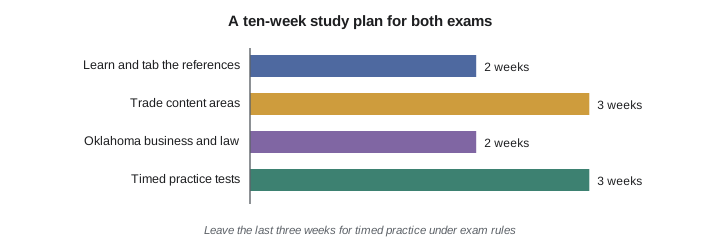
The bulletin is the best map of the exam. It lists each exam's content areas and the approximate number of questions in each, and it lists the references. A good study plan gives each content area time in proportion to its share of the questions and to the candidate's weakness in it. For the Business and Law exam, Renee's plan gave the most time to the Oklahoma-specific references, which she had never used, and less to estimating and project management, which she had done for years. For the Unlimited Contractor exam, she gave the most time to calculations and special occupancies, where she was rusty, and less to wiring methods she used every day.
Tabbing and indexing
Open-book exams reward candidates who can find things quickly. Permanent tabs on the NEC should mark the articles that come up most often: the general requirements, branch circuits, feeders and services, load calculations, overcurrent protection, grounding and bonding, wiring methods, conductor ampacity, boxes and raceway fill, motors, transformers and the special occupancies. The binder of Oklahoma references needs its own tabs: the Act by section, the rules by subchapter, the fine schedule, the lien sections including the pre-lien notice, and the workers' compensation excerpts.
Highlighting and indexing are allowed, so use them. Many candidates highlight key words in the NEC index and in the Act's section headings, and some make a one-page index of where common answers live. Remember the bulletin's limits: no handwritten notes in the references, no temporary tabs and no loose papers. Renee was tempted to carry a printed page of section numbers, then remembered that loose papers are not allowed, so she put that effort into clearer tabs and highlighted index entries instead. When in doubt, ask PSI before exam day.
Timed practice tests
A practice test is a measuring tool, not a study tool. Take it under exam conditions: the same references, the same calculator, the full time and no interruptions. Then spend at least as long reviewing it as you spent taking it. Each miss belongs in one of four groups: a lookup problem, where you knew the topic but could not find the answer in time; a knowledge gap, where you did not know the topic; a reading error, where you misread the question; and a pacing problem, where you ran out of time. Each group has a different fix.
| Cause of miss | What it looks like | Fix |
|---|---|---|
| Lookup | Knew the topic, could not find it in time | More tabs, better index, lookup drills |
| Knowledge gap | Did not know the topic | Study the content area and rework examples |
| Reading error | Missed a word such as not, except or minimum | Underline key words on the scratch paper; reread before answering |
| Pacing | Ran out of time with questions unanswered | Checkpoints, skip and return, never leave blanks |
misses = ["lookup"] * 11 + ["gap"] * 4 + ["reading"] * 4
score, total = 31, 50
fixes = {"lookup": "tab and drill the references", "gap": "study the topic",
         "reading": "slow down on key words", "pacing": "use checkpoints"}

print(f"score: {score}/{total}, about {round(total * 0.7)} needed")
counts = {}
for m in misses:
    counts[m] = counts.get(m, 0) + 1
for cause, n in sorted(counts.items(), key=lambda kv: -kv[1]):
    print(f"{cause:8} {n:2}  -> {fixes[cause]}")
recoverable = counts.get("lookup", 0) + counts.get("reading", 0)
print("score if lookup and reading misses are fixed:", score + recoverable)score: 31/50, about 35 needed lookup 11 -> tab and drill the references gap 4 -> study the topic reading 4 -> slow down on key words score if lookup and reading misses are fixed: 46
The numbers told Renee where to spend her last three weeks. Fixing lookup and reading misses alone would have moved her score from 31 to 46, well over the line. She spent the next week drilling lookups: Hector read questions aloud and timed how long she took to find each answer. Her second practice test scored 41 and her third 44.
Pacing
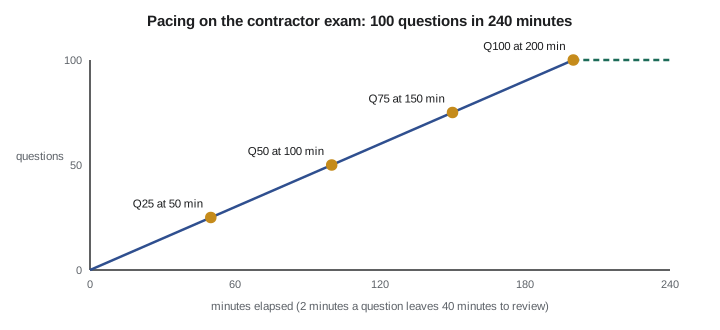
Both exams allow an average of 2.4 minutes a question. A pacing plan sets checkpoints so you know whether you are on track. On the Unlimited Contractor exam, 100 questions in 240 minutes, a candidate who answers at about two minutes a question will reach question 25 at about 50 minutes, question 50 at about 100 minutes and question 100 at about 200 minutes, leaving 40 minutes to return to marked questions. On the Business and Law exam, 50 questions in 120 minutes, the same pace reaches question 25 at about 50 minutes and question 50 at about 100 minutes, leaving 20 minutes to review.
A routine for each question
A routine keeps you from losing time on any single question. Read the question once, all the way through, and note the key words: the occupancy, the voltage, the conductor material, words such as not, except, minimum and maximum. Decide whether you know the answer, know where to find it or need to skip. If you know it, answer and move on. If you know where to find it, look it up, but if the lookup takes more than about three minutes, pick your best answer, mark the question and move on. If you have no idea, make your best guess, mark it and move on. Never leave a question blank; an unanswered question is always wrong.
Calculation questions deserve a short written setup on the scratch material PSI provides. Write the knowns, the formula or the rule you are applying, and the units. That setup catches most arithmetic errors and makes it faster to recheck the question during review.
The day before and the morning of
Do not cram the night before. Check that every reference meets the bulletin's rules: permanent tabs only, no handwriting, no loose papers, statutes bound. Pack the references, the calculator, your identification and the exam confirmation. Know the route to the test center and how long the drive takes, and plan to arrive early. Renee's test center was in Oklahoma City, forty minutes from her house, and she left an hour and a quarter before her check-in time.
On the morning of the exam, eat something, bring water if the center allows it in the waiting area, and use the tutorial before the clock starts to settle in. During the exam, check your pace at each checkpoint. If you fall behind, speed up on questions you can answer quickly, and save long lookups for the review time.
If you need a retake
A failing score report shows performance by content area. Compare it with your practice test analysis. If the weak areas match what you already knew, follow the same fixes with more time. If they surprise you, take another full practice test and sort the misses again. Remember the 30-day wait before a retake and the new fee. Many good contractors passed on the second try; the score report is how they did it.
Renee passed the Business and Law exam on her first attempt with a comfortable margin, and three weeks later she passed the Unlimited Contractor exam. She called Dale from the test center parking lot. "Now we do the paperwork," he said, and laughed. "And then you get to worry about everything I've been worrying about for thirty-two years."
Worked problem
Setting checkpoints
A candidate takes the Business and Law exam, 50 questions in 120 minutes, and wants to leave 20 minutes for review. What average pace is needed, and where should the checkpoints fall at questions 10, 25 and 40?
Show solution
- Leaving 20 minutes means answering 50 questions in 100 minutes.
- That is 2 minutes a question.
- Question 10 by 20 minutes, question 25 by 50 minutes and question 40 by 80 minutes.
- All 50 by 100 minutes, then 20 minutes to review marked questions.
Answer: Two minutes a question, with checkpoints at 20, 50 and 80 minutes.
Studying with a full-time job
Renee studied while running crews full time. She set a fixed schedule: an hour each weekday evening, three hours on Saturday mornings and Sunday off. On weekday evenings she worked through one content area at a time, reading the relevant parts of the reference and doing timed lookups. Saturday mornings were for longer practice sets and, in the last three weeks, full timed tests. She told the foremen about the schedule so they would not call her about tomorrow's work during study time unless something was urgent.
She also studied in small pieces during the day. She kept a short list of questions on her phone, mostly about the Oklahoma references, and looked up one or two at lunch. Hector quizzed her on lien deadlines and fine amounts while they drove between jobs. Small repetitions like these are what make figures such as 75 days, 5,000 dollars and twelve hours stick.
Common business and law question types
The Business and Law exam mixes Oklahoma law questions with general business questions. The Oklahoma questions usually ask for a specific figure or rule: a bond amount, an insurance minimum, a deadline, a fine, a license term or who has jurisdiction. Those are lookup questions, and good tabs answer them quickly. The general business questions often involve a short calculation: markup and margin, break-even, payroll taxes, depreciation, retainage, interest or a simple schedule. Practice those with the NASCLA guide's examples until the setup is automatic.
On the trade exam, the calculation questions take the most time. Load calculations, voltage drop, motor branch circuits and conductor adjustments each have a routine. Write the setup on the scratch material, keep the units, and check whether the question asks for the minimum size, the maximum rating or the number of conductors. A correct calculation answering the wrong question is still a miss.
Finally, keep the references after the exam. The same tabbed Act, rules, lien law and workers' compensation excerpts that helped Renee pass became the start of the office's reference shelf. She updated them as the laws changed and used them to answer questions from foremen and customers. The exam is a single day, but the knowledge it tests is what a contractor uses every week.
Renee also wrote a short note to herself after each exam: what went well, what surprised her and what she would tell a future candidate. A year later she gave that note to one of Canadian River's journeymen who had started preparing for the contractor exams.
Common mistakes
MistakeUsing practice tests only to see the score.
InsteadSort every miss by cause and fix each cause differently.
MistakeSpending ten minutes on one hard lookup.
InsteadAfter about three minutes, answer, mark and move on.
MistakeLeaving questions blank.
InsteadUnanswered questions are always wrong; guess and mark.
MistakeBringing a loose page of notes.
InsteadThe bulletin bans loose papers; bind any allowed index into the reference.
Summary and key terms
- Build the study plan from the bulletin's content areas and references.
- Tab the NEC and the Oklahoma references with permanent tabs and use highlighting and indexing.
- Take timed practice tests and sort misses into lookup, knowledge, reading and pacing problems.
- At about two minutes a question, both exams leave time to review marked questions.
- Never leave a blank; use a score report and the 30-day wait to plan any retake.
- Checkpoint
- A planned question number and time used to check pacing.
- Lookup miss
- A wrong answer caused by not finding the reference in time.
- Mark for review
- A test feature that lets you return to a question later.
- Score report
- PSI's report showing performance by content area.
- Lookup drill
- Practice finding answers in the references against the clock.
Practice problems
Work each problem on paper first, then reveal the answer to check.
What is the average time per question on both Oklahoma contractor exams?
Show answer
2.4 minutes.
What are the four causes of a practice miss?
Show answer
Lookup, knowledge gap, reading error and pacing.
How long should you spend on a hard lookup before moving on?
Show answer
About three minutes, then answer, mark and move on.
What does a failing score report show?
Show answer
Performance by content area, to guide study for a retake.
Lesson quiz · 5 questions
Score 60% or more to complete this lesson.
Create a free account to save your progress, take quizzes and earn a certificate.