
MELU-311 · Lesson 1 of 12 · 19 min
How electrical licensing works in Oklahoma
▶ Video coming soon A video version of this lesson is on the way.
Dale Whitfield started Canadian River Electric in 1994 with a used bucket truck, a borrowed shop in south Norman and an electrical contractor license he had earned the year before. Thirty-two years later the company owns a metal building off State Highway 9, employs fourteen electricians and apprentices, and keeps an office manager named Patty Sloan and an estimator named Hector Vance busy with dental clinics, churches, small shop buildings, school additions and residential service calls from Moore down to Purcell. On a hot afternoon in August, Dale called his lead journeyman, Renee Castillo, into the office. "I turn sixty-seven in March," he said. "The Construction Industries Board knows me as the contractor for this firm. When I retire, Canadian River needs somebody with an unlimited contractor license who is an owner here and can stand behind the work. I want that to be you, and I want to sell you a share of the company to make it happen." He handed her a printout of the Board's electrical page and the PSI candidate bulletin.
Renee registered as an apprentice in 2011, earned her unlimited journeyman license in 2016 and has run Canadian River's commercial crews since 2020. She has already studied the master-level material on the National Electrical Code, load calculations, grounding and bonding, motors and special occupancies. This course applies that preparation to Oklahoma: which state agency licenses electrical work, what the contractor license requires, how the PSI exams and their open-book references work, which NEC edition is enforced, how permits and inspections are split between cities and the state, and the Oklahoma law on bonds, insurance, liens, workplace safety, renewal and continuing education that a contractor needs to know.
One state board for the trades
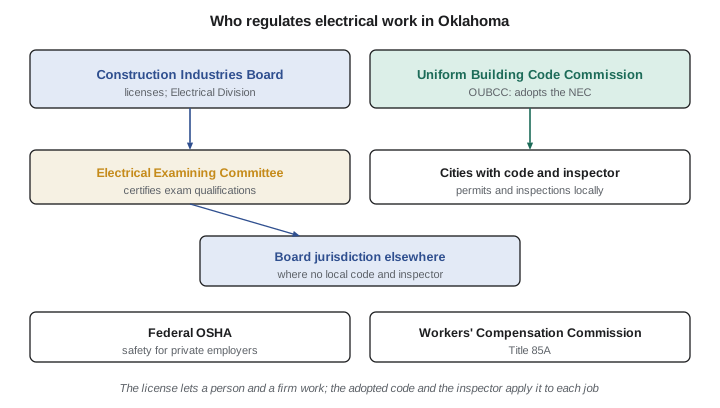
Oklahoma licenses electrical workers through a single state agency, the Construction Industries Board, usually shortened to CIB. The CIB also licenses plumbers, mechanical contractors, elevator workers and inspectors, and it has an Electrical Division that handles electrical licensing, compliance and state inspections. The law that sets up electrical licensing is the Electrical License Act, found in Title 59 of the Oklahoma Statutes starting at Section 1680. The Act says that no one may engage in electrical work in the state without the right license or registration, and it gives the Board power to write rules, examine applicants, issue and renew licenses and discipline people who break the law.
Inside the Act there is also an Electrical Examining Committee. The Committee is a group of people from the industry who advise the Board on the electrical trade, review qualifications and certify that applicants have passed the required examinations. When the Act says the Board shall issue a license to anyone "certified by the Committee" as having passed the exam, it is describing this split: the Committee looks at the trade qualifications and the Board issues the license and handles enforcement. In day-to-day practice you deal with the CIB staff, the PSI testing company and, after you are licensed, the CIB's bond and insurance staff.
A license for the person and for the firm
Unlike states that license only the business, Oklahoma licenses individuals by skill level and then ties the contractor license to a firm. The Act and the Board's rules describe a ladder. An apprentice registers with the Board and works under supervision while gaining hours. A journeyman electrician holds a license to perform electrical work under a contractor. A contractor holds a license to contract for electrical work with the public and is responsible for the work of the firm. The Act also has a temporary journeyman license for use during declared emergencies and an alarm endorsement, and the Board's rules list categories inside each level.
The main categories you will meet are unlimited, limited and residential. An unlimited electrical contractor may contract for any electrical work the Act covers, from a kitchen circuit to a hospital switchboard. A limited electrical contractor qualifies mainly through engineering education or long experience in estimating and design, and the rules say a limited contractor may not do the work of a journeyman, perform field work or supervise field work. A residential contractor or journeyman is limited to residential occupancies as the rules define them. There are also refinery journeyman categories for work inside petroleum refineries. This course is about the unlimited electrical contractor license, which is the one Renee needs, but the exam questions often ask what the other categories can and cannot do.
The contractor license has a second layer. The Board's rules say each electrical firm must have a licensed electrical contractor who is an officer, partner or owner of the firm and who works full time supervising its electrical work. That is why Dale offered Renee a share of the company and not just a raise. A contractor may represent only one firm. When firms join forces on a project, each needs its own licensed contractor. Lesson 7 covers these duties, and Lesson 8 covers the bond and insurance that make a contractor license active.
| Level | What it allows | Key limits |
|---|---|---|
| Apprentice registration | Electrical work while learning | Works under licensed supervision; renews every year |
| Journeyman license (unlimited, residential or refinery) | Performs electrical work | Works for a licensed contractor; cannot contract with the public |
| Limited electrical contractor | Contracts and runs an electrical firm | May not perform or supervise field work |
| Unlimited electrical contractor | Contracts for electrical work of any size or type | Needs a bond and insurance to be active; one firm only |
What the Act covers and what it leaves out
The Act defines electrical work broadly. It covers installing, altering, repairing and maintaining wiring and equipment that carries electrical energy in or on buildings and structures. It also lists exemptions. Work by a utility on its own system, certain work by employees on the property of their employer, work on low-voltage Class 2 and Class 3 circuits as the Act describes them, and some other narrow categories are outside the license requirement. Each exemption has conditions, and a person who claims one carries the burden of showing it applies. A homeowner exemption also exists for some work on a single-family home the owner lives in, but the city may still require a permit and inspection.
Renee's first reaction was that the exemptions did not matter much to a company like Canadian River, and for licensing she is right: everything the company does is licensed work. The exemptions matter in a different way. A building owner who hires an unlicensed handyman to add circuits in a retail space, or a sign company that wires its own sign service, can create a code problem that Canadian River later inherits. Knowing where the line falls helps a contractor explain to a customer why the earlier work failed inspection and why it has to be redone by a licensed firm.
Who adopts the code
The license says who may do the work. A different body decides what the installation has to look like. The Oklahoma Uniform Building Code Commission, usually called the OUBCC, adopts building codes for the state, including the National Electrical Code. Its adoptions take effect through the state's administrative rules process, and the Commission has in the past published Oklahoma amendments to the NEC along with an adoption. Lesson 5 covers the current edition, the effective dates and how to check for amendments.
The Electrical License Act points to codes as well. It says a city or other political subdivision that has adopted a nationally recognized electrical code and appointed an electrical inspector has jurisdiction over electrical work and code interpretation inside its limits. Where a political subdivision has not done that, the Board has jurisdiction. That split is the subject of Lesson 6, and it explains why Canadian River deals with the City of Norman's inspectors on most jobs but has to think harder about a shop building out in the county.
Renee's map of the work
Renee started by mapping the company's current jobs against these layers. For each job she wrote down the type of work, which license category covers it, whether a local inspector has jurisdiction and whether the company had registered with that city. Two jobs stood out. The metal shop building east of Lake Thunderbird sits in unincorporated Cleveland County, so she needed to find out who inspects it. The warehouse in Purcell was in a town where Canadian River had never worked, so the company had to register there before pulling a permit.
| Job | Location | License category needed | Likely inspection authority | Local registration |
|---|---|---|---|---|
| Residential service upgrade | Moore | Residential or unlimited | City of Moore | Already registered |
| Dental clinic fit-out | Norman | Unlimited | City of Norman | Already registered |
| Church fellowship hall | Noble | Unlimited | City of Noble | Already registered |
| Metal shop building | Unincorporated Cleveland County | Unlimited | Check the county, then the Board | Not applicable |
| Warehouse | Purcell | Unlimited | City of Purcell | Must register first |
jobs = [
    ("Service upgrade", "Moore", "city", True),
    ("Dental clinic", "Norman", "city", True),
    ("Fellowship hall", "Noble", "city", True),
    ("Shop building", "Cleveland County", "county", None),
    ("Warehouse", "Purcell", "city", False),
]

for name, place, kind, registered in jobs:
    if kind == "city":
        authority = f"City of {place} inspector"
        reg = "registered" if registered else "REGISTER BEFORE PERMIT"
    else:
        authority = "ask the county; if no code and inspector, the Board"
        reg = "no city registration"
    print(f"{name} ({place})")
    print(f"  inspection: {authority}")
print(f" local status: {reg}")Service upgrade (Moore) inspection: City of Moore inspector local status: registered Dental clinic (Norman) inspection: City of Norman inspector local status: registered Fellowship hall (Noble) inspection: City of Noble inspector local status: registered Shop building (Cleveland County) inspection: ask the county; if no code and inspector, the Board local status: no city registration Warehouse (Purcell) inspection: City of Purcell inspector local status: REGISTER BEFORE PERMIT
The script answers two questions Renee will ask on every bid once she is the contractor: who has jurisdiction over this address, and is the firm registered there? In Oklahoma the Act requires a licensed contractor to register with each city that requires registration before working there, and the Act says the Board's bond and insurance requirements take the place of any a city might otherwise set. A contractor who skips the registration step can lose days waiting for a permit on a job the company has already scheduled.
Layers of law
It helps to keep the layers of Oklahoma law straight. The Electrical License Act and the Board's rules govern who may do and contract for electrical work, and what bond and insurance a contractor must carry. The OUBCC adoptions govern which code edition applies. City ordinances govern permits, fees and inspection procedures where a city has its own inspector. The lien law in Title 42 governs payment security. The workers' compensation law in Title 85A governs the company's duty to cover its employees, and federal OSHA standards govern site safety for private employers. A contractor does not need to be a lawyer, but needs to know which layer a question belongs to and which office answers it.
That map also tells you who to call. A question about whether a lapsed insurance certificate made the license inactive goes to the CIB's insurance staff. A question about whether a circuit needs ground-fault protection goes to the inspector for that address. A question about whether you can still file a lien goes to a construction lawyer, quickly, because the deadlines are short. A question about whether an apprentice's registration is current goes to the CIB's license lookup.
Penalties sit behind all of this. The Act makes most violations a misdemeanor with a fine in the hundreds to a thousand dollars, and it lets the Board impose administrative fines after a hearing, with each day of a continuing violation counted separately. The Act also says a license is not transferable and that lending your license to someone else is a crime. Dale made sure Renee read that line twice. The license Canadian River works under is personal to the contractor, and it is the contractor's name the Board will look at first when something goes wrong.
Common mistakes
MistakeAssuming Oklahoma only licenses the business, as some states do.
InsteadOklahoma licenses individuals as apprentices, journeymen and contractors, and the contractor must be an owner, partner or officer of the firm.
MistakeTreating a limited contractor license as a step up from journeyman.
InsteadA limited contractor may not perform or supervise field work; it is a different path, mainly for engineers and estimators.
MistakeAssuming the state inspects every job.
InsteadA city that has adopted a code and appointed an inspector has jurisdiction inside its limits; the Board has jurisdiction where no such inspector exists.
MistakeLending a license to a friend's company to help it pull a permit.
InsteadLicenses are not transferable, and lending one is a misdemeanor under the Act.
Summary and key terms
- The Construction Industries Board licenses electrical work in Oklahoma under the Electrical License Act in Title 59.
- The Electrical Examining Committee certifies exam qualifications, and the Board issues and enforces licenses.
- The license levels are apprentice, journeyman and contractor, with unlimited, limited, residential and refinery categories.
- Each electrical firm needs a licensed contractor who is an owner, partner or officer and supervises its work full time.
- The OUBCC adopts the NEC, cities with inspectors enforce it locally and the Board covers areas without a local inspector.
- Construction Industries Board
- The state agency that licenses electrical, plumbing, mechanical and other trades in Oklahoma.
- Electrical License Act
- The statute in Title 59, beginning at Section 1680, that governs electrical licensing.
- Electrical Examining Committee
- The industry committee that advises the Board and certifies that applicants passed the exams.
- Unlimited electrical contractor
- The license that allows a person to contract for electrical work of any size or type.
- OUBCC
- The Oklahoma Uniform Building Code Commission, which adopts the NEC and other codes for the state.
Practice problems
Work each problem on paper first, then reveal the answer to check.
Which agency issues electrical contractor licenses in Oklahoma?
Show answer
The Construction Industries Board.
Why did Dale offer Renee a share of the company?
Show answer
The Board's rules require the firm's contractor to be an officer, partner or owner of the firm.
Who has jurisdiction over a job in a city that adopted a code and appointed an inspector?
Show answer
The city, through its electrical inspector.
May a limited electrical contractor supervise field work?
Show answer
No. The rules prohibit a limited contractor from performing or supervising field work.
Lesson quiz · 5 questions
Score 60% or more to complete this lesson.
Create a free account to save your progress, take quizzes and earn a certificate.