
MELU-311 · Lesson 6 of 12 · 19 min
Permits, inspections and the inspection authority
▶ Video coming soon A video version of this lesson is on the way.
The metal shop building east of Lake Thunderbird was a simple job on paper: a 60-by-100-foot steel building for a welding and fabrication business, a 400-ampere three-phase service, lighting, welder receptacles and a small office. The owner, Travis Beal, had bought the land in unincorporated Cleveland County because it was outside the city. When Renee asked him who had issued his building permit, he looked surprised. "Nobody," he said. "There's no permit out here. That's the point." Renee knew that might be true for the building, but she also knew the Electrical License Act does not stop at city limits. Before Canadian River set a pole, she needed to know who had jurisdiction over the electrical work.
This lesson explains how the Electrical License Act divides inspection authority between cities and the Board, how to find the right authority for an address, what a permit application involves, how a typical inspection sequence runs, what happens when an inspection fails, how the utility release works and how disputes are handled. It ends with Renee's answer for the shop building.
The jurisdiction rule
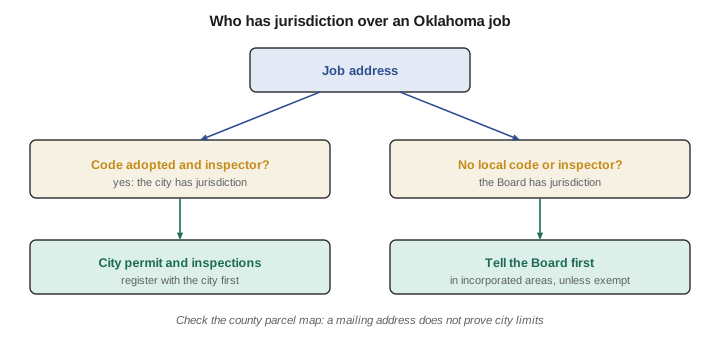
The Electrical License Act sets out a simple test. A city, town or other political subdivision that has adopted a nationally recognized electrical code and appointed an electrical inspector has jurisdiction over code interpretation and electrical work within its borders. Inside that city, the city's inspector reviews plans, issues permits, inspects the work and decides code questions, subject to the state's inspector licensing law. Where a political subdivision has not adopted a code and appointed an inspector, the Board has jurisdiction.
The Act adds a notice rule. Before anyone covered by the Act installs, modifies or alters electrical facilities in an incorporated area that does not have a qualifying local code and inspector, they must give the Board notice. The Act exempts routine maintenance and the replacement of existing appliances or fixtures from that notice requirement, along with work at petroleum refineries and their research facilities. The Board can enforce the notice rule.
The Act also gives the state an emergency role inside cities. Even where a city has jurisdiction, a state inspector may work directly with licensees when a code violation creates an immediate threat to life or health. That is rare, but it means a dangerous installation does not escape attention just because a city's inspector has not seen it yet.
City permits and city inspectors
The Act also speaks directly to city permits. It says no electrical work may be done in a city that requires a permit unless the permit has been obtained, and it sets a qualification for city electrical inspectors: they must have the experience the Act describes, which the published text states as three years in the electrical trade, and they are licensed under the state's inspector law. That combination means the person who inspects Canadian River's work in Norman is a qualified electrician with a state inspector license, working under a city ordinance that adopts the code.
Most of Canadian River's work is inside cities with full building departments. In Norman, Moore and Oklahoma City, permits are applied for online, plan review is required for most commercial work, and inspections are requested through the same portal. Smaller towns such as Noble and Purcell may handle permits at the city hall counter and use a part-time inspector or a contracted inspection service. Both kinds of city have jurisdiction under the Act, as long as they have adopted a code and appointed an inspector.
| Situation | Who has jurisdiction | What the contractor does |
|---|---|---|
| City adopted a code and appointed an inspector | The city | Register, pull the city permit, call the city for inspections |
| Incorporated town with no code or no inspector | The Board | Give the Board notice before starting; follow the Board's process |
| Unincorporated county area | Check the county; if it has no code and inspector, the Board | Ask the county and the CIB before starting |
| Immediate threat to life or health in a city | City, with the state able to act | Correct the hazard at once |
Finding the authority for an address
Addresses can mislead. A Norman mailing address does not mean the property is inside the Norman city limits, and a property can sit inside a town whose name does not appear in the address at all. Renee's routine is to look up the parcel on the county assessor's map, which shows whether a parcel is inside an incorporated city, and then check that city's building department page. If the parcel is outside any city, she calls the county and the CIB.
For the shop building, the assessor's map showed the parcel outside Norman's limits in unincorporated Cleveland County. Renee called the county, which confirmed it did not issue electrical permits or employ an electrical inspector for that area. She then called the CIB's Electrical Division, explained the job and asked what the Board required. The Board has jurisdiction in areas without a local code and inspector, and its staff explained how it handles inspection requests and complaints in those areas.
The permit application
Inside a city, the permit application asks for the job address, the owner, the contractor's state license and city registration, a description of the work, the size of the service and, for commercial work, a set of plans. Many cities require a load calculation for a new service or a service change, a one-line diagram for larger services and the panel schedules. Fees are usually based on the value of the work or on a count of circuits and devices. The contractor signs the application, and the permit is issued in the contractor's name.
Plan review is where many problems get solved before they reach the field. A city plans examiner may ask for a revised load calculation, a change to the grounding electrode system or a different location for the service disconnect. The earlier those comments come back, the cheaper they are to fix. Canadian River submits commercial plans as soon as the drawings are final, even if the start date is weeks away.
A typical inspection sequence
Most cities follow a similar sequence. A temporary power inspection may come first if the job needs a construction pole. An underground inspection checks conduits, conductors and burial depth before trenches are backfilled, and a footing or ufer inspection may check the concrete-encased electrode before the pour. A rough-in inspection checks boxes, raceways, cables and supports before walls and ceilings are covered. A service inspection checks the service equipment, grounding and bonding before the utility connects. A final inspection checks devices, fixtures, labeling, equipment and working space when the job is complete.
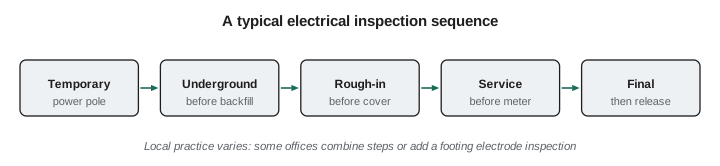
Inspection requests usually need a day's notice or more, and the inspector may arrive in a window rather than at a set time. The job must be ready when the inspector arrives. If a rough-in inspection is called and the crew is still pulling wire, the inspector may fail it and charge a reinspection fee. Renee's foremen use a short checklist before every call, and she reviews it on commercial jobs.
sequence = ["temporary power", "underground", "rough-in", "service", "final"]
results = {"temporary power": "pass", "underground": "pass",
           "rough-in": "fail", "service": None, "final": None}
REINSPECT_FEE = 75

fees = 0
for step in sequence:
    r = results[step]
    if r is None:
        print(f"{step}: not yet called")
        break
    print(f"{step}: {r}")
    if r == "fail":
        fees += REINSPECT_FEE
        print("  correct the items, then call a reinspection")
        print("  do not cover the work until it passes")
        break
print("reinspection fees so far:", fees, "dollars (illustrative)")temporary power: pass underground: pass rough-in: fail correct the items, then call a reinspection do not cover the work until it passes reinspection fees so far: 75 dollars (illustrative)
Failed inspections and disputes
A failed inspection comes with a correction notice that lists the items and usually the code section the inspector relies on. The contractor corrects the items and calls for a reinspection, often with a fee. Work that has not passed may not be covered. If the contractor disagrees with a call, the first step is a polite conversation with the inspector, asking for the specific section and the reasoning. If that does not settle it, most cities have a chief electrical inspector or building official who can review the decision, and a board of appeals for code interpretation.
Where the Board has jurisdiction, the Board's own process applies. The Act gives the Board power to hold hearings and issue orders, and its rules describe how complaints and appeals are handled. In either setting, keep the discussion about the code, document it in writing and correct any real hazard right away while the disagreement is resolved.
The utility release
The electric utility will not set a meter on a new or changed service until the inspection authority releases it. Inside a city, the city sends the release to the utility after the service or final inspection passes. In areas under the Board's jurisdiction, the utility may have its own process for confirming that the installation is safe to energize. The utilities that serve Canadian River's area publish service requirements that cover meter locations, service entrance details and clearances, and those requirements apply alongside the code. Read them before you set the meter base.
Worked problem
Who inspects the shop building?
A steel shop building with a new 400-ampere three-phase service is in unincorporated Cleveland County. The county does not issue electrical permits or employ an electrical inspector for the area. Who has jurisdiction, and what should the contractor do before starting?
Show solution
- Under the Act, a political subdivision has jurisdiction only if it has adopted a code and appointed an inspector.
- The county has neither for this area, so the Board has jurisdiction.
- The contractor contacts the CIB's Electrical Division and follows its process for inspection or notice.
- The contractor also checks the utility's service requirements, because the utility must agree before it energizes the service.
Answer: The Board has jurisdiction. Contact the CIB before starting, follow its process and coordinate the service with the utility.
Renee wrote to Travis Beal explaining that the electrical work would be done under the Board's jurisdiction, that Canadian River would follow the Board's process and the utility's requirements, and that the price included the time to do so. Travis was not thrilled about the extra step, but he signed, and the job went ahead.
Working in Oklahoma City and other large cities
Large cities run full building departments with separate electrical plans examiners and inspectors, online permit and inspection systems, and their own published fee schedules and procedures. Canadian River's work in Oklahoma City follows the same pattern as in Norman, but on a larger scale: plan review for every commercial job, inspections requested through the city's portal and correction notices posted online. Renee makes sure each foreman can log in and see the inspection results for the jobs they run, so nobody waits for a phone call to find out whether a rough-in passed.
Keep the permit card on site where the inspector can see it, and keep the approved plans with it. An inspector who cannot find the permit or the approved drawings may refuse to inspect, and the reinspection that follows costs the same as a failure. Canadian River's foremen put both in a weatherproof sleeve at the panel location on the first day of work.
Common mistakes
MistakeAssuming no city permit means no inspection authority.
InsteadWhere no local code and inspector exist, the Board has jurisdiction.
MistakeTrusting the mailing address to identify the city.
InsteadCheck the county assessor's parcel map, then the city.
MistakeCovering work after a failed rough-in.
InsteadCorrect the items and pass the reinspection before covering anything.
MistakeArguing a code call in the field without the section.
InsteadAsk for the section, document the discussion and use the appeal process.
Summary and key terms
- A political subdivision that has adopted a code and appointed an inspector has jurisdiction inside its borders.
- Where no such code and inspector exist, the Board has jurisdiction.
- In an incorporated area without a qualifying code and inspector, give the Board notice before starting work, unless an exemption applies.
- City inspectors must meet the Act's experience requirement and hold a state inspector license.
- A typical sequence runs temporary power, underground, rough-in, service and final, followed by the utility release.
- Jurisdiction
- The authority to issue permits, inspect and interpret the code for an address.
- Correction notice
- The list of items an inspector requires to be fixed after a failed inspection.
- Reinspection
- A second inspection after corrections, often with a fee.
- Utility release
- The inspection authority's notice that lets the utility energize a service.
- Parcel map
- The county assessor's map that shows whether a property is inside a city.
Practice problems
Work each problem on paper first, then reveal the answer to check.
When does a city have jurisdiction over electrical work under the Act?
Show answer
When it has adopted a nationally recognized electrical code and appointed an electrical inspector.
Who has jurisdiction where a political subdivision has no code and inspector?
Show answer
The Board.
What must be done before electrical work in an incorporated area with no qualifying code and inspector?
Show answer
Give the Board notice, unless the work is exempt maintenance or replacement.
May work be covered after a failed rough-in inspection?
Show answer
No. It must pass the reinspection first.
Lesson quiz · 5 questions
Score 60% or more to complete this lesson.
Create a free account to save your progress, take quizzes and earn a certificate.