
MELU-311 · Lesson 11 of 12 · 19 min
Renewal and continuing education
▶ Video coming soon A video version of this lesson is on the way.
On the morning she received her contractor license, Renee asked Patty a question she had never thought about as a journeyman. "When does this one expire?" Patty turned the certificate over and pointed to the date. "Your birth month," she said. "Same as your journeyman license used to. Every year, and the Board won't renew it unless your continuing education is current and the bond and insurance are on file. Dale nearly lost his in 2009 because a renewal letter went to an old address." Renee put a reminder in her phone for sixty days before the end of March and asked Patty to show her the Board's renewal form.
This lesson covers how Oklahoma electrical licenses are renewed: the license term, the birth-month expiration, the grace period, late renewal and reinstatement, the continuing education requirement that took effect on January 1, 2026, the exemption for newly licensed people, what counts as approved education, apprentice reregistration and how to keep every credential in a single calendar.
The license term
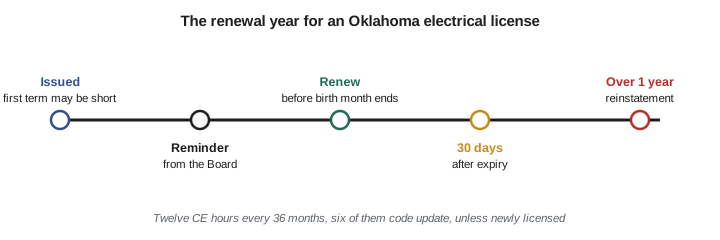
The Electrical License Act says no license may be issued for longer than one year, and that licenses expire on the last day of the licensee's birth month. A license issued in December to someone born in March will expire the following March, so the first term can be shorter than a year. After that, the license renews every year in the birth month. The same rule applies to journeyman and contractor licenses, and it means a firm's licensed people have expiration dates spread across the year.
The CIB's electrical page describes journeyman renewal on a 36-month cycle in its overview of license types, while the Act itself still sets a one-year maximum term. The two are easier to reconcile than they look: the 36-month figure is the continuing education period, described below. A licensee should follow the expiration date printed on the license and the renewal notice from the Board, and should ask the CIB if anything looks inconsistent.
Grace period, late renewal and reinstatement
The Act allows renewal within a window around the expiration date, which the published text describes as thirty days before or after. A license renewed more than thirty days after expiration may be renewed only by paying all fees and any late penalty the Board sets, along with meeting the continuing education requirement. A license that stays expired for more than a year cannot be renewed at all and must be reinstated under the Board's rules, which can involve more paperwork and, in some cases, retesting.
For a contractor, the grace window is not a license to keep working. An expired contractor license cannot be used to contract or pull permits, and a city permit counter that checks the CIB's license lookup will refuse a permit while the license shows as expired. Canadian River treats the expiration date as the real deadline and renews well before it.
Continuing education from 2026
Section 1688.1 of the Act, effective January 1, 2026, sets the continuing education requirement. Contractors and journeymen must complete twelve hours of continuing education every three years, or in the thirty-six months before license renewal. The CIB's page explains that six of those hours must be code update courses on the codes adopted by the OUBCC and their revisions, and the remaining six may cover other electrical topics such as wiring methods, grounding and bonding and NFPA 70E electrical safety. Apprentices must complete three hours of continuing education each year before they reregister, with an exemption for students in approved programs.
The Act also says the Board will not renew a journeyman or contractor license unless the licensee has completed the required hours. In other words, the education is a condition of renewal, not a separate obligation tracked on its own schedule. A licensee should complete the hours before submitting the renewal application.
| Licensee | Hours | Period | Content |
|---|---|---|---|
| Contractor | 12 | Every 36 months before renewal | 6 code update hours, 6 other approved hours |
| Journeyman | 12 | Every 36 months before renewal | 6 code update hours, 6 other approved hours |
| Apprentice | 3 | Every year before reregistering | Approved apprentice courses; students in approved programs exempt |
The new-license exemption
The Act exempts licensees from the continuing education requirement for renewal for three years after they pass their current licensing exam. Renee passed the contractor exams in November 2026, so she will not need continuing education hours to renew the contractor license until three years have passed. She plans to take the hours anyway, starting with a code update course on the next NEC edition when Oklahoma adopts it, because the exemption runs out on a fixed date and the hours have to be in place by then.
from datetime import date

exam_passed = date(2026, 11, 14)
birth_month = 3
exempt_until = date(exam_passed.year + 3, exam_passed.month, exam_passed.day)

for year in range(2027, 2032):
    expires = date(year, birth_month, 31)
    needs_ce = expires > exempt_until
    print(f"renewal for March {year}: {'12 hours in prior 36 months' if needs_ce else 'exempt (new license)'}")
print("exemption ends:", exempt_until)renewal for March 2027: exempt (new license) renewal for March 2028: exempt (new license) renewal for March 2029: exempt (new license) renewal for March 2030: 12 hours in prior 36 months renewal for March 2031: 12 hours in prior 36 months exemption ends: 2029-11-14
The script shows the first renewal that needs hours is March 2030, and those hours must have been completed in the thirty-six months before that renewal. If Renee takes four hours a year from 2027, she will be ready without a last-minute rush.
Approved courses
Hours count only if the course is approved by the Board. The CIB publishes a list of approved continuing education providers and courses on its continuing education page, and it uses course codes to show which requirement a course meets: an E code for code update courses, an EO code for other electrical courses and an EA code for apprentice courses. Providers report completions to the Board, but licensees should keep their own certificates in case of a question at renewal.
Canadian River sponsors an in-house code update course each year with an approved provider, so every licensed person in the company can complete code update hours together. Renee has also signed up for an approved NFPA 70E course to count toward the other hours.
What else is checked at renewal
A contractor's renewal is more than a form and a fee. The Board checks that the bond and insurance are on file and current, that any fines have been paid and that the licensee is not under an order that blocks renewal. The renewal form may also ask about criminal convictions and discipline in other states since the last renewal. A contractor whose insurance certificate has lapsed will find that the license shows as inactive even if the renewal itself is paid.
Apprentice reregistration
Apprentice registrations cover a twelve-month period. A new application is due each year, signed by the licensed contractor or an approved school or training instructor, along with proof of the three hours of continuing education unless the apprentice is exempt as a student. Because apprentices cannot work on electrical installations with a lapsed registration, the contractor has a strong interest in tracking those dates, as Lesson 7 described.
One calendar for everything
Patty keeps a single calendar for every credential the company depends on: each licensed person's birth month and expiration, each apprentice's registration date, each person's continuing education hours and exemption date, the bond, the liability, auto, umbrella and workers' compensation policies, each city registration and the company's own business filings. She reviews it on the first business day of each month. Renee added one more line when she became the contractor: the date of the next OUBCC electrical committee meeting, so she would know early when a new NEC edition was coming.
Worked problem
Planning hours for a journeyman
A journeyman passed the exam five years ago and renews each June. The next renewal is in June 2027. In the last thirty-six months the journeyman completed four code update hours and five other approved hours. What is still needed?
Show solution
- The exam was five years ago, so the three-year new-license exemption ended two years ago and hours are required.
- Twelve hours are needed, six of them code update.
- The journeyman has four code update hours and needs two more.
- The journeyman has five other hours and needs one more, or could take three more code update hours instead to reach twelve.
Answer: At least two more code update hours and one more approved hour, for twelve in total with six code update.
Changes between renewals
Renewal is also a good moment to check the information the Board has on file. The rules require changes to be reported within 30 days when they happen, but renewal is when mistakes tend to surface: an old address, a firm name that changed, an insurance certificate that the Board never received. Patty compares the renewal notice with the firm's records each year and corrects anything that does not match before she submits the renewal.
A licensed staff with many dates
A firm with fourteen licensed people has fourteen birth months. Canadian River's licensed journeymen renew on their own schedules, and each one is responsible for their own renewal and continuing education. The firm helps by sponsoring courses and keeping the roster, but it cannot renew someone else's license for them. Renee made it a condition of every journeyman's annual review that their license and hours were current, and she reminded the foremen that a journeyman with an expired license may not do electrical work for the firm.
Continuing education as a business tool
Continuing education is a requirement, but it can also be useful. Code update courses help the estimators and foremen understand changes before they show up on drawings or in correction notices. NFPA 70E courses refresh the safety program. Some approved courses cover business topics that help a new contractor manage risk. Renee planned her hours around what the firm needed to learn in the coming year, not just around the hours the Act requires.
She also kept a simple record for herself: the date, the provider, the course title, the course code and the hours for every course, with a scanned copy of each certificate. If the Board ever asks during an audit of continuing education, she will not have to reconstruct three years of training from memory.
Finally, renewal is a reminder to look at the firm as a whole. Each year when her own license renews, Renee plans to read the current Act, rules and fine schedule again, check the OUBCC page for any new adoption, review the firm's insurance limits with Mitch and ask whether the firm's safety program still matches its work. The renewal form takes ten minutes. The review takes an afternoon, and it is the part that keeps the firm out of trouble in the year ahead.
She also asked the CIB how it announces rule changes and made a habit of checking those announcements each quarter. Rules can change between renewals, and a contractor who learns of a change at renewal may already have been out of compliance for months.
Common mistakes
MistakeTreating the grace window as extra time to work on an expired license.
InsteadRenew before the end of the birth month; an expired license cannot be used to contract.
MistakeTaking any electrical course for continuing education.
InsteadOnly Board-approved courses count; check the course code.
MistakeForgetting the six code update hours.
InsteadSix of the twelve hours must be code update courses.
MistakeLetting the license stay expired for more than a year.
InsteadAfter a year expired, the license must be reinstated, not renewed.
Summary and key terms
- Electrical licenses are issued for no more than one year and expire on the last day of the birth month.
- Renewal more than thirty days after expiration needs fees and any late penalty; after a year, reinstatement is required.
- From January 1, 2026, contractors and journeymen need twelve hours every thirty-six months, six of them code update.
- Apprentices need three hours each year before reregistering.
- New licensees are exempt from continuing education for three years after passing their current exam.
- Birth month
- The month a license expires each year.
- Late renewal
- Renewal more than thirty days after expiration, with fees and penalty.
- Reinstatement
- The process required for a license expired more than a year.
- Code update course
- An approved course on the adopted codes and their revisions, shown with an E code.
- New-license exemption
- Three years without continuing education after passing the current exam.
Practice problems
Work each problem on paper first, then reveal the answer to check.
When does an Oklahoma electrical license expire?
Show answer
On the last day of the licensee's birth month.
How many continuing education hours do contractors need, and over what period?
Show answer
Twelve hours every thirty-six months, six of them code update.
How many hours do apprentices need each year?
Show answer
Three.
What happens to a license expired for more than a year?
Show answer
It cannot be renewed and must be reinstated.
Lesson quiz · 5 questions
Score 60% or more to complete this lesson.
Create a free account to save your progress, take quizzes and earn a certificate.