
MELU-311 · Lesson 7 of 12 · 19 min
Duties and responsibilities of the Electrical Contractor License holder
▶ Video coming soon A video version of this lesson is on the way.
In early November, a call came in that Dale had been dreading for years. A former Canadian River apprentice, now running his own small crew, asked whether Dale would "just pull the permit" for a restaurant job in Moore. "You're registered there and I'm not licensed as a contractor yet," the young man said. "I'll do the work right. You'd just be on the paperwork." Dale said no, politely and firmly, and then sat down with Renee to explain why. "When you're the contractor," he said, "every permit with your name on it is yours. If somebody else does the work and something goes wrong, it's your license, your bond and your name on the hearing notice."
This lesson covers the duties that come with an Oklahoma electrical contractor license: who the contractor must be in relation to the firm, the supervision duty, the one-firm rule, joint ventures, reporting changes to the Board, using and protecting the license, apprentice and journeyman supervision, record keeping, conduct that leads to discipline and the penalties the Act provides. It ends with the habits that keep a contractor out of trouble.
The contractor and the firm
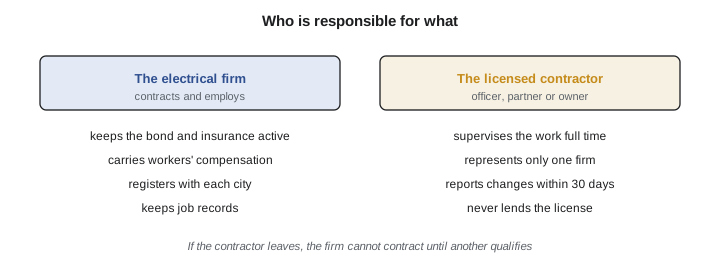
The Board's rules say each electrical firm must have a licensed electrical contractor who is employed full time in supervising the firm's electrical work, and that the contractor must be an officer, partner or owner of the firm. The contractor is responsible for the electrical work of the firm and is licensed on the firm's behalf. This rule ties the person who passed the exams to the business that signs the contracts. A firm cannot simply rent a license from a retired contractor who never visits the jobs.
Full-time supervision does not mean the contractor must stand on every job site every hour. It means the contractor's job is running the firm's electrical work: planning installations, assigning qualified people, checking that work meets the code, dealing with inspectors and correcting problems. On a large job, a licensed journeyman foreman runs the crew day to day, and the contractor visits, reviews and answers for the result. Renee had done the foreman part for years. The new part was answering for all of it.
One firm at a time
The rules also say an electrical contractor may represent only one electrical firm. That stops a single license from being spread across several companies. If Renee becomes Canadian River's contractor, she cannot also serve as the contractor for her brother-in-law's company, even part time. When two firms team up on a project, the rules say each firm must have its own licensed electrical contractor, and each must register with the city where registration is required. A joint venture cannot borrow one partner's license to cover the other.
Reporting changes
The rules require each electrical contractor to advise the Board's electrical license unit in writing within 30 days of any change in the information on file, such as the firm's name, address, ownership or the contractor's own employment. Failing to report a change can lead to administrative sanctions. When Dale retires and Renee takes his place, both changes have to reach the Board on time: Dale's departure from the firm and Renee's start as its contractor. Patty also planned to notify the bond surety and the insurance agent the same day, because the bond and the insurance certificate name the contractor and the firm.
Changes also matter at the city level. Each city registration lists the contractor. If the registration still shows Dale after he leaves, a permit clerk may refuse a new permit until the record is updated. Lesson 3 described Patty's list of registrations; this is when she uses it.
| Change | Who to tell | When |
|---|---|---|
| Contractor leaves the firm | The Board, the surety, the insurer, each city | Within 30 days for the Board; at once for the others |
| New contractor for the firm | The Board, the surety, the insurer, each city | Before contracting under the new contractor |
| Firm name or address changes | The Board and each city | Within 30 days |
| Insurance lapses or is canceled | The Board receives notice as certificate holder | The license becomes inactive until fixed |
Using and protecting the license
The Act says licenses are not transferable and that lending a license to another person is a misdemeanor. Pulling a permit for work someone else will do, letting an unlicensed company use your name or license number on a bid, or signing an inspection request for a job your firm is not running are all ways of lending a license. They expose the contractor to criminal penalties, Board discipline and claims against the firm's bond. Dale's answer to the former apprentice was the only safe one.
Protecting the license also means keeping it visible and accurate. Cities and owners often ask for the license number on bids, contracts, permits and vehicles. Some cities require it on signs or trucks. The contractor should make sure every use of the number is for the firm's own work.
Supervising journeymen and apprentices
The Act requires anyone doing electrical work to hold the right license or registration. A licensed journeyman may perform electrical work for a licensed contractor. A registered apprentice may do electrical work only under the supervision the rules describe, usually the direct supervision of a licensed journeyman or contractor, and the contractor should check the current rules for any limit on how many apprentices one licensed person may supervise. The contractor is responsible for staffing jobs so those rules are met and for checking that every apprentice's registration is current, since apprentice registrations renew each year.
Canadian River keeps a simple roster with each worker's license or registration number, category and expiration date. Patty checks it monthly. When an apprentice's registration is about to lapse, the apprentice and the foreman both get a reminder. An apprentice with a lapsed registration is not allowed to work on electrical installations until it is renewed, and the firm can be cited for letting them.
from datetime import date

roster = [
    ("Renee Castillo", "journeyman, unlimited", date(2027, 3, 31)),
    ("Luis Ortega", "journeyman, unlimited", date(2027, 7, 31)),
    ("Kayla Dunn", "apprentice", date(2026, 11, 30)),
    ("Ben Harjo", "apprentice", date(2026, 12, 31)),
    ("Sam Pruitt", "apprentice", date(2026, 10, 31)),
]
today = date(2026, 11, 10)

for name, kind, expires in roster:
    days = (expires - today).days
    if days < 0:
        status = "LAPSED - keep off electrical work until renewed"
    elif days <= 45:
        status = f"renew soon ({days} days)"
    else:
        status = "current"
print(f"{name:15} {kind:22} {status}")Renee Castillo journeyman, unlimited current Luis Ortega journeyman, unlimited current Kayla Dunn apprentice renew soon (20 days) Ben Harjo apprentice current Sam Pruitt apprentice LAPSED - keep off electrical work until renewed
Records
A contractor should keep records that show who did what, where and when: permits, inspection results, plans and revisions, change orders, daily reports, time sheets and material invoices. The Board can ask for records during a complaint investigation, and lien claims, warranty disputes and insurance claims all depend on them. Keep them for at least as long as the lien and contract claim periods run, and longer for larger jobs.
Discipline and penalties
The Act and the Board's rules list conduct that can lead to discipline. Typical examples include doing or contracting for electrical work without the proper license, lending a license, working without a required permit, failing to correct code violations, working while the bond or insurance has lapsed, fraud or false statements on an application, and failing to pay a fine or comply with a Board order. The Board can deny, suspend or revoke a license, and it can impose administrative fines.
The Act sets two kinds of monetary penalty. A criminal conviction for violating the Act is a misdemeanor punishable by a fine of not less than 200 dollars and not more than 1,000 dollars, plus costs. After a hearing, the Board can impose an administrative fine of up to 500 dollars per violation, with each day of a continuing violation counted as a separate violation, and the Act caps the administrative fine at 1,000 dollars. The Board's fine schedule in Title 158, Chapter 10 lists the fine for common violations, and it is a reference on the Business and Law exam.
The rules also say the Board may collect unpaid fines and penalty orders, and fines imposed by courts for violating city ordinances, through the contractor's surety bond. A contractor who ignores a fine does not make it go away. The surety pays, then comes back to the contractor for the money, and the bond may be canceled, which makes the license inactive.
Worked problem
A permit for someone else's crew
A licensed contractor pulls a permit in his firm's name for a restaurant, but the work is done by an unlicensed crew that the contractor does not employ or supervise. An inspection finds serious violations. What exposure does the contractor have?
Show solution
- Pulling the permit for another crew's work is effectively lending the license, a misdemeanor under the Act.
- The Board can open a complaint, hold a hearing and impose administrative fines and discipline.
- The violations are on the contractor's permit, so the contractor must correct them.
- Unpaid fines can be collected through the contractor's bond.
Answer: Criminal, administrative and financial exposure; the only safe answer is not to pull the permit.
Supervision in practice
Renee wrote down what full-time supervision would mean for her week as contractor. On Mondays she would review the schedule with the foremen and assign licensed journeymen to each job. Each week she would visit every active commercial job at least once, look at the work before major inspections and review correction notices with the foreman who received them. She would sign off on every permit application, every energized work permit and every change order over a set amount. Once a month she would review the license and registration roster with Patty. None of that is written in the rules in those words, but it is how a contractor shows that the firm's electrical work is under real supervision.
She also decided which decisions she would not delegate. Whether to take a job outside the firm's experience, whether to accept a contract with unusual risk transfer, whether to work in an area under the Board's jurisdiction and whether to dispute an inspector's call all belong to the contractor. Foremen bring the facts, and the contractor decides.
When the contractor leaves
Every firm should have a plan for the day its contractor leaves, whether by retirement, illness or a change of job. Without a licensed contractor who is an officer, partner or owner, the firm cannot contract for electrical work. Canadian River's plan is the one this course follows: identify a successor years ahead, help that person qualify, bring them into the ownership and overlap long enough to transfer the relationships with inspectors, customers, the surety and the insurer. Firms that wait until the contractor is gone often find that no one on staff meets the experience rule or can pass the exams in time.
Common mistakes
MistakeServing as contractor for two related companies.
InsteadA contractor may represent only one firm.
MistakePulling a permit as a favor for an unlicensed crew.
InsteadThat is lending the license, a misdemeanor, and the violations land on the contractor.
MistakeWaiting until renewal to report a change of address or ownership.
InsteadReport changes to the Board within 30 days.
MistakeLetting an apprentice work with a lapsed registration.
InsteadCheck registrations monthly; a lapsed apprentice may not do electrical work.
Summary and key terms
- The firm's contractor must be an officer, partner or owner employed full time supervising its electrical work.
- A contractor may represent only one firm, and each firm in a joint venture needs its own contractor.
- Changes in the information on file must be reported to the Board within 30 days.
- Licenses are not transferable, and lending one is a misdemeanor.
- Criminal fines run from 200 to 1,000 dollars; administrative fines are up to 500 dollars per violation, capped at 1,000 dollars, and can be collected through the bond.
- Full-time supervision
- The contractor's duty to run and answer for the firm's electrical work.
- One-firm rule
- The rule that a contractor may represent only one electrical firm.
- Lending a license
- Allowing someone else to use your license for work you do not run; a misdemeanor.
- Fine schedule
- The Board's list of fines for common violations in Title 158, Chapter 10.
- Administrative fine
- A fine imposed by the Board after a hearing.
Practice problems
Work each problem on paper first, then reveal the answer to check.
Who must the firm's contractor be in relation to the firm?
Show answer
An officer, partner or owner employed full time supervising its electrical work.
Within how many days must a change be reported to the Board?
Show answer
30 days.
What is the range of the criminal fine for violating the Act?
Show answer
Not less than 200 dollars and not more than 1,000 dollars, plus costs.
How can the Board collect an unpaid fine?
Show answer
Through the contractor's surety bond.
Lesson quiz · 5 questions
Score 60% or more to complete this lesson.
Create a free account to save your progress, take quizzes and earn a certificate.