
MELU-311 · Lesson 10 of 12 · 19 min
Workplace safety law and OSHA for electrical contractors
▶ Video coming soon A video version of this lesson is on the way.
In January, a compliance officer from the federal OSHA area office in Oklahoma City stopped at a school addition in Moore where Canadian River had a crew pulling feeders. The officer was there because of a complaint about the general contractor's scaffolding, but while walking the site she looked at the electrical work too: the temporary power, the ground-fault protection on the cords, the ladders and the lockout on a panel that had been energized the week before. Everything Canadian River controlled was in order. Renee, who was on site that morning, watched the inspection closely. As contractor, she would be the person who answered for every one of those things.
This lesson covers workplace safety law for an Oklahoma electrical contractor: who enforces safety rules for private and public employers, the OSHA construction standards that matter most for electrical work, the employer's training and program duties, injury reporting deadlines, the multi-employer rules on construction sites, NFPA 70E and the electrically safe work condition, and the excavation notice law. It connects to the OSHA Part 1926 reference on the trade exam.
Who enforces safety in Oklahoma
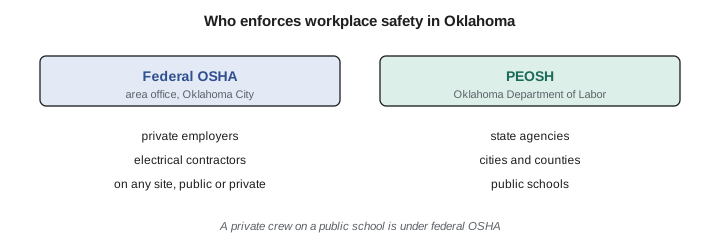
Oklahoma does not have an OSHA state plan for private employers. Federal OSHA enforces the Occupational Safety and Health Act for private businesses in the state, including electrical contractors, through its area office in Oklahoma City. The Oklahoma Department of Labor runs the Public Employees Occupational Safety and Health program, usually called PEOSH, which covers state agencies, cities, counties and public schools as employers. So a Canadian River crew working on a public school is inspected by federal OSHA, because Canadian River is a private employer, while the school district's own maintenance electricians fall under PEOSH.
The Oklahoma Department of Labor also runs free on-site safety consultation for small private businesses through OSHA's consultation program. Consultation visits are separate from enforcement, they do not result in citations, and they can help a smaller contractor review its programs. Dale had used the service twice over the years.
The construction standards
Most of an electrical contractor's field work falls under OSHA's construction standards in 29 CFR Part 1926. Subpart K covers electrical safety on construction sites, including ground-fault protection for temporary receptacles, the assured equipment grounding conductor program as an alternative where allowed, the condition of cords and tools, guarding of live parts, and lockout and tagging of circuits. Subpart M covers fall protection, Subpart X covers ladders, Subpart L covers scaffolds and Subpart P covers excavations. Subpart CC covers cranes and the clearances from overhead power lines. These are the parts of Part 1926 that show up most often on the trade exam and in inspections.
Maintenance and service work in existing buildings can fall under the general industry standards in Part 1910, including the electrical safety-related work practices and the lockout and tagout standard. A service crew replacing a panel in an occupied office building may be doing construction work or maintenance work depending on the scope, and the employer should know which standard applies. In both cases the basic rule is the same: deenergize and lock out before working, unless deenergizing is infeasible or creates a greater hazard, and then follow strict work practices for energized work.
| Topic | Where it is | What it covers for electrical crews |
|---|---|---|
| Electrical | Part 1926, Subpart K | Ground-fault protection, cords and tools, guarding, lockout and tags |
| Fall protection | Part 1926, Subpart M | Protection at heights and on roofs |
| Ladders | Part 1926, Subpart X | Ladder use, condition and placement |
| Excavations | Part 1926, Subpart P | Trenches, cave-in protection and access |
| Recordkeeping and reporting | Part 1904 | Injury logs and reporting deadlines |
Programs and training
OSHA expects employers to have written programs where the standards require them and to train workers on the hazards they face. For an electrical contractor that usually means a hazard communication program for chemicals, a lockout and tagout procedure, an assured equipment grounding conductor program if the firm uses one, fall protection training, ladder training, excavation training for anyone entering trenches and a competent person for excavations and scaffolds. Training must be in a language and vocabulary the workers understand, and the employer should keep records of who was trained and when.
Canadian River runs a short safety meeting every Monday on each job and a longer training session each quarter. New hires get a site orientation before they start work. Renee keeps the sign-in sheets in the same binder as the job's permits and inspection results, because an OSHA inspector or an insurance auditor may ask for them.
Reporting injuries
OSHA's recordkeeping rule in Part 1904 sets reporting deadlines. An employer must report a work-related fatality to OSHA within 8 hours. It must report an in-patient hospitalization, an amputation or the loss of an eye within 24 hours. Employers with more than ten employees in most industries, including construction, must also keep the OSHA injury and illness log, post an annual summary and, depending on size and industry, submit data electronically. Workers' compensation reporting under Title 85A is a separate duty, covered in Lesson 8.
DEADLINES = {"fatality": 8, "in-patient hospitalization": 24, "amputation": 24, "loss of an eye": 24}

events = [("in-patient hospitalization", "06:40"), ("amputation", "14:15"), ("fatality", "09:00")]

def due_at(start, hours):
    h, m = map(int, start.split(":"))
    total = h * 60 + m + hours * 60
    day, rem = divmod(total, 24 * 60)
    hh, mm = divmod(rem, 60)
    return f"{hh:02d}:{mm:02d}" + (" next day" if day else "")

for kind, when in events:
    hrs = DEADLINES[kind]
print(f"{kind} learned of at {when}: report within {hrs} hours, by {due_at(when, hrs)}")in-patient hospitalization learned of at 06:40: report within 24 hours, by 06:40 next day amputation learned of at 14:15: report within 24 hours, by 14:15 next day fatality learned of at 09:00: report within 8 hours, by 17:00
Multi-employer sites
Construction sites have many employers, and OSHA's multi-employer citation policy lets it cite more than one employer for the same hazard. The creating employer caused the hazard. The exposing employer let its workers be exposed. The correcting employer was responsible for fixing it. The controlling employer, usually the general contractor, had general supervisory authority over the site. An electrical contractor can be any of these. If a general contractor's scaffold is unsafe, Canadian River's crew should not use it, and Renee should report it to the general contractor in writing, because Canadian River can be cited as an exposing employer if its workers climb it.
Temporary power is a common example of the reverse. If Canadian River installs the temporary power on a site and another trade uses it, Canadian River may be the creating and correcting employer for a missing ground-fault protection device, even though the other trade's workers were the ones exposed. The firm should inspect its temporary installations regularly and fix problems at once.
NFPA 70E and the electrically safe work condition
OSHA's standards say what employers must achieve. NFPA 70E, the Standard for Electrical Safety in the Workplace, is the consensus standard most employers use to meet those requirements for electrical hazards. It describes how to create an electrically safe work condition: identify the sources, disconnect them, verify the disconnects are open, apply locks and tags, test for absence of voltage with a properly rated tester and ground where needed. It also describes shock and arc flash risk assessments, approach boundaries, energized work permits and personal protective equipment for the rare cases where energized work is justified.
Canadian River's written electrical safety program is based on NFPA 70E. Every foreman carries a voltage tester and a lock kit, and the firm's energized work permit form requires Renee's signature before any crew works on energized parts. In thirty years, Dale says, the firm has signed only a handful.
Calling before you dig
Oklahoma's underground facilities damage prevention law requires anyone who plans to excavate to notify the state's one-call center, known as OKIE811, before digging, so that underground utility operators can mark their lines. The law sets how far in advance the request must be made, which is commonly stated as at least 48 hours excluding weekends and holidays, and how long a locate remains valid. Trenching for a service, setting a pole or driving a ground rod can all count as excavation. Check the current law and the one-call center's rules before every job that breaks ground.
Worked problem
Who is cited for the temporary power?
Canadian River installed temporary power on a school site. A drywall subcontractor plugs a damaged cord into a Canadian River receptacle whose ground-fault protection device has been removed. An OSHA officer finds the problem. Which employers might be cited under the multi-employer policy?
Show solution
- The drywall subcontractor exposed its own workers and used a damaged cord, so it may be cited as an exposing employer.
- Canadian River created the temporary installation and is responsible for maintaining it, so it may be cited as a creating or correcting employer.
- The general contractor controls the site and may be cited as the controlling employer if it failed to take reasonable steps.
- Each employer's defense depends on what it knew and what it did about the hazard.
Answer: All three may face citations; Canadian River should inspect and repair its temporary power regularly.
Inspections and citations
An OSHA inspection can start from a complaint, a referral, a reported injury, a programmed inspection of high-hazard work or simply an officer seeing a hazard from the road. The officer presents credentials, holds an opening conference, walks the site and holds a closing conference. The employer may have a representative accompany the officer, and employees may have one as well. If the officer finds violations, OSHA may issue citations with proposed penalties and abatement dates. The employer can contest a citation within the time stated on it, or request an informal conference to discuss it. Whatever happens with the paperwork, real hazards should be fixed at once.
Renee's rule for the Moore school job was the one Dale had always used: be polite, be accurate, show the officer what was asked for and nothing misleading, take notes and photographs of the same things the officer looks at, and call the office before signing anything. Canadian River's crew had nothing to hide that day, and the officer left without citing the firm.
Heat, weather and the Oklahoma job site
Oklahoma summers are hot and humid, and electrical crews often work in attics, on roofs and inside steel buildings where temperatures climb far above the outdoor reading. Employers have a general duty to protect workers from recognized hazards, and heat is one of them. Canadian River schedules attic and roof work early in the day in summer, provides water and shade, lets new workers build up to full workloads and trains foremen to recognize heat illness. Severe weather is the other Oklahoma hazard. Crews stop work when lightning is near, and every job has a plan for tornado warnings.
Vehicles are part of the safety program too. Electrical crews spend hours on Oklahoma highways and county roads, and motor vehicle crashes are a leading cause of serious injury in construction. Canadian River's trucks carry secured ladders and material racks, and the firm's rules ban phone use while driving. Those rules protect the crews and the public, and they also protect the firm's auto insurance rating.
Common mistakes
MistakeAssuming Oklahoma runs its own OSHA for private contractors.
InsteadFederal OSHA covers private employers; PEOSH covers public employers.
MistakeReporting a fatality the next business day.
InsteadA fatality must be reported to OSHA within 8 hours.
MistakeLetting a crew use another trade's unsafe scaffold.
InsteadAn exposing employer can be cited; report the hazard and keep the crew off it.
MistakeDigging a ground rod trench without a locate request.
InsteadCall OKIE811 before any excavation the law covers.
Summary and key terms
- Federal OSHA enforces safety for private employers in Oklahoma; the Department of Labor's PEOSH covers public employers.
- Part 1926 Subparts K, M, X, L, P and CC cover most electrical construction hazards.
- Report a fatality within 8 hours and an in-patient hospitalization, amputation or eye loss within 24 hours.
- OSHA's multi-employer policy can cite creating, exposing, correcting and controlling employers.
- NFPA 70E describes the electrically safe work condition, and OKIE811 must be called before excavation.
- PEOSH
- The Oklahoma Department of Labor's program for public employee safety.
- Subpart K
- The electrical part of OSHA's construction standards.
- Multi-employer policy
- OSHA's policy for citing several employers on one site.
- Electrically safe work condition
- A state in which equipment is deenergized, locked out, tested and safe to work on.
- OKIE811
- Oklahoma's one-call center for locating underground facilities.
Practice problems
Work each problem on paper first, then reveal the answer to check.
Who enforces OSHA for a private electrical contractor in Oklahoma?
Show answer
Federal OSHA.
Within how many hours must a work-related fatality be reported?
Show answer
8 hours.
Which OSHA subpart covers electrical safety on construction sites?
Show answer
Part 1926, Subpart K.
Who must be called before digging a trench for a service?
Show answer
OKIE811, the state's one-call center.
Lesson quiz · 5 questions
Score 60% or more to complete this lesson.
Create a free account to save your progress, take quizzes and earn a certificate.