
MELU-311 · Lesson 3 of 12 · 19 min
Applying, approval and booking the exam
▶ Video coming soon A video version of this lesson is on the way.
By the second week of September, Renee had her hour records in a folder and a target: pass both contractor exams before the end of the year, so the Board could list her as Canadian River's contractor in the spring, when Dale planned to step back. Patty drew a timeline on the whiteboard in the break room, working backward from April. "The Board has to approve you before PSI will let you book," she said. "Then you need study time, then the exams, then the license, then the bond and insurance, then every city we work in. If any one of those slips, April slips."
This lesson follows the path from deciding to apply to holding an active contractor license. It covers reading the current rules and the candidate bulletin, filing the application with the Board, the approval step, booking the PSI exams, exam fees and retakes, issuing the license and the steps that make it active: the bond, the insurance, the workers' compensation statement and local registrations. It ends with the calendar that keeps everything on track.
Step one: read the current documents
Before filling out a form, Renee downloaded three documents and read them end to end. The first was the Electrical License Act, the statute. The second was Title 158, Chapter 40 of the Oklahoma Administrative Code, the Board's electrical rules. The third was the PSI candidate information bulletin for Oklahoma construction trades, which lists every exam, its question count, time limit, passing score, references and fee. She noticed the bulletin carried an effective date in September 2026, and she made a note to check whether a newer edition appeared before her exam date.
Reading the documents first saves time. The Business and Law exam is open book, and the references include the Act and the rules themselves, so the hours spent reading now count twice: once to apply correctly and once to prepare for the exam. Lesson 4 lists every reference.
Step two: apply to the Board
Oklahoma uses an approval step before testing. The candidate files an application with the CIB for the exam and license category, pays the application fee the Board sets and attaches the experience verification described in Lesson 2. The CIB staff review the application, and the Electrical Examining Committee's standards decide whether the experience qualifies. If the application is approved, the candidate receives authorization to schedule with PSI. If something is missing, the staff send a deficiency notice, and the clock stops until the candidate fixes it.
Most delays come from incomplete experience verification. A form signed without a notary seal, hours that are not broken down by type, or a signature from someone who was not a licensed contractor or company officer can all send an application back. Patty had seen each of these. She checked every page of Renee's packet against the form instructions, made a copy, and sent it by a method that gave her proof of delivery.
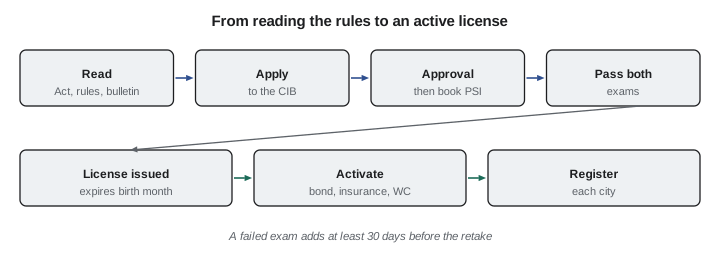
Step three: book the PSI exams
After approval, the candidate books the exams with PSI, online or by phone, and chooses a test center and date. For an unlimited contractor candidate there are two exams: the Electrical Business and Law exam and the Unlimited Electrical Contractor exam. They can be taken on the same day or on different days, depending on seat availability and the candidate's stamina. The bulletin listed the exam fee as 92 dollars for each exam portion in late 2026, paid to PSI, and the fee is not refundable or transferable.
PSI's rules on rescheduling and missed appointments matter. A candidate who misses an appointment or arrives late can lose the fee. The bulletin explains how far in advance a candidate must reschedule and what identification to bring. Renee booked the Business and Law exam for a Saturday in late October and the Unlimited Contractor exam for a Saturday three weeks later, so that she could focus on one set of references at a time.
| Item | Who sets it | Late-2026 figure or rule |
|---|---|---|
| Application fee | The Board | Set by the Board; check the payment portal |
| Exam fee | PSI bulletin | 92 dollars per exam portion |
| Retake wait | PSI bulletin and the Board | 30 days after the previous attempt |
| Retake fee | PSI bulletin | Paid again for each retake |
| Eligibility expiry | PSI bulletin | The bulletin listed no expiration of eligibility |
Retakes
Not everyone passes both exams on the first try. The bulletin says a candidate who fails an electrical exam must wait 30 days before retesting, and the CIB's electrical page says the same thing. Each retake costs another exam fee. PSI gives a score report that breaks down performance by content area, and that report is the best guide to what to study before the retake. A candidate who passes one exam and fails the other retakes only the one that was failed.
Build the retake wait into the timeline from the start. Renee's plan put the second exam three weeks after the first. If she failed the first, she could not retake it until 30 days later, which would still leave time before the end of the year. Patty added that possibility to the whiteboard in a lighter color.
from datetime import date, timedelta

approval = date(2026, 10, 2)
bl_exam = date(2026, 10, 24)
contractor_exam = date(2026, 11, 14)
RETAKE_WAIT = 30

print("approval received:", approval)
print("business and law exam:", bl_exam)
print("unlimited contractor exam:", contractor_exam)
for name, d in [("business and law", bl_exam), ("contractor", contractor_exam)]:
    retake = d + timedelta(days=RETAKE_WAIT)
    print(f"  earliest {name} retake if needed: {retake}")
target = date(2027, 4, 1)
worst = contractor_exam + timedelta(days=RETAKE_WAIT)
print("days of slack before the April target:", (target - worst).days)approval received: 2026-10-02 business and law exam: 2026-10-24 unlimited contractor exam: 2026-11-14 earliest business and law retake if needed: 2026-11-23 earliest contractor retake if needed: 2026-12-14 days of slack before the April target: 108
Even in the worst case, where she fails the contractor exam and retakes it 30 days later, Renee has more than three months of slack before Dale's April target. That slack covers the license issue, the bond and insurance filings and the city registrations that follow.
Step four: the license issues
When both exams are passed, PSI reports the scores, and the Committee certifies the candidate as having passed. The Board then issues the license after the license fee is paid. The Act says a license is issued for no longer than one year and expires in the licensee's birth month, so the first term may be shorter than a full year. Lesson 11 covers renewal.
A new contractor license is not automatically active for contracting. The Board's rules require a contractor to file a 5,000-dollar license bond and a certificate of general liability insurance naming the Board as certificate holder, and to state on the application that the contractor complies with the workers' compensation law. Until those are on file, the license is inactive. Renee planned to keep hers inactive until Dale was ready to step aside, then file the bond and insurance through Canadian River's insurance agent the same week.
Worked problem
Activating the license
Renee passes both exams in November and receives her contractor license in December. Dale steps back on April 1. What has to be on file with the Board before Renee can contract as Canadian River's contractor?
Show solution
- A 5,000-dollar continuous license bond filed with the Board's bonds and insurance staff.
- A certificate of general liability insurance with limits of at least 50,000 dollars combined single limit, listing the Board as certificate holder.
- Her statement on the application that the firm complies with the workers' compensation law.
- A notice to the Board, within 30 days, of the change in the firm's licensed contractor.
Answer: The bond, the insurance certificate and the workers' compensation statement must be on file to make the license active, and the change of contractor must be reported.
Step five: register locally
The Act requires a licensed contractor to register with each city or town that requires registration before working there. Registration usually means filing proof of the state license, the bond and the insurance with the city's permit office and paying any registration fee the city charges. The Act limits what the city can demand. Because the Board's bond and insurance requirements replace municipal ones, a city may not require its own separate electrical bond or a different insurance amount. The statewide license is what qualifies the contractor; the city's role is to record it and to issue permits.
Renee made a list of the cities where Canadian River had permits open or expected to work in the next year: Norman, Moore, Noble, Purcell, Lexington and Oklahoma City. For each one Patty would update the registration to show Renee as the contractor on the day the Board's records changed. The company had learned years earlier that a city registration showing a retired contractor can hold up a permit counter for days.
Keeping track
Patty set up a single page in the office binder with every date that mattered: the approval date, both exam dates, the retake windows, the expected license date, the bond and insurance effective dates, the date the Board was notified of the contractor change and the registration renewal date in each city. She also added Renee's birth month, because that is when the license will expire each year. Renee kept her own copy in her truck.
Applying as an owner, not just an employee
Renee's application had one feature that a journeyman's application does not. Because the Board's rules require the firm's contractor to be an officer, partner or owner, the Board would eventually need to see her connection to Canadian River Electric, LLC. The exam application itself is about the person: her experience, her identity and her eligibility to test. The firm's paperwork comes later, when she asks the Board to list her as the contractor for the firm and files the bond and insurance in the firm's name. Patty kept the two sets of papers in separate folders so that nothing from the ownership side slowed the exam approval.
The company's lawyer drafted the membership documents in parallel. They gave Renee a small ownership interest effective on the day Dale stepped back, and they named her an officer of the LLC. Patty planned to send copies to the Board with the contractor change notice, to the surety with the bond rider and to the insurer with the request for an updated certificate. Each of those parties keys its records to the firm and the contractor, so a mismatch between them is one of the most common reasons a license shows as inactive after a change.
Common reasons a timeline slips
Patty listed the delays she had seen over the years. An employer verification came back unsigned. A notary seal was missing. A candidate booked a test center that had no seats for six weeks. A candidate passed both exams but waited two months to pay the license fee. A surety asked for updated financial statements before issuing a bond rider. A city registration required an original insurance certificate instead of a copy. None of these is hard to fix, but each one costs a week or two, and they stack. The best defense is to start every step as early as the previous one allows and to keep a copy of every page sent.
Common mistakes
MistakeBooking the exam before the Board approves the application.
InsteadOklahoma uses an approval step; PSI schedules only after the Board authorizes the candidate.
MistakeSending experience forms without a notary seal or the right signer.
InsteadCheck every verification form against the instructions; incomplete forms are the most common cause of delay.
MistakeAssuming a new contractor license is active as soon as it is issued.
InsteadThe license is inactive until the bond, insurance certificate and workers' compensation statement are on file.
MistakeForgetting the 30-day retake wait in the schedule.
InsteadBuild the wait into the timeline from the start.
Summary and key terms
- Read the Act, the Board's rules and the PSI bulletin before applying.
- Apply to the CIB with verified experience; PSI schedules only after approval.
- The bulletin listed 92 dollars per exam portion and a 30-day wait before a retake.
- A new contractor license is inactive until the 5,000-dollar bond, the insurance certificate and the workers' compensation statement are filed.
- Register with each city that requires it; cities may not add their own bond or insurance requirements.
- Approval
- The Board's authorization that lets a candidate schedule the PSI exams.
- Deficiency notice
- A notice from the Board that an application is missing information.
- Exam portion
- One of the PSI exams, each with its own fee.
- Retake wait
- The 30 days a candidate must wait after failing an electrical exam.
- Local registration
- The filing a contractor makes with each city before working there.
Practice problems
Work each problem on paper first, then reveal the answer to check.
What must happen before a candidate can book the PSI exams?
Show answer
The Board must approve the application.
How long must a candidate wait after failing an electrical exam?
Show answer
30 days.
What three filings make a new contractor license active?
Show answer
The 5,000-dollar bond, the insurance certificate naming the Board as certificate holder and the workers' compensation statement.
May a city require its own electrical contractor bond?
Show answer
No. The Board's bond and insurance requirements replace municipal ones.
Lesson quiz · 5 questions
Score 60% or more to complete this lesson.
Create a free account to save your progress, take quizzes and earn a certificate.