
MELU-311 · Lesson 5 of 12 · 18 min
The NEC as adopted in Oklahoma and state amendments
▶ Video coming soon A video version of this lesson is on the way.
In October, Canadian River bid a small medical office building in north Norman. The architect's electrical sheets carried a general note that read "all work per the 2020 NEC." Hector flagged it during the bid review. "The state moved to the 2023 code two years ago," he said. "Are we bidding the drawings or the code?" Renee, who was studying the 2023 edition every evening, knew the answer would come up on her exam and on every job she ran as contractor. The code that applies is the one in force where and when the permit is issued, not the one printed on an old title block, and finding out which one that is means knowing how Oklahoma adopts the NEC.
This lesson explains who adopts the National Electrical Code for Oklahoma, how an adoption becomes enforceable, the editions and effective dates in recent years, what an Oklahoma amendment is and how to find one, how cities fit in and how a contractor resolves conflicts between drawings, the exam edition and the enforced code. It does not reproduce any text from the NEC; the point is how the adoption system works.
The Oklahoma Uniform Building Code Commission
The Oklahoma Uniform Building Code Commission, the OUBCC, was created by statute to adopt building codes for the state. It reviews new editions of model codes, including the National Electrical Code published by the National Fire Protection Association as NFPA 70, decides whether to adopt them and whether to change any provisions for Oklahoma, and publishes the result as administrative rules. Those rules go through the same steps as other state agency rules: notice, public comment, a vote of the Commission and review by the governor and the legislature. Once the rules take effect, the adopted codes are the minimum standard for construction in the state.
The Commission works through technical committees made up of people from the industry. The electrical committee reviews each new NEC edition, hears proposals for Oklahoma amendments and makes recommendations to the full Commission. Electrical contractors, inspectors, engineers and manufacturers can take part in those meetings. Dale had attended two of them over the years, once to speak in favor of a change and once just to learn how the process worked.
Editions and effective dates
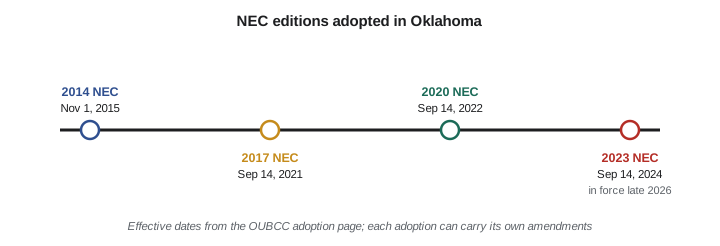
The Commission's adoption page shows a regular cycle. The 2011 NEC took effect in Oklahoma on November 1, 2012. The 2014 NEC took effect on November 1, 2015. The 2017 NEC took effect on September 14, 2021. The 2020 NEC took effect on September 14, 2022. The 2023 NEC took effect on September 14, 2024, and as of late 2026 the page lists no superseded date for it, which means it is the edition in force. The 2026 NEC has been published by NFPA, but the page did not show an Oklahoma adoption of it in late 2026.
Two things stand out in that history. First, Oklahoma has recently tracked new editions within about a year or two of publication. Second, there was a long gap between the 2014 and 2017 adoptions, followed by two quick moves. A contractor who has worked in the state for many years has seen editions change at different speeds, and should not assume the next edition will arrive on any fixed schedule.
| Edition | Effective in Oklahoma | Superseded |
|---|---|---|
| 2011 NEC | November 1, 2012 | Amended September 12, 2014; replaced November 1, 2015 |
| 2014 NEC | November 1, 2015 | September 14, 2021 |
| 2017 NEC | September 14, 2021 | September 14, 2022 |
| 2020 NEC | September 14, 2022 | September 14, 2024 |
| 2023 NEC | September 14, 2024 | In force in late 2026 |
What an Oklahoma amendment is
When the Commission adopts an edition, it can adopt it as published or with changes. A change is an amendment: the rule text says which NEC section is deleted, replaced or added to, and the amended version is what applies in Oklahoma. The Commission's page shows that Oklahoma has used amendments in the past. In the 2014 cycle, the Commission adopted an amendment to correct errors in the earlier adoption and a later amendment dealing with alternative fuel fueling stations and repair garages. In 2020 it adopted emergency rules on electrical installations in facilities that grow and process plant materials, a response to the rapid growth of that industry in the state. The 2011 cycle had an amendment to restore language that had been left out of the legislative resolution approving the rules.
For the current edition, the adoption rule linked from the Commission's page is the place to check. It states whether the 2023 NEC is adopted as published or with Oklahoma amendments, and it lists any amended sections. Renee printed the current rule and kept it in her exam binder and in the office plan room. The PSI bulletin lists the NEC "as adopted in Oklahoma," so an amendment in force can be fair game on the trade exam.
Amendments are also where many field disagreements start. An inspector who has worked in another state may remember a rule that Oklahoma changed, or a contractor may remember an Oklahoma amendment that did not carry forward to the next edition. Each adoption stands on its own. An amendment to the 2014 NEC does not automatically apply to the 2023 NEC unless the new rule carries it forward. When an amendment is in question, ask the inspector which rule and section they are relying on and check the current adoption.
Cities and the adopted code
Oklahoma cities that run their own building departments also adopt codes by ordinance. Many adopt the codes the OUBCC has adopted, sometimes with their own local amendments, and the OUBCC's statute sets limits on how local amendments relate to the state codes. The Electrical License Act adds its own condition: a city has jurisdiction over electrical work inside its limits when it has adopted a nationally recognized electrical code and appointed an electrical inspector. In practice the inspector for a city will tell you which edition and which local amendments the city enforces.
Large cities may run a few months behind or ahead of a new state edition while they update their ordinances. Canadian River's practice is to check the city's adopted code page and, for any job near a change in edition, to ask the permit office which edition will apply to the permit. The answer usually depends on the date the permit application is filed.
from datetime import date

ADOPTIONS = [
    (date(2015, 11, 1), "2014 NEC"),
    (date(2021, 9, 14), "2017 NEC"),
    (date(2022, 9, 14), "2020 NEC"),
    (date(2024, 9, 14), "2023 NEC"),
]

def edition_on(d):
    current = None
    for start, name in ADOPTIONS:
        if d >= start:
            current = name
    return current

for label, d in [("old warehouse permit", date(2022, 3, 10)),
                 ("church addition permit", date(2024, 9, 1)),
                 ("medical office bid", date(2026, 10, 20))]:
print(f"{label} on {d}: state edition in force = {edition_on(d)}")old warehouse permit on 2022-03-10: state edition in force = 2017 NEC church addition permit on 2024-09-01: state edition in force = 2020 NEC medical office bid on 2026-10-20: state edition in force = 2023 NEC
The script is a reminder that the date decides. A church addition permitted on September 1, 2024 was under the 2020 NEC, while one permitted two weeks later was under the 2023 NEC. The script shows only the state adoption; a city's ordinance and the permit office's practice still need checking.
Drawings, the exam and the field
Back to the medical office bid. The architect's note said 2020 NEC, but the permit would be issued under the 2023 NEC. Renee explained the rule she follows: the enforced code is the minimum. If the drawings show something the 2023 NEC requires anyway, there is no conflict. If the drawings show something the 2023 NEC does not allow, the installation has to meet the code, and the contractor raises the issue before bidding, through a request for information, so the price reflects what will actually be built.
Hector wrote a short RFI asking the architect to confirm that the work would be designed and installed to the code in force at permit, the 2023 NEC as adopted in Oklahoma, and to identify any items on the sheets that relied on the older edition. The architect issued an addendum changing the general note. Two items changed as a result, and the bid included them.
The exam and the field can also differ. The PSI bulletin names the edition used on the exam, which in late 2026 was the 2023 NEC. If the state adopts a new edition, the bulletin will eventually change, but not necessarily on the same day. A candidate studies the edition the current bulletin lists, and a contractor installs to the edition the permit is issued under. Those were the same edition for Renee, but a candidate testing near a change should read the bulletin carefully.
Worked problem
Which code applies?
A city in Oklahoma adopted the state codes by ordinance. A permit for a restaurant was applied for on August 20, 2024 and issued on September 20, 2024. The drawings reference the 2017 NEC. Which state edition was in force when the application was filed, and what should the contractor do?
Show solution
- The 2020 NEC was in force from September 14, 2022 until September 14, 2024.
- On August 20, 2024, the date of the application, the 2020 NEC was the state edition in force.
- The drawings' reference to the 2017 NEC is out of date either way.
- Ask the city which edition it applies to a permit filed before the change and issued after it, and send an RFI on any item that depends on the older edition.
Answer: The 2020 NEC was in force on the application date; confirm with the city which edition governs this permit and resolve the drawings by RFI.
When the next edition arrives
NFPA publishes a new NEC every three years, and the 2026 edition was already in print by late 2026. Oklahoma had not adopted it at that time. When the OUBCC begins the adoption process, its electrical committee will review the new edition, consider any proposed Oklahoma amendments and send a recommendation to the Commission, which then goes through the rulemaking steps. The Commission publishes notices of its meetings and proposed rules, so a contractor who follows them will know months ahead when a new edition is coming.
A change of edition affects more than the field crews. Estimators need to price new requirements, the office needs new code books, the PSI bulletin will eventually list the new edition and the continuing education requirement includes code update hours tied to the adopted codes. Renee added a line to Patty's calendar for the OUBCC electrical committee meetings so that Canadian River would not be surprised.
The same caution applies to manufacturers' instructions and listings. The code often requires equipment to be installed according to its listing and labeling, and those instructions change with product revisions. A contractor who checks the adopted edition but not the installation instructions for a new piece of equipment can still fail an inspection. Renee's foremen keep the instructions for each major piece of equipment in the job box until the final inspection passes.
Common mistakes
MistakeBidding to the edition printed on the drawings.
InsteadThe code in force when the permit is issued is the minimum; raise conflicts before bidding.
MistakeAssuming an older Oklahoma amendment carries forward to a new edition.
InsteadEach adoption stands on its own; check the current rule.
MistakeAssuming the exam edition always matches the field edition.
InsteadStudy the edition the bulletin lists and install to the edition the permit is issued under.
MistakeTreating the OUBCC as the inspection agency.
InsteadThe OUBCC adopts codes; cities and the Board enforce them.
Summary and key terms
- The OUBCC adopts the NEC for Oklahoma through the state rulemaking process.
- The 2023 NEC took effect on September 14, 2024 and was in force in late 2026.
- Oklahoma has adopted state amendments to past editions, such as the 2014 amendments on fueling stations and repair garages.
- Check the current adoption rule for any amendments to the 2023 NEC; each adoption stands on its own.
- Cities adopt codes by ordinance; the edition in force on the permit date governs the job.
- OUBCC
- The Oklahoma Uniform Building Code Commission, which adopts building codes for the state.
- Adoption
- The rule that makes a code edition enforceable in Oklahoma.
- Amendment
- A change the Commission makes to a model code provision for Oklahoma.
- Effective date
- The date an adopted edition starts to apply.
- RFI
- A request for information sent to the designer to resolve a conflict in the documents.
Practice problems
Work each problem on paper first, then reveal the answer to check.
Which body adopts the NEC for Oklahoma?
Show answer
The Oklahoma Uniform Building Code Commission.
When did the 2023 NEC take effect in Oklahoma?
Show answer
September 14, 2024.
Did Oklahoma ever amend the 2014 NEC?
Show answer
Yes, including an amendment on alternative fuel fueling stations and repair garages.
A drawing note says 2020 NEC on a job permitted in 2026. What should the contractor do?
Show answer
Bid and install to the code in force at permit and send an RFI on any conflicting items.
Lesson quiz · 5 questions
Score 60% or more to complete this lesson.
Create a free account to save your progress, take quizzes and earn a certificate.