
MELU-311 · Lesson 2 of 12 · 18 min
Eligibility for the Electrical Contractor License
▶ Video coming soon A video version of this lesson is on the way.
The Monday after Dale's offer, Renee and Patty Sloan sat down with everything Renee had kept since 2011: her apprentice registration cards, her journeyman license, old pay stubs, a letter from her first employer in Oklahoma City and a spreadsheet she had started years ago to track hours. Renee had assumed the experience rule would be the easy part. "I've been doing this for fifteen years," she said. Patty, who had helped two other employees through the Board's paperwork, pushed the rules printout across the table. "The Board doesn't count years," she said. "It counts hours, it counts what kind of hours, and it wants somebody who employed you to swear to them."
This lesson covers who may sit for the Oklahoma unlimited electrical contractor exam and who may be licensed afterward. It walks through the experience rules for the unlimited contractor, the related rules for journeymen and limited contractors, the role of classroom hours, how experience is verified, the age and character conditions and the routes for people licensed in other states. It ends with the ownership condition that ties a contractor to a firm.
The experience rule for the unlimited contractor
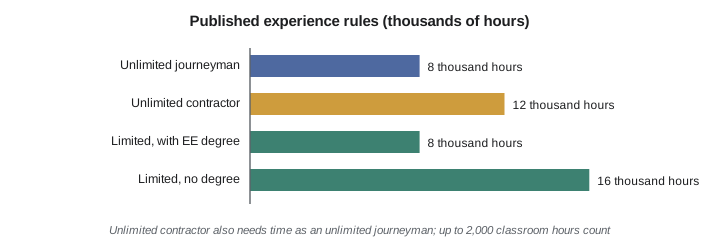
The rule for the unlimited electrical contractor examination is built on hours, not years. As published, it asks for at least 12,000 hours of electrical experience, which the rule equates to six years, with at least 6,000 of those hours in commercial or industrial work. The hours must have been gained while employed by a licensed electrical contractor or in an equivalent setting the Board accepts. On top of that, the applicant must have held an unlimited journeyman license for a period the rule states, which the published text describes as two years. Some code publishers summarize the journeyman part as a set number of hours worked as a licensed journeyman instead. Either way the point is the same: the Board wants contractors who have worked as licensed journeymen, not just as apprentices.
The split between residential and commercial or industrial work matters. An electrician who spent twelve years wiring houses may have far more than 12,000 hours and still not qualify for the unlimited exam, because fewer than 6,000 of those hours were commercial or industrial. That electrician might qualify for a residential contractor license instead, or might need to spend a few more years on commercial crews. The Board's application asks the employer to break the hours down by type for exactly this reason.
Renee's record is straightforward. She worked about 8,400 hours as a registered apprentice from 2011 to 2016, mostly on commercial jobs for her first employer, and she has worked roughly 20,000 hours as a licensed unlimited journeyman since 2016, most of them on Canadian River's commercial and light industrial jobs. She has well over 12,000 total hours, well over 6,000 commercial and industrial hours, and ten years as a licensed journeyman. Her only real work was gathering proof.
The journeyman rule, for comparison
The journeyman exam has its own experience rule. As published, the unlimited journeyman exam asks for 8,000 hours, or four years, of electrical experience, with at least 4,000 hours in commercial or industrial work, gained as a registered apprentice working for a licensed contractor. Because the unlimited contractor rule builds on the journeyman license, most candidates follow the same path Renee did: register as an apprentice, gain hours, pass the journeyman exam, work as a journeyman and then sit for the contractor exam. The Business and Law exam is the extra step at the contractor level.
Classroom training counts for part of the experience. The published rules allow up to 2,000 hours of approved classroom instruction to be credited toward the experience requirement. That credit usually comes from a Board-approved apprenticeship program, a technology center electrical program or a similar course. A graduate of a two-year technology center program might count close to the full 2,000 hours, which shortens the field time needed. Classroom hours do not replace the commercial or industrial split, so a candidate still needs real field hours of the right type.
The limited electrical contractor
The limited contractor license is a separate path. The published rule gives two ways to qualify for the limited contractor exam. The first is a degree in electrical engineering from an accredited school plus 8,000 hours, or four years, of experience in field construction, electrical estimating or design in commercial and industrial work. The second is 16,000 hours, or eight years, of verified experience in the electrical trade in commercial or industrial work. The rule also sets the minimum age at eighteen.
What the limited contractor gains in entry routes, it gives up in field work. The rule says the limited contractor may not do the work of a journeyman electrician and may not perform or supervise field work. A limited contractor can own and run an electrical firm, sign contracts and stand behind the business, but the firm still needs licensed journeymen in the field, and supervising those journeymen has to fall to someone licensed to do so. For a candidate like Renee, who runs crews every day, the unlimited license is the only one that fits.
| Exam | Published experience rule | Notes |
|---|---|---|
| Unlimited journeyman | 8,000 hours, with 4,000 commercial or industrial | As an apprentice for a licensed contractor; classroom credit allowed |
| Unlimited contractor | 12,000 hours, with 6,000 commercial or industrial, plus time as an unlimited journeyman | Plus the Business and Law exam |
| Limited contractor, with degree | Electrical engineering degree plus 8,000 hours | No field work or field supervision |
| Limited contractor, no degree | 16,000 hours of commercial or industrial experience | No field work or field supervision |
Proving the hours
The Board does not take an applicant's word for experience. The application asks for each employer to verify the period of employment and the hours by type, usually on a notarized form signed by a licensed contractor or an officer of the company. Some applicants also attach pay records, tax forms or apprenticeship transcripts. If a former employer has closed or will not sign, the CIB staff can explain what substitute proof it will consider, but the applicant should expect questions.
This is where Renee's old spreadsheet helped. Her first employer in Oklahoma City had been bought by a larger company, but its human resources department still had her employment dates, and the contractor who had supervised her, now retired, agreed to sign a statement. For the years since 2016, Dale signed as the licensed contractor of Canadian River, and Patty attached the company's payroll summary. Renee kept copies of everything in a folder labeled with the date she sent it.
records = [
    ("Apprentice, OKC firm", 2011, 2016, 8_400, 0.85),
    ("Journeyman, Canadian River", 2016, 2026, 20_100, 0.78),
]
classroom = 1_200
NEEDED_TOTAL, NEEDED_COMM, CLASS_CAP = 12_000, 6_000, 2_000

field = sum(h for _, _, _, h, _ in records)
comm = sum(round(h * share) for _, _, _, h, share in records)
credit = min(classroom, CLASS_CAP)

print(f"field hours: {field:,}   commercial/industrial: {comm:,}")
print(f"classroom credit: {credit:,} (cap {CLASS_CAP:,})")
print(f"total counted: {field + credit:,}")
print("total rule met:", field + credit >= NEEDED_TOTAL)
print("commercial rule met:", comm >= NEEDED_COMM)field hours: 28,500 commercial/industrial: 22,818 classroom credit: 1,200 (cap 2,000) total counted: 29,700 total rule met: True commercial rule met: True
The check is simple, but it is the same arithmetic the CIB staff will do, and it shows why the commercial share matters. Even with all of her residential service work set aside, Renee clears both figures by a wide margin. A younger candidate with 12,500 hours, mostly residential, could pass the total and fail the commercial test.
Worked problem
Counting hours for a borderline candidate
A journeyman has 9,800 field hours, of which 5,100 are commercial or industrial, and 1,600 hours of approved classroom training. Does the candidate meet the published total and commercial figures for the unlimited contractor exam?
Show solution
- Classroom credit is capped at 2,000 hours, so all 1,600 count.
- Total counted hours are 9,800 plus 1,600, which is 11,400.
- That is short of 12,000 by 600 hours.
- Commercial or industrial hours are 5,100, which is short of 6,000 by 900 hours; classroom credit does not fill this gap.
Answer: No. The candidate needs at least 600 more hours in total and 900 more commercial or industrial hours.
Age, character and other conditions
The published rules set a minimum age of eighteen for the contractor exams. The application also asks about criminal history and past discipline in Oklahoma or elsewhere. A conviction does not automatically bar an applicant, but the Board can consider whether the offense relates to the duties of the license, and false answers on the application are themselves grounds for denial or later discipline. Applicants should answer fully and attach any explanation the form asks for.
The Board also expects the applicant to be able to meet the contractor's financial and insurance conditions once licensed. Those are not eligibility conditions for the exam, but a candidate who passes and then cannot get the bond or insurance will hold an inactive license. Lesson 8 covers the bond and insurance in detail.
Licensed in another state
The Act allows the Committee to certify an applicant who holds a valid license from another state or government entity whose requirements are substantially similar to Oklahoma's. The Board publishes reciprocity guidelines on its electrical page, listing the states it has agreements with and the categories covered. Reciprocity lists change as agreements are signed or allowed to lapse, and an agreement for journeymen does not always cover contractors. A candidate licensed elsewhere should read the current guidelines before booking any exam, because the Business and Law exam may still be required even when the trade exam is waived.
Tying the license to a firm
Passing the exams makes a person eligible to be licensed as a contractor. Being the contractor for a firm adds the ownership condition. The rules say the firm's licensed contractor must be an officer, partner or owner of that firm and must be employed full time supervising its electrical work. So Renee and Dale had to agree on how she would join the ownership of Canadian River Electric, LLC before the Board would list her as the firm's contractor. They chose a small membership interest in the LLC, documented by the company's lawyer, with an option to buy more as Dale steps back.
Renee also learned that a contractor license can be held on inactive status. The rules say an inactive contractor is exempt from the bond and insurance requirements, may not offer electrical services to the public and may still work as a journeyman. That gives a newly licensed contractor some flexibility. Renee could pass the exams in the fall, hold the license inactive while the ownership paperwork closes and activate it with the bond and insurance when she becomes the firm's contractor.
Common mistakes
MistakeCounting years instead of hours.
InsteadThe rules count hours, with a commercial or industrial share, and employers must verify them.
MistakeUsing classroom credit to cover a shortfall in commercial hours.
InsteadClassroom credit counts toward the total but does not replace the required commercial or industrial field hours.
MistakeChoosing the limited contractor license to supervise crews.
InsteadA limited contractor may not perform or supervise field work.
MistakeAssuming reciprocity always waives every exam.
InsteadCheck the current reciprocity guidelines; the agreement may cover only some categories, and the Business and Law exam may still apply.
Summary and key terms
- The published unlimited contractor rule asks for 12,000 hours, 6,000 of them commercial or industrial, plus time as an unlimited journeyman.
- The published journeyman rule asks for 8,000 hours, 4,000 of them commercial or industrial.
- Up to 2,000 hours of approved classroom training can count toward the total.
- The limited contractor qualifies with an engineering degree plus 8,000 hours or with 16,000 hours, and may not do field work.
- The firm's contractor must be an officer, partner or owner who supervises its work full time; an inactive license allows journeyman work only.
- Unlimited journeyman
- The journeyman license that allows electrical work of any type under a licensed contractor.
- Commercial or industrial hours
- The share of experience the rules require outside residential work.
- Classroom credit
- Approved instruction hours, capped at 2,000, that count toward the experience total.
- Limited electrical contractor
- A contractor license for engineers and estimators that excludes field work.
- Inactive status
- A contractor license held without bond and insurance, allowing journeyman work but not contracting.
Practice problems
Work each problem on paper first, then reveal the answer to check.
How many total hours does the published unlimited contractor rule require?
Show answer
12,000 hours, with at least 6,000 in commercial or industrial work.
What is the cap on classroom credit?
Show answer
2,000 hours.
A candidate has an electrical engineering degree and 8,500 hours of estimating experience. Which exam can the candidate sit for?
Show answer
The limited electrical contractor exam.
What may an inactive contractor do?
Show answer
Work as a journeyman, but not offer electrical services to the public.
Lesson quiz · 5 questions
Score 60% or more to complete this lesson.
Create a free account to save your progress, take quizzes and earn a certificate.