
MELU-310 · Lesson 9 of 12 · 19 min
Contracts and mechanics' liens in Ohio
▶ Video coming soon A video version of this lesson is on the way.
The Brookville warehouse was a good job until the developer stopped paying. Stillwater's subcontract was with the general contractor, Crestline Builders, and Crestline had paid the first three applications on time. The fourth, for the service and switchgear, was ninety thousand dollars, and it was now forty days late. Crestline's project manager said the owner had not paid them yet. Dale had seen this before. He called Keisha and Linda into the conference room and opened a folder labeled "Brookville lien". Inside were a copy of the notice of commencement from the county recorder, Stillwater's notice of furnishing with its certified mail receipt, and a calendar with one date circled in red: the last day to record an affidavit for mechanic's lien.
This lesson covers Ohio contract basics for electrical contractors and the Ohio mechanics' lien law in Chapter 1311 of the Revised Code: the notice of commencement, the notice of furnishing, the affidavit for mechanic's lien and its deadlines, enforcement, the protections for homeowners, waivers, and the Ohio Prompt Payment Act in section 4113.61. Deadlines are summarized from the statutes and legal guides as of late 2026. Lien law is technical and unforgiving; use this lesson to understand the system and talk to a construction lawyer about real claims.
Contracts on electrical jobs
Electrical contractors in Ohio usually work under one of two kinds of contracts: a prime contract directly with the owner, common on smaller commercial work and on public projects that bid trades separately, or a subcontract with a general contractor or construction manager. Either way, the contract should state the scope of work, the price or pricing method, the schedule, how changes are priced and approved, payment terms including retainage, insurance and indemnity requirements, warranty, and how disputes are resolved. Many general contractors use standard forms, such as those published by AIA or ConsensusDocs, with their own changes.
Two clauses deserve special attention. A pay-if-paid or pay-when-paid clause shifts some risk of the owner's nonpayment to the subcontractor; how Ohio courts treat such clauses depends on the exact wording, so read them carefully and get advice before signing. Indemnity clauses may require the subcontractor to defend and pay for claims; Ohio law limits indemnity for a party's own negligence in construction contracts, but the details matter. Change orders should be signed before the work is done whenever possible, because unpriced extra work is the most common source of disputes.
Who has lien rights
Ohio's mechanics' lien law gives contractors, subcontractors, material suppliers and laborers who furnish work or materials to improve private real property a lien on the owner's interest in that property, subject to the statute's procedures. The lien secures payment of the amount owed for the work. The rights are created by statute, so a lien claimant must follow the statutory steps exactly; missing a notice or a deadline can defeat the lien even when the debt is valid. Public property generally cannot be liened; on public projects, subcontractors look instead to payment bonds and to the public improvement laws' claim procedures.
The notice of commencement
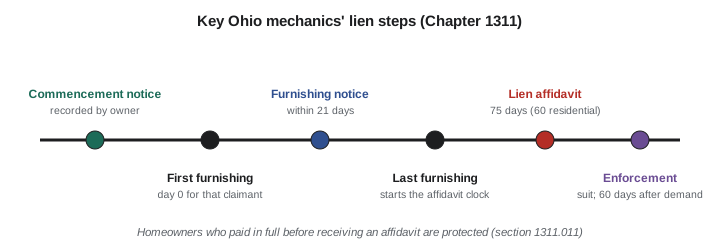
On most commercial projects, the owner, part owner or lessee who contracts for the improvement records a notice of commencement with the county recorder before work begins, in each county where the property is located. The notice identifies the property, the owner, the original contractor and other information the statute lists, and a copy is posted on the site. The notice of commencement is the starting point for the notice process: it tells lower-tier parties who the owner is and where to send notices. Subcontractors and suppliers should request a copy at the start of every job, as Linda did for Brookville.
Residential projects under a home construction contract for one- and two-family dwellings generally do not use the notice of commencement process unless a lender requires it, and the protections for homeowners described below apply instead.
The notice of furnishing
Subcontractors and suppliers who do not have a contract directly with the owner generally must serve a notice of furnishing to preserve their lien rights when a notice of commencement has been recorded. Legal guides summarize the deadline as twenty-one days after first furnishing labor or materials, or, if the owner records the notice of commencement late, twenty-one days after it is recorded. The notice goes to the owner and the original contractor, usually by certified mail, and the claimant keeps proof of service. A notice served too early, before first furnishing, may be ineffective, so timing matters on both ends. The notice of furnishing does not apply to the original contractor, who has a direct contract with the owner, and laborers are generally excluded.
Stillwater's first delivery to Brookville, a load of underground conduit, was on July 8. Linda mailed the notice of furnishing on July 12 by certified mail, well inside twenty-one days, and stapled the receipt into the folder.
| Step | Who | Deadline (summary) |
|---|---|---|
| Owner's notice of commencement | Owner | Recorded before work begins on most commercial projects |
| Serve a notice of furnishing | Subcontractors and suppliers not in privity with the owner | Within 21 days of first furnishing (or of a late notice of commencement) |
| Affidavit for mechanic's lien, most projects | Any lien claimant | Within 75 days of last furnishing |
| Affidavit, one- or two-family dwelling or condominium unit | Any lien claimant | Within 60 days of last furnishing |
| Affidavit, oil or gas well | Any lien claimant | Within 120 days of last furnishing |
| Enforcement action | Lien claimant | Generally within 6 years of filing, or 60 days after a notice to commence suit |
The affidavit for mechanic's lien
To perfect a lien, the claimant records an affidavit for mechanic's lien with the county recorder within the statutory deadline, counted from the last day the claimant furnished labor or materials. Legal guides summarize the deadlines as seventy-five days for most projects, sixty days for a one- or two-family dwelling or a single condominium unit, and one hundred twenty days for oil and gas wells. If the deadline falls on a weekend or legal holiday, filing on the next business day is generally timely. The affidavit states the amount due, describes the property and the work, and identifies the owner, and a copy must be served on the owner within the time the statute sets after recording.
The last day of furnishing must be real work under the contract. Punch list or warranty work done only to extend the deadline is unlikely to count. Keisha's crew finished the Brookville switchgear terminations on October 3, and the last day of contract work was October 7, when they completed the final labeling. Seventy-five days after October 7 is December 21, the date circled in red.
# Ohio lien affidavit deadline from the last day of furnishing (study aid)
from datetime import date, timedelta
def affidavit_deadline(last_furnishing, project):
    days = {"most projects": 75, "one- or two-family dwelling": 60, "oil or gas well": 120}[project]
    d = last_furnishing + timedelta(days=days)
    while d.weekday() >= 5:            # Saturday or Sunday: next business day
        d += timedelta(days=1)
    return d
for last, kind in [(date(2026, 10, 7), "most projects"), (date(2026, 8, 14), "one- or two-family dwelling")]:
print(kind, "last furnished", last.isoformat(), "-> record by", affidavit_deadline(last, kind).isoformat())most projects last furnished 2026-10-07 -> record by 2026-12-21 one- or two-family dwelling last furnished 2026-08-14 -> record by 2026-10-13
Enforcement and the owner's notice to commence suit
A recorded lien does not collect itself. The claimant enforces it by filing a foreclosure action in the court of common pleas. Legal guides summarize the time limit as six years from the filing of the lien in general, but the owner can shorten it by serving a notice to commence suit, after which the claimant must file within sixty days or lose the lien. Owners and lenders can also discharge a lien by posting a bond with the court, which moves the claim from the property to the bond.
Protections for homeowners
Ohio gives owners of one- and two-family homes special protection. Under section 1311.011, if the owner paid the original contractor in full before receiving a copy of a lien affidavit, no lien attaches to the home, and if the owner had not paid in full, lien claims are limited to the unpaid balance of the contract minus the cost to complete it. Similar protection applies to buyers who paid in full under a home purchase contract. A lien claimant who does not release a lien within thirty days after receiving written notice of full payment may be liable for damages. For subcontractors on residential work, these rules mean the lien is a weaker remedy, and getting paid on time matters even more.
Waivers and releases
Owners and general contractors usually require lien waivers or releases in exchange for payments. A partial waiver releases lien rights for the amount paid through a certain date; a final waiver releases all lien rights for the job. Read every waiver before signing. A waiver signed before payment is received, or one that waives more than the amount actually paid, can give up rights you still need. Some contractors sign conditional waivers that take effect only when the payment clears.
The Ohio Prompt Payment Act
Section 4113.61 requires a contractor that receives payment from the owner to pay its subcontractors and material suppliers their share within ten calendar days, after subtracting contract retainage and amounts withheld for disputed liens or claims. Late payments earn interest at an annual rate of 18 dollars for every 100 dollars owed, starting on the eleventh day, and the same ten-day rule applies to the release of retainage and to lower tiers. If payment is more than thirty days overdue, the unpaid party may sue, and the court generally awards the interest plus reasonable attorney fees. These payment terms cannot be waived by agreement. The section does not apply to single-, two- and three-family detached dwellings.
For Stillwater, the Prompt Payment Act changed the conversation with Crestline. If the owner had paid Crestline, Crestline owed Stillwater within ten days and interest was running; if the owner had not paid, the lien was Stillwater's protection against the owner's property.
Worked problem
Protecting the Brookville payment
Stillwater's last day of furnishing at Brookville was October 7, 2026. It served a timely notice of furnishing in July. On November 20, Crestline admits the owner paid it for the switchgear work on November 2. What are Stillwater's options?
Show solution
- Under section 4113.61, Crestline had ten calendar days from November 2, to November 12, to pay Stillwater.
- Interest at the statutory rate runs from November 13, and after thirty days overdue Stillwater may sue for payment, interest and attorney fees.
- Stillwater's lien rights are separate: it must record its affidavit by December 21, 2026, seventy-five days after its last furnishing, to keep them.
- Recording the affidavit and serving the owner protects Stillwater even if Crestline fails to pay, while the prompt payment claim targets Crestline.
Answer: Demand payment with interest under the Prompt Payment Act and record the lien affidavit by December 21 to keep both remedies.
Keeping lien records
Linda's lien folder for each commercial job holds the same documents in the same order: the notice of commencement, the notice of furnishing with proof of service, every pay application and the payments received, every waiver signed, the daily reports showing the first and last days of work, and a sheet with the lien deadline calculated as soon as the last day of furnishing is known. The folder makes it possible to act quickly when a payment problem appears, which is usually when it matters most.
Common mistakes
MistakeWaiting to see whether payment arrives before calculating the lien deadline.
InsteadCount the deadline from the last day of furnishing as soon as work ends.
MistakeServing a notice of furnishing before first furnishing.
InsteadA notice served too early may be ineffective; serve it within 21 days after first furnishing.
MistakeExpecting a lien on a public school.
InsteadPublic property generally cannot be liened; use the payment bond and public claim procedures.
MistakeSigning a final waiver before the money clears.
InsteadUse conditional or partial waivers that match the amount actually received.
Summary and key terms
- Electrical contracts should define scope, price, changes, payment, retainage, insurance, indemnity and disputes, and pay-if-paid and indemnity clauses deserve review.
- Ohio lien rights are statutory: owners record a notice of commencement, and lower-tier claimants serve a notice of furnishing within 21 days of first furnishing.
- Affidavits must be recorded within 75 days of last furnishing for most projects, 60 days for one- or two-family dwellings and condominium units, and 120 days for oil and gas wells.
- Homeowners who paid in full before receiving a lien affidavit are protected, and claims are limited to the unpaid balance otherwise.
- The Prompt Payment Act requires payment to subcontractors within 10 days of receiving the owner's payment, with interest and fees for late payment.
- NOC (notice of commencement)
- The owner's recorded notice that identifies the project and starts the notice process.
- NOF (notice of furnishing)
- The notice a lower-tier claimant serves to preserve lien rights.
- Affidavit for mechanic's lien
- The recorded document that perfects a lien claim.
- Demand to commence suit
- An owner's demand that shortens the claimant's time to enforce the lien to 60 days.
- Prompt Payment Act
- Section 4113.61, requiring payment to subcontractors within 10 days of receiving payment.
Practice problems
Work each problem on paper first, then reveal the answer to check.
How long does a subcontractor generally have to serve a notice of furnishing?
Show answer
Twenty-one days after first furnishing labor or materials.
What is the affidavit deadline for most commercial projects?
Show answer
Seventy-five days after the last day of furnishing.
A homeowner paid the electrical contractor in full before receiving a supplier's lien affidavit. Does the lien attach?
Show answer
No. Section 1311.011 protects the homeowner who paid in full first.
Within how many days must a contractor pay a subcontractor after receiving the owner's payment under section 4113.61?
Show answer
Ten calendar days.
Lesson quiz · 5 questions
Score 60% or more to complete this lesson.
Create a free account to save your progress, take quizzes and earn a certificate.