
MELU-310 · Lesson 3 of 12 · 18 min
Applying, approval and booking the exam
▶ Video coming soon A video version of this lesson is on the way.
Keisha mailed her testing application on the first Monday in February, with a check for twenty-five dollars made out to the Treasurer, State of Ohio, a copy of her apprenticeship certificate and six years of W-2s. Linda marked the date on the office calendar and added three more reminders: one for four weeks later to call if nothing had arrived, one for the background check, and one for the day the approval would expire if she had not tested by then. "The paperwork is a project," Linda said. "Treat it like one."
This lesson follows an application from the mailbox to a license: filing, board review, approval, the background check, scheduling with PSI, taking and retaking the exams, and requesting the license. The steps and fees come from the board's testing application, the PSI candidate bulletin, section 4740.06 and the fee rule in the Administrative Code as of late 2026. Fees and procedures change, so confirm each one on the current forms.
Filing the testing application
The testing application is a Division of Industrial Compliance form. It asks for the applicant's identification, the license type sought, employment history with the name and position held at each contracting company, answers to background questions, and the experience documents described in Lesson 2. The application fee in the board's fee rule is twenty-five dollars for application for examination. The form directs applicants to mail the package to the Division of Industrial Compliance in Reynoldsburg, and it also lists an email address for the board; use whichever submission method the current form allows, and keep proof of the date you sent it.
An incomplete application is the most common reason for delay. The reviewer must be able to match the employment history to the tax documents and see that the supporting item is one of the accepted types. If a document is missing or unclear, the board may send the application back or ask for more information, and the clock does not restart until the answer arrives.
Board review and approval
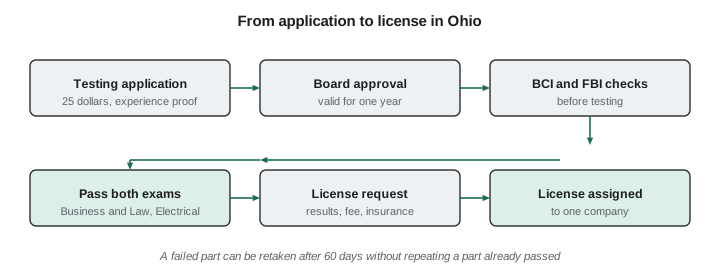
The electrical section reviews each testing application to decide whether the applicant is eligible to sit for the examination, and the applicant is notified by mail. An approval letter is the applicant's ticket to the testing process; the board then notifies PSI, and the applicant receives the PSI Candidate Information Bulletin with scheduling instructions. According to the testing application, approval is valid for one year, and the PSI bulletin says a candidate has one year from the board's notice of eligibility to schedule and take the exam. A candidate who lets that year pass will generally need to reapply.
If the board denies an application, the denial letter should explain the reason. Common reasons include missing tax years, experience that does not appear to be in the trade, and supporting items that are not on the accepted list. An applicant who disagrees with a denial has rights under the Ohio administrative procedure law, including a hearing in many cases, and should read the letter carefully for deadlines.
The background check
After approval and before the exam, the applicant must obtain a background check from the Ohio Bureau of Criminal Investigation and one from the FBI. These are usually done with electronic fingerprinting at a WebCheck location, and the results are sent to the agency the applicant designates. Ask the board which reason code and recipient to use, because a check sent to the wrong agency must be repeated. Keisha's checks came back in under two weeks, but Linda has seen them take longer in busy months.
Scheduling with PSI
PSI administers the Ohio contractor exams by computer at test centers in Ohio and other states. Approved candidates follow the instructions in the bulletin to register and pay the examination fee. The bulletin lists an examination fee of sixty-nine dollars per registration and states that registration fees are not refundable or transferable. Each exam part is registered separately, so a candidate taking both the electrical exam and the business and law exam pays for each one, and a retake is a new registration with a new fee.
Candidates can usually choose the order of the exams. Many people take the business and law exam first, because it is shorter and its reference book is different from the NEC, and then schedule the electrical exam a week or two later. Others prefer to take the electrical exam while the code is fresh from their core studies. Keisha chose to take the business and law exam first, on a Thursday morning in March, and the electrical exam the following Tuesday.
| Step | What happens | Typical fee or limit |
|---|---|---|
| Testing application | Filed with the Division of Industrial Compliance | 25 dollars |
| Approval | Board reviews eligibility; valid for one year | No fee |
| Background checks | BCI and FBI checks after approval | Fingerprinting vendor fees |
| Exam registration | Each part registered with PSI | 69 dollars per registration, not refundable |
| Retake | After a failed part | Wait 60 days; new registration and fee |
| License request | Results, insurance certificate and issuance fee | 25 dollars |
Test day logistics
PSI's bulletin explains identification rules, arrival time, what may be brought into the testing room and how the open-book references are checked. Arrive early with the required identification, and expect your references to be inspected before you begin. The Ohio exams are open book, but only the references listed in the bulletin may be used, and the business and law reference may not be highlighted or annotated during the exam. Lesson 4 covers the exam parts and references in detail.
Candidates receive notice of pass or fail at the end of each exam session. A passing score report is the document the board will want to see when you request the license, so keep it safe and make a copy.
Retakes and attempt limits
A candidate who fails a part does not have to retake a part already passed. The PSI bulletin says a candidate must wait sixty days after a failed portion before retesting, and section 4740.06 says an applicant who fails may retake the exam no sooner than sixty days after the most recent attempt. The bulletin also mentions retesting up to five times in a year, and the statute provides that after five attempts the applicant must reapply before testing again. The practical lesson is that each failure costs at least two months, a new fee and part of the one-year eligibility window, so it pays to be well prepared for the first attempt.
# Plan retakes inside the one-year eligibility window (study aid)
from datetime import date, timedelta
eligible_from = date(2027, 2, 22)        # board notified PSI of eligibility
window_ends = eligible_from + timedelta(days=365)
first_try = date(2027, 3, 18)
wait = timedelta(days=60)
attempt = first_try
n = 1
while attempt <= window_ends and n <= 5:
    print("attempt", n, "on or after", attempt.isoformat())
    attempt = attempt + wait
    n += 1
print("eligibility window ends", window_ends.isoformat())attempt 1 on or after 2027-03-18 attempt 2 on or after 2027-05-17 attempt 3 on or after 2027-07-16 attempt 4 on or after 2027-09-14 attempt 5 on or after 2027-11-13 eligibility window ends 2028-02-22
The calculation shows that a candidate who first tests a month after approval can, in the worst case, fit several retakes into the year, but each one is two months later than the last. Most candidates who prepare properly never need the second line.
Requesting the license
Passing both exams does not automatically produce a license. According to the testing application, after passing both sections the candidate requests the state license by sending a copy of the exam results, a check for twenty-five dollars payable to the Treasurer, State of Ohio, and proof of at least 500,000 dollars of contractor liability insurance in the form of a certificate of liability insurance. The license and the insurance must be assigned to a contracting company as defined in section 4740.01. Section 4740.06 says the appropriate section of the board must authorize the license within ninety days after the application was filed, provided the applicant meets the qualifications and has passed the exam.
Keisha's license would be assigned to Stillwater Electric Company, and the company's insurance agent prepared a certificate naming the company, showing the required limit and listing the Division of Industrial Compliance as the certificate holder. Lesson 8 explains the insurance requirement and what happens to the assignment if the license holder leaves the company.
Worked problem
Building Keisha's calendar
Keisha's approval letter is dated February 22, 2027. She plans to take the business and law exam on March 18 and the electrical exam on March 23. If she fails the electrical exam, what is the earliest date she could retake it, and is she still inside the one-year window?
Show solution
- The retake rule requires a sixty-day wait after the failed attempt.
- Sixty days after March 23 is May 22, 2027.
- The one-year eligibility window runs to about February 22, 2028.
- May 22, 2027 is well inside the window, and the business and law pass would not need to be repeated.
Answer: May 22, 2027 at the earliest, comfortably inside her one-year window.
Keeping the paperwork organized
A licensing application involves more documents than most electricians expect, and they arrive at different times: the approval letter, the PSI bulletin, the background check confirmations, two PSI registration confirmations, two score reports, the insurance certificate and finally the license. Linda keeps a single checklist for each applicant with a line for every document, the date it was sent or received and where the copy is filed. When the board or PSI asks a question, the answer is in one place.
Keisha added her own step: she scanned every document into a folder on her phone. On the morning of her electrical exam, the PSI check-in clerk asked to see her confirmation and her identification, and having both ready made the process quick. The day her license arrived, she scanned it too and sent a copy to every building department where Stillwater was registered.
Out-of-state candidates and test centers
PSI offers Ohio exams at test centers in Ohio and in other states, which helps candidates who live near a state line or are moving to Ohio. The board also publishes a separate testing application for out-of-state license holders who use the alternative route in section 4740.06. Those applicants still take the Business and Law exam and, unless the board decides otherwise, the trade exam. An out-of-state applicant should read the out-of-state application carefully, because its document list differs from the standard tradesperson route, and should confirm that the employer is registered in Ohio before applying.
Whichever route an applicant uses, the final steps are the same: a passing score on both exams, proof of insurance and assignment of the license to an Ohio contracting company.
Common mistakes
MistakeMailing the application without the fee or with the fee payable to the wrong party.
InsteadSend the 25-dollar fee payable as the form directs, to the Treasurer, State of Ohio.
MistakeAssuming passing the exams issues the license automatically.
InsteadYou must request the license with the results, the 25-dollar fee and proof of 500,000 dollars of liability insurance.
MistakeRetaking a failed part the next week.
InsteadWait at least sixty days after a failed attempt.
MistakeLetting the eligibility year run out while studying.
InsteadSchedule both parts soon after approval and track the one-year window.
Summary and key terms
- The testing application, with a 25-dollar fee and the experience documents, is filed with the Division of Industrial Compliance.
- The electrical section reviews eligibility; approval is valid for one year, and PSI gives a year from eligibility to test.
- BCI and FBI background checks are required after approval and before testing.
- Each exam registration with PSI costs 69 dollars and is not refundable; failed parts may be retaken after sixty days, within attempt limits.
- After passing, the candidate requests the license with the results, a 25-dollar fee and proof of 500,000 dollars of liability insurance assigned to a contracting company.
- Testing application
- The form that starts the process and asks the board to approve the applicant for the exams.
- Candidate Information Bulletin
- PSI's guide to registration, fees, identification, references and exam content.
- Retake wait
- The sixty days that must pass after a failed attempt before retesting.
- License request
- The post-exam submission of results, fee and insurance proof that leads to license issuance.
- Assignment
- The designation of the contracting company that will use the individual's license.
Practice problems
Work each problem on paper first, then reveal the answer to check.
What is the board's fee for the application for examination?
Show answer
Twenty-five dollars.
How much is each PSI exam registration, according to the bulletin?
Show answer
Sixty-nine dollars per registration, not refundable or transferable.
A candidate fails the electrical exam on June 10. When is the earliest retake?
Show answer
Sixty days later, on August 9.
What three items does the testing application say to send to request the license?
Show answer
A copy of the exam results, a 25-dollar check and proof of at least 500,000 dollars of contractor liability insurance.
Lesson quiz · 5 questions
Score 60% or more to complete this lesson.
Create a free account to save your progress, take quizzes and earn a certificate.