
MELU-310 · Lesson 10 of 12 · 18 min
Workplace safety law and OSHA for electrical contractors
▶ Video coming soon A video version of this lesson is on the way.
Keisha's first serious safety decision as license holder came on a Friday afternoon at the Oakwood dental office. The building owner wanted a new circuit added to an existing panel without shutting down the dental chairs on a busy day, and the owner's facility manager asked whether Stillwater's electrician could "just work it hot, carefully." The electrician, Josh, called Keisha. She drove over, looked at the panel, and said no. "We'll schedule the shutdown for Saturday morning," she told the facility manager. "If you want it done today, the answer is still no." On the drive back to the shop she thought about what the business and law exam had asked about safety, and how differently it felt when the decision was real.
This lesson covers the safety law that applies to Ohio electrical contractors: federal OSHA jurisdiction in Ohio, the construction and general industry standards most relevant to electrical work, NFPA 70E, OSHA recordkeeping and reporting, incident rates, the BWC's safety programs, and the license holder's role in building a safety culture. OSHA requirements summarized here come from federal rules as of late 2026; read the current regulations and talk to a safety professional for real decisions.
Who enforces safety law in Ohio
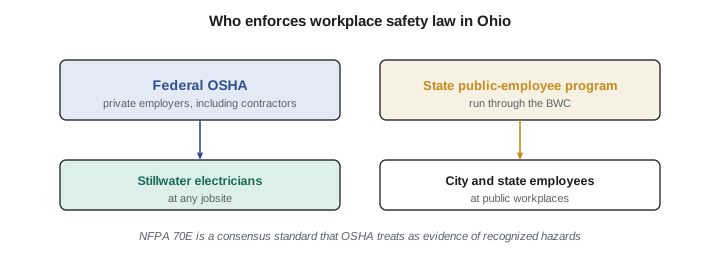
Ohio does not operate a state OSHA plan for private employers, so private-sector workplaces in Ohio, including electrical contractors and their jobsites, fall under federal OSHA. Federal OSHA area offices in Ohio inspect workplaces, respond to complaints and serious incidents, and issue citations and penalties under the Occupational Safety and Health Act. Public employees of state and local government in Ohio are covered by a separate state program run through the Bureau of Workers' Compensation, known as the Public Employment Risk Reduction Program. A Stillwater electrician working at a city water plant is protected by federal OSHA as a private employee, even though the city's own workers on the same site fall under the state public-employee program.
Under the federal law, every employer has a general duty to provide a workplace free from recognized hazards that are causing or likely to cause death or serious physical harm, in addition to following the specific standards. On multi-employer construction sites, OSHA may cite a contractor that created a hazard, exposed its employees to it, was responsible for correcting it, or controlled the site, which is why general contractors and subcontractors both care about each other's safety practices.
Standards that matter most for electrical work
Electrical contractors work under both the construction standards in 29 CFR Part 1926 and the general industry standards in 29 CFR Part 1910, depending on whether the work is construction or maintenance. In construction, Subpart K of Part 1926 covers electrical safety, including ground-fault protection for temporary power on jobsites, which can be met with GFCIs or an assured equipment grounding conductor program. Other construction subparts cover fall protection, ladders, scaffolds, excavations, personal protective equipment and hazard communication. In general industry, Subpart S of Part 1910 covers electrical work practices and the control of hazardous energy standard, often called lockout/tagout, covers servicing and maintenance of machines and equipment.
The rule that matters most is simple: work on electrical equipment should be done de-energized unless de-energizing creates a greater hazard or is infeasible because of equipment design or operational limits. Inconvenience is not a reason to work energized, which is why Keisha refused the Friday request. When equipment must be de-energized, it must be locked out and tagged out according to a written procedure and verified as de-energized before work begins.
| Topic | Main source | What it requires (summary) |
|---|---|---|
| Temporary power on jobsites | 29 CFR 1926 Subpart K | Ground-fault protection by GFCI or an assured equipment grounding conductor program |
| Electrical work practices | 29 CFR 1910 Subpart S and 1926 Subpart K | De-energize where feasible; safe work practices near energized parts |
| Control of hazardous energy | 29 CFR 1910.147 and 1910.333 | Written lockout/tagout procedures and verification |
| Arc flash and shock risk assessment | NFPA 70E (consensus standard) | Risk assessments, boundaries, PPE and energized work permits |
| Fall protection | 29 CFR 1926 Subpart M | Protection at heights during construction |
| Recordkeeping | 29 CFR 1904 | Logs, summaries and reporting of serious injuries |
NFPA 70E
NFPA 70E, Standard for Electrical Safety in the Workplace, is a consensus standard rather than a regulation, but OSHA uses it as evidence of recognized hazards and feasible protective measures, and many owners require contractors to follow it. It describes how to establish an electrically safe work condition, how to perform shock and arc flash risk assessments, the approach boundaries around exposed energized parts, the selection of personal protective equipment, the training required for qualified persons, and the energized electrical work permit that must be completed when energized work is justified. A contractor that follows 70E is in a much stronger position if OSHA ever investigates an incident.
OSHA recordkeeping and reporting
Under 29 CFR Part 1904, employers with more than ten employees in most industries, including construction, must record work-related injuries and illnesses that meet the recording criteria on the OSHA 300 log, complete an OSHA 301 incident report for each case, and prepare the OSHA 300A annual summary. The 300A must be posted from February 1 to April 30 of the following year, and the records must be kept for five years. Establishments of certain sizes in designated industries must also submit injury data electronically to OSHA each year by March 2. Separately from recordkeeping, every employer must report a work-related fatality to OSHA within eight hours, and an in-patient hospitalization, amputation or loss of an eye within twenty-four hours.
Linda keeps Stillwater's 300 log, and Keisha reviews every entry. The log is more than a legal chore: it shows which jobs and tasks produce injuries, and it feeds the incident rate that customers ask about in prequalification forms.
Incident rates
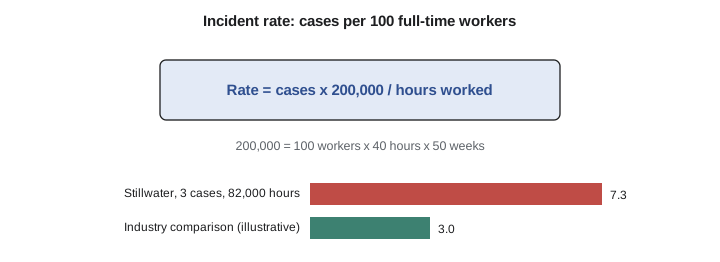
The total recordable incident rate expresses recordable cases per one hundred full-time workers per year. It is calculated by multiplying the number of recordable cases by 200,000, which represents one hundred workers working forty hours a week for fifty weeks, and dividing by the total hours worked by all employees. A similar formula with only the days-away, restricted or transferred cases gives the DART rate. Owners and general contractors compare these rates, along with the BWC experience modifier from Lesson 8, when they decide which contractors may bid.
# Total recordable and DART incident rates (study aid)
hours_worked = 41 * 2000          # about 41 full-time workers for a year
recordable_cases = 3
dart_cases = 1
trir = recordable_cases * 200000 / hours_worked
dart = dart_cases * 200000 / hours_worked
print("hours worked:", hours_worked)
print(f"TRIR: {trir:.2f} cases per 100 full-time workers")
print(f"DART: {dart:.2f} cases per 100 full-time workers")hours worked: 82000 TRIR: 7.32 cases per 100 full-time workers DART: 2.44 cases per 100 full-time workers
With three recordable cases in 82,000 hours, Stillwater's total recordable rate is about 7.3, which would stand out on many owners' prequalification forms. The number shows why one serious injury can affect a small contractor's ability to bid for years.
The BWC's safety programs
Because the BWC insures most Ohio employers, it also runs programs to reduce workplace injuries. These have included safety consulting services, training through its safety education center, grants to help employers buy safety equipment, and premium discount programs that reward employers for safety activities. Program names and requirements change, so check the BWC's current offerings. For a mid-size contractor like Stillwater, BWC training and consulting can supplement the company's own safety program at little or no extra cost, and lower claim costs improve the experience modifier that sets future premiums.
The license holder and safety culture
Ohio's licensing law does not make the license holder the company's safety officer, but the duty of personal supervision described in Lesson 7 makes it hard to separate supervision of the work from supervision of how safely it is done. A license holder who allows crews to work energized for convenience, skips lockout or ignores temporary power protection is putting the license at risk as well as the workers. Keisha's approach was to write three non-negotiable rules on the whiteboard in the shop: no energized work without a 70E permit approved by her, no work on a circuit until it is locked, tagged and tested, and no work at height without the right protection. Everything else could be discussed.
Worked problem
The Friday request, on paper
The dental office facility manager asks Stillwater to add a breaker to an energized panel during business hours. What does the analysis look like under OSHA and NFPA 70E?
Show solution
- De-energizing the panel is feasible; the only cost is inconvenience to the dental practice.
- Inconvenience is not an acceptable reason for energized work under OSHA's work practice rules or NFPA 70E.
- The work is scheduled for a planned shutdown with lockout/tagout and verification of absence of voltage.
- If energized work were truly justified, an energized electrical work permit, risk assessment, boundaries and PPE would be required first.
Answer: Schedule a shutdown; energized work is not justified by convenience.
Building a written safety program
OSHA requires written programs for certain hazards, such as hazard communication and lockout/tagout, and many owners and general contractors require a written company safety program before a contractor may work on their sites. A practical program for an electrical contractor covers management commitment and responsibilities, hazard identification and job hazard analysis, electrical safe work practices and NFPA 70E procedures, lockout/tagout, temporary power and ground-fault protection, fall protection, ladders and scaffolds, excavation and trenching for underground work, personal protective equipment, hazard communication, first aid and emergency response, incident reporting and investigation, and training records.
A program on paper is only useful if crews use it. Stillwater holds a short toolbox talk at the start of each week on every job, often on a topic drawn from a recent near miss or inspection finding, and records attendance. New hires go through an orientation that covers the company's three non-negotiable rules before they set foot on a site. Supervisors complete NFPA 70E training, and qualified electricians receive refresher training on the schedule the standard sets.
Investigating incidents and near misses
When something goes wrong, or almost goes wrong, the goal of an investigation is to find the causes and prevent a repeat, not to assign blame. A simple investigation records what happened, when and where, who was involved, what the conditions were, and then asks why at each step until the underlying causes appear. The fixes might be a changed procedure, better equipment, additional training or a change in scheduling pressure. Near misses deserve the same attention as injuries, because they reveal the same hazards without the cost.
Keisha reviews every incident and near-miss report personally. After a crew member received a minor shock from a mislabeled circuit in an occupied building, she added a step to the lockout procedure: test every conductor in the box before touching it, not just the one on the labeled breaker.
Over her first year, Keisha also learned to read the 300 log as a management tool. Three of the year's first-aid cases involved cuts from cable stripping, so the company switched to a different stripping tool and the cuts stopped.
Common mistakes
MistakeAssuming Ohio has a state OSHA plan for private contractors.
InsteadPrivate employers in Ohio are under federal OSHA; the state program covers public employees.
MistakeWorking energized because shutting down is inconvenient.
InsteadInconvenience does not justify energized work; de-energize, lock out and verify.
MistakePosting the 300A summary only on request.
InsteadPost it from February 1 to April 30 and keep records for five years.
MistakeReporting a hospitalization at the end of the week.
InsteadReport in-patient hospitalizations, amputations and eye losses within 24 hours, and fatalities within 8 hours.
Summary and key terms
- Private employers in Ohio, including electrical contractors, are under federal OSHA; public employees are covered by a BWC program.
- Construction standards in Part 1926 and general industry standards in Part 1910 both apply to electrical work, including ground-fault protection and lockout/tagout.
- NFPA 70E guides risk assessment, boundaries, PPE and energized work permits, and OSHA treats it as evidence of recognized hazards.
- OSHA 300, 301 and 300A records are kept for five years, the 300A is posted February 1 to April 30, and serious events must be reported within 8 or 24 hours.
- Incident rates use cases times 200,000 divided by hours worked, and the BWC offers safety programs that can lower costs.
- General duty clause
- The requirement that employers keep workplaces free of recognized serious hazards.
- Lockout/tagout
- Procedures for isolating and securing energy sources before servicing equipment.
- NFPA 70E
- The consensus standard for electrical safety in the workplace.
- OSHA 300 log
- The record of work-related injuries and illnesses.
- TRIR
- Total recordable incident rate: recordable cases per 100 full-time workers per year.
Practice problems
Work each problem on paper first, then reveal the answer to check.
Which agency enforces safety law for a private electrical contractor in Ohio?
Show answer
Federal OSHA.
Within how many hours must a work-related fatality be reported to OSHA?
Show answer
Eight hours.
What is the TRIR for 2 recordable cases in 100,000 hours?
Show answer
2 x 200,000 / 100,000 = 4.0.
Is inconvenience a valid reason to work on energized equipment?
Show answer
No.
Lesson quiz · 5 questions
Score 60% or more to complete this lesson.
Create a free account to save your progress, take quizzes and earn a certificate.