
MELU-310 · Lesson 2 of 12 · 19 min
Eligibility for the Electrical Contractor License
▶ Video coming soon A video version of this lesson is on the way.
Before Keisha could book a single exam, the electrical section of the board had to agree that she was qualified to sit for it. In Ohio the eligibility review happens before testing, not after. An applicant files a testing application with the Division of Industrial Compliance, the board reviews the experience and the supporting documents, and only an approved applicant receives the PSI bulletin and the right to schedule. Linda, who had helped two other Stillwater foremen apply over the years, pulled a folder from the filing cabinet labeled "OCILB" and said, "Most people who get rejected don't lack the experience. They just can't prove it. Let's get your paperwork right the first time."
This lesson covers the eligibility requirements in section 4740.06 of the Revised Code and the testing application: the basic qualifications, the experience routes, the documents that prove experience, and the background check that comes after approval. Figures and document lists are taken from the board's testing application and the statute as of late 2026; check the current forms before you apply.
The basic qualifications
To be approved to take the examination, an applicant must meet several basic conditions. The applicant must be at least eighteen years old. The applicant must be a United States citizen or a legal alien who can produce valid documents showing legal residence in the United States. The applicant must not have committed violations of Chapter 4740 or the board's rules, and must not have used fraud, misrepresentation or deception in obtaining or renewing a license or in conducting business. The testing application also asks about criminal convictions, because Ohio limits licensing denials to disqualifying offenses identified under the state's criminal record reforms; an applicant with a conviction should read the board's list of disqualifying offenses and may ask the board in advance whether a particular conviction would be disqualifying.
Two other conditions apply at the license stage rather than the testing stage. The applicant must carry contractor's liability insurance in the amount the electrical section requires, held under only one contracting company name, and the license must be assigned to a contracting company. Lessons 3 and 8 cover those steps. For eligibility to test, the central question is experience.
The experience routes
Section 4740.06 offers several routes to the experience requirement. The standard route is five years of work as a tradesperson in the electrical trade immediately before the date of application. The word immediately matters: the five years are counted back from the application date, so an electrician who left the trade for several years and has just returned may need to rebuild recent experience before applying. The testing application uses the same wording, describing work as a tradesperson in the licensed trade for not less than five years immediately prior to the date of application.
The engineer route is for an applicant who is currently registered as a professional engineer in Ohio and has three years of business experience in the construction industry in the trade. The application also describes a government inspector route: five years of experience as an Ohio government inspector in the electrical trade. The statute adds two special routes. An applicant licensed in another state may qualify by showing at least five building authorizations issued by a local enforcement authority, at least one tax return showing income from that license, and that the employer is registered in Ohio as a foreign corporation or foreign limited liability company with an in-state agent. An applicant with recent military service may qualify by showing active service in the uniformed services for at least three of the five years before applying, and the electrical section may waive that three-year requirement by rule.
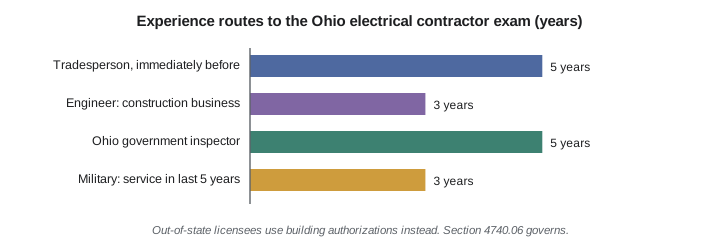
| Route | Experience required | Notes |
|---|---|---|
| Tradesperson | 5 years in the trade immediately before applying | The standard route; proved with tax documents plus one supporting item |
| Registered professional engineer | Current Ohio registration plus 3 years of business experience in construction in the trade | For engineers moving into contracting |
| Government inspector | 5 years as an Ohio government inspector in the trade | Listed on the testing application |
| Out-of-state license holder | 5 building authorizations, a tax return, and an Ohio-registered employer | For licensees from other states |
| Military service | Active service in at least 3 of the last 5 years | The section may waive the 3 years by rule |
Proving five years of experience
The tradesperson route is where most applicants come from, and the testing application spells out how to prove it. Every applicant on that route submits five consecutive years of tax documents, such as W-2 forms or Schedule C of the federal Form 1040 for self-employed work, showing work in the trade. In addition, the applicant submits one of four supporting items:
- permits showing at least one permit for each of the last five years obtained by the applicant's licensed contractor employer, not counting sewer, water, gas service or drain cleaning permits;
- an active journeyman's card in the trade;
- a certificate of completion from a State of Ohio or United States Department of Labor approved apprenticeship; or
- proof of forty hours of non-duplicated code continuing education from an OCILB-approved training agency, taken live or virtually, with self-guided courses not accepted.
Keisha had several of these items. Her W-2s from Stillwater and her previous employer covered more than five consecutive years. She also had a certificate of completion from her state-registered apprenticeship and a journeyman card issued by the City of Dayton. Linda recommended sending the apprenticeship certificate, because it was a single clean document from a recognized program, and keeping the journeyman card as a backup if the reviewer asked for more.
The application itself asks for an employment history, the name of each contracting company, and the applicant's position with each one, described as owner, employee or partner. Reviewers compare the history with the tax documents, so gaps or inconsistencies slow the process down. Veterans complete the full application, including the question about military service, and attach a DD214; supporting documents such as training certificates or a letter from a commanding officer are optional but can help.
# Check a tradesperson-route application before mailing it (study aid)
application = {
    "age": 33,
    "years_in_trade_immediately_before": 10,
    "consecutive_tax_years": 6,
    "supporting_items": ["apprenticeship certificate", "journeyman card"],
    "fee_dollars": 25,
}
accepted_items = {
    "permit for each of last 5 years",
    "journeyman card",
    "apprenticeship certificate",
    "40 hours live code education",
}
problems = []
if application["age"] < 18:
    problems.append("under 18")
if application["years_in_trade_immediately_before"] < 5:
    problems.append("fewer than 5 years immediately before applying")
if application["consecutive_tax_years"] < 5:
    problems.append("fewer than 5 consecutive years of tax documents")
if not accepted_items & set(application["supporting_items"]):
    problems.append("no accepted supporting item")
if application["fee_dollars"] != 25:
    problems.append("check the application fee")
print("ready to mail" if not problems else "fix: " + "; ".join(problems))ready to mail
The check is deliberately simple, but it mirrors how the reviewers think: age, five years immediately before applying, five consecutive years of tax documents, and at least one accepted supporting item. An application that fails any of these is likely to be returned or denied, which costs weeks.
What counts as work in the trade
Experience must be in the electrical trade. Work as an electrician's helper, apprentice, journeyman or foreman on electrical installations generally fits, while time spent in unrelated work does not. Time in a closely related trade, such as low-voltage cabling or HVAC controls, may or may not be accepted depending on the duties, and the electrical section has discretion to accept other experience it finds acceptable. An applicant who is unsure should describe the duties clearly on the application and, if possible, provide a letter from the employer listing the kinds of electrical work performed.
Location matters less than many applicants expect. Experience gained in another state can count toward the tradesperson route if it is documented, because the statute asks about work as a tradesperson, not work in Ohio. Out-of-state license holders may also use the separate route described above. In every case, the documents must show the work clearly enough for a reviewer who has never met the applicant.
Worked problem
Will Josh qualify next year?
Josh Kaminski, Stillwater's fourth-year apprentice, will finish his registered apprenticeship in June 2027. He started as a helper with a residential contractor in March 2022 and joined Stillwater in September 2023. He wants to apply for the electrical contractor exam as soon as possible. When could he reasonably apply on the tradesperson route?
Show solution
- The standard route needs five years in the trade immediately before applying.
- Counting from March 2022, five years of trade work would be complete in March 2027, assuming the helper work was electrical work and he has worked continuously.
- He needs five consecutive years of tax documents for those years: W-2s from both employers would cover 2022 through 2026, with the partial years shown on the forms.
- His apprenticeship certificate will not exist until June 2027, so for an earlier application he would need another supporting item, such as permits from his employers for each of the last five years or forty hours of live code education.
- Applying in mid-2027, after the certificate is issued, gives him the cleanest file.
Answer: About mid-2027, after five full years of trade work and the apprenticeship certificate are both in hand.
After approval: the background check
The board reviews the testing application and notifies the applicant by mail. According to the testing application, approval is valid for one year. After approval, and before sitting for the examination, the applicant must obtain both an Ohio Bureau of Criminal Investigation background check and an FBI background check, usually through a WebCheck fingerprinting location. The PSI candidate bulletin also says that once the board notifies PSI that a candidate is eligible, the candidate has one year to schedule and take the examination. Keisha booked her fingerprints the same week her approval letter arrived, because the reports can take time and the one-year window starts running immediately.
Common problems in testing applications
Linda's folder of past applications showed the same few problems again and again. The first was a gap in the tax documents: an applicant who changed employers in the middle of a year sent the W-2 from the new employer but forgot the one from the old employer, so the reviewer saw only part of that year. The second was a supporting item that did not match the rules, such as a journeyman card from a city that had expired, or a list of permits that included water and sewer permits, which do not count. The third was an employment history that described the work too vaguely. "Electrician" is better than "laborer," and "installed commercial feeders, branch circuits and motor controls" is better than "electrician."
Small details matter as well. The name on the application should match the name on the tax documents and identification, and a name change should be explained. The fee should be in the form and amount the current application requires. The application should be signed and dated where the form asks. Each of these takes a minute to check and can save weeks of back-and-forth with the board.
Keisha's application went through on the first review. The approval letter arrived about three weeks after she mailed it, and she scheduled her fingerprints the same afternoon.
Common mistakes
MistakeCounting five years of experience from anywhere in your career.
InsteadThe standard route requires five years immediately before the application date.
MistakeSending tax documents without a supporting item.
InsteadThe tradesperson route needs five consecutive years of tax documents plus one of the four supporting items.
MistakeUsing sewer or gas service permits as proof.
InsteadSewer, water, gas service and drain cleaning permits do not count toward the permit option.
MistakeWaiting months after approval to start the background check.
InsteadThe checks are required before testing, and both the approval and the testing eligibility run for about a year.
Summary and key terms
- Applicants must be at least 18, a citizen or legal alien, and free of disqualifying conduct and offenses.
- The standard route requires five years as a tradesperson in the electrical trade immediately before applying.
- Alternative routes cover registered professional engineers with three years of construction business experience, Ohio government inspectors, out-of-state license holders and recent military service.
- Tradesperson applicants submit five consecutive years of tax documents plus one supporting item: annual permits, a journeyman card, an approved apprenticeship certificate or forty hours of live code education.
- Approval is valid for one year, and BCI and FBI background checks are required before testing.
- Tradesperson route
- The standard path to eligibility: five years of electrical trade work immediately before applying.
- Supporting item
- One of the four documents that, with tax records, proves tradesperson experience.
- Testing application
- The form filed with the Division of Industrial Compliance to be approved to take the exams.
- BCI and FBI checks
- State and federal criminal background checks required after approval and before testing.
- Approved apprenticeship
- A program registered with the State of Ohio or the U.S. Department of Labor.
Practice problems
Work each problem on paper first, then reveal the answer to check.
What is the minimum age to apply?
Show answer
Eighteen.
How many consecutive years of tax documents does a tradesperson applicant submit?
Show answer
Five.
A registered professional engineer wants to apply. What experience must they show?
Show answer
Current Ohio registration plus three years of business experience in the construction industry in the electrical trade.
Can self-guided online courses count toward the forty hours of code education option?
Show answer
No. The forty hours must be taken live or virtually from an OCILB-approved training agency; self-guided courses are not permitted.
Lesson quiz · 5 questions
Score 60% or more to complete this lesson.
Create a free account to save your progress, take quizzes and earn a certificate.