
MELU-310 · Lesson 11 of 12 · 19 min
Renewal and continuing education
▶ Video coming soon A video version of this lesson is on the way.
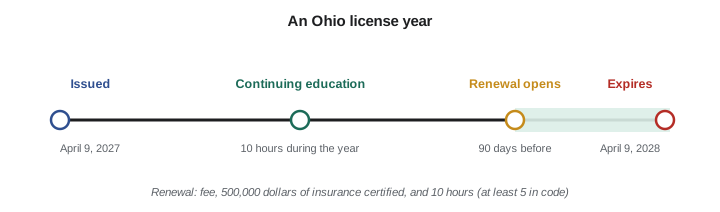
Keisha's license was issued on April 9, 2027, and Linda immediately added a recurring entry to the office calendar for every year on that date, with reminders ninety, sixty and thirty days ahead. Dale laughed when he saw it. "I renewed mine every year for thirty-five years," he said, "and twice I almost forgot. Once it was the insurance certificate. Once it was the code class." Linda did not laugh. "That's why the calendar has three reminders," she said.
This lesson explains how an Ohio electrical contractor license is kept current: the annual renewal cycle and the triennial option, fees and late fees, the insurance certification, continuing education hours and topics, inactive status and reactivation, and what happens when renewal is missed. Details come from section 4740.06 and the board's rules in Chapter 4101:16 of the Administrative Code as of late 2026; rules and fees change, so confirm them with the Division of Industrial Compliance before each renewal.
The renewal cycle
Section 4740.06 provides that licenses expire annually on the same date as the contractor's original license, so each license holder has a personal renewal date tied to the day the license was first issued rather than a common statewide deadline. A license holder may file a renewal application up to ninety days before expiration, without reexamination. The board's fee rule lists both an annual renewal fee and a triennial renewal fee, which allows a license holder to renew for three years at once where the board permits it.
Renewal requires three things: the renewal fee, certification that the license holder carries the required contractor liability insurance, and proof that the continuing education requirement has been met. The renewal rule says the license holder certifies coverage of five hundred thousand dollars in contractor liability insurance. Missing any of the three can stop the renewal.
| Item | Amount or rule | Source |
|---|---|---|
| Annual renewal fee | 60 dollars per license | Fee rule 4101:16-2-09 |
| Triennial renewal fee | 180 dollars per license | Fee rule 4101:16-2-09 |
| Late fee | Not more than 120 dollars per license | Fee rule 4101:16-2-09 |
| Earliest renewal filing | 90 days before expiration | Section 4740.06 |
| Insurance certification | 500,000 dollars of contractor liability insurance | Renewal rule 4101:16-2-07 |
| Continuing education | 10 hours each year; no carryover | Rule 4101:16-2-08 |
Continuing education hours and topics
Rule 4101:16-2-08 requires ten classroom hours of approved continuing education each year as a condition of renewal. For a license holder who holds only the electrical contractor license, at least five of the ten hours must be electrical code courses approved by the electrical section, and the remaining five must be health and safety, business or technology courses approved by the electrical section. A license holder who also holds another license under Chapter 4740, such as an HVAC license, must take five hours of electrical code and may take the other five hours in any course approved by any specialty section.
Hours beyond the requirement cannot be carried over to the next renewal period. A license holder who takes twenty hours in one year still needs ten new hours the following year. Courses must be approved by the board and offered by approved providers; a course that is not on the approved list does not count, no matter how useful it is. Many providers offer live classroom sessions and live online sessions, and the rule's references to classroom hours mean license holders should check how a particular format is treated before signing up.
# Check a year's continuing education against rule 4101:16-2-08 (study aid)
courses = [
    ("2023 NEC changes, part 1", "code", 3),
    ("Grounding and bonding review", "code", 2),
    ("NFPA 70E for supervisors", "safety", 3),
    ("Lien law and payment", "business", 2),
]
code_hours = sum(h for _, kind, h in courses if kind == "code")
other_hours = sum(h for _, kind, h in courses if kind in ("safety", "business", "technology"))
total = code_hours + other_hours
print("code hours:", code_hours, "| safety, business or technology hours:", other_hours, "| total:", total)
ok = code_hours >= 5 and total >= 10
print("meets the electrical-only requirement" if ok else "short of the requirement")code hours: 5 | safety, business or technology hours: 5 | total: 10 meets the electrical-only requirement
Keisha's first-year plan used the same split: five hours on the 2023 NEC, three hours of NFPA 70E for supervisors and two hours on lien law and payment, all from board-approved providers. She chose topics that would also help the company, so the hours did double duty.
Keeping proof
Providers report completions or issue certificates, and the license holder should keep copies of every certificate for several years. If the board audits a renewal, the license holder must be able to show that the hours were completed, approved and of the right type. Linda keeps a folder for each license holder with the certificates sorted by renewal year.
Missed renewals, suspension and late renewal
If renewal requirements are not met by the expiration date, the license is automatically suspended under the renewal rule. A company whose only license holder's license is suspended may not contract for licensed electrical work until the license is restored, and building departments may refuse to issue permits. The rule allows reactivation and late renewal applications within one calendar year of expiration, with payment of the renewal fee plus a late fee. Section 4740.06 also allows the board's section, within one calendar year after expiration, to waive renewal requirements for substantial compliance or excusable neglect and to impose conditions that must be met before the license is reissued.
Beyond one year, the path back is harder, and the license holder should ask the board what is required, which may include reexamination. The practical lesson is the one Linda's calendar teaches: renew early, inside the ninety-day window, and never let the insurance or the continuing education be the last item finished.
Inactive status
A license that is not assigned to any contracting company is placed in inactive status under section 4740.07. Inactive status lets an individual keep the license without contracting, for example after retiring or while working for an owner rather than a contractor. To return to active status, the individual assigns the license to a contracting company and provides proof of the required insurance, along with any renewal and continuing education requirements the board applies. The board publishes an active status request form for that purpose. Dale planned to move his license to inactive status when Keisha's license replaced his on Stillwater's records, keeping the option to return if the company ever needed a second license holder.
Changes to report between renewals
Renewal is not the only time the board needs to hear from a license holder. Changes in the contracting company to which the license is assigned, the holder's address, or the company's legal form should be reported promptly, and a change of company starts the ninety-day window described in Lesson 7. Insurance changes, such as a new carrier, should be backed by a new certificate on file. Keeping the board's records current avoids renewal problems and makes it easier for building departments to verify the license.
Worked problem
Planning Keisha's first renewal
Keisha's license was issued on April 9, 2027. When does it expire, when can she first file the renewal, and what must be in place?
Show solution
- Ohio licenses expire annually on the same date as the original license, so it expires April 9, 2028.
- She may file up to ninety days before expiration, which is January 10, 2028.
- She needs ten approved hours of continuing education completed in the license year: at least five in electrical code and five in health and safety, business or technology.
- She must certify 500,000 dollars of contractor liability insurance and pay the renewal fee.
- If she misses April 9, the license is suspended; late renewal within one year requires the fee plus a late fee.
Answer: Expires April 9, 2028; file from January 10, 2028 with ten hours of approved education, the insurance certification and the fee.
Choosing continuing education that helps the business
Ten hours a year is a small amount of time, and choosing the courses carefully turns a requirement into an advantage. Code courses are most useful when they focus on changes in the edition being enforced and on the topics that cause failed inspections. Safety courses can meet NFPA 70E refresher training needs for supervisors. Business courses on estimating, contracts, lien law and financial management help a license holder run the company better. Technology courses can cover areas where Stillwater is growing, such as EV charging, energy storage and building controls.
Keisha planned her courses around the company's needs. In her first year, the EV charger work at a credit union and a school district led her to a code course that covered EV supply equipment and load management. In her second year, a dispute over a change order led her to a business course on contracts. She kept a short list of topics she wanted to learn about and checked it against approved course listings each fall.
Keeping several licenses current
Some contractors hold more than one OCILB license, such as electrical and HVAC, and some license holders hold licenses in other states as well. Each Ohio license has its own renewal date, fee and continuing education requirement, although the rule allows a license holder with an electrical license and another Chapter 4740 license to use five hours from any specialty section's approved courses alongside the five electrical code hours. Licenses in other states have their own rules and do not count toward Ohio's requirements unless a course is approved in both places.
Linda's calendar handles all of this with one rule: each license gets its own line, its own renewal date and its own reminders, even when the same person holds several. The cost of a missed renewal, in suspended work and lost permits, is always higher than the cost of a few calendar entries.
Planning for the long term
License continuity is a business planning issue. A company with a single license holder is exposed if that person leaves, becomes ill or dies. Many contractors encourage a second qualified employee to earn a license, so that one can step in if needed. Stillwater's plan was for Keisha to hold the assigned license and for Ray, who already held an Ohio license, to keep his license active so it could be assigned quickly if necessary. Dale kept his own license inactive. With two licensed people on staff, the company would never face the ninety-day deadline from Lesson 7 without a ready answer.
Linda also keeps a record of every renewal submitted, with the date, the confirmation and a copy of the insurance certificate, so the company can prove a timely filing if a question ever comes up.
A renewal checklist
Ninety days out, Linda confirms that the continuing education hours are complete or scheduled and that the insurance certificate on file runs past the renewal date. Sixty days out, she gathers the certificates of completion and checks that the board shows the hours. Thirty days out, the renewal should already be filed; if it is not, the reason goes to Keisha the same day. After the renewal is approved, she files the new license copy, sends it to the building departments that keep one on file, and sets next year's reminders.
Common mistakes
MistakeAssuming everyone renews on the same statewide date.
InsteadOhio licenses expire annually on the anniversary of the original license.
MistakeCarrying extra hours forward.
InsteadHours beyond ten cannot be applied to the next renewal period.
MistakeTaking ten hours of business courses.
InsteadElectrical-only license holders need at least five hours of electrical code.
MistakeWaiting until the expiration date to renew.
InsteadFile early in the ninety-day window; a missed renewal suspends the license automatically.
Summary and key terms
- Ohio licenses expire annually on the anniversary of the original license, and renewals may be filed up to 90 days early.
- The fee rule lists 60 dollars for annual renewal, 180 dollars for triennial renewal and a late fee of not more than 120 dollars.
- Renewal requires the fee, certification of 500,000 dollars of liability insurance and ten hours of approved continuing education.
- Electrical-only license holders need at least five code hours and five health and safety, business or technology hours, with no carryover.
- Missed renewals suspend the license; late renewal is possible within one year, and unassigned licenses go inactive.
- Renewal window
- The 90 days before expiration when a renewal may be filed.
- Triennial renewal
- Renewing a license for three years at once, with a three-year fee.
- Continuing education
- Approved courses required each year: ten hours, at least five in electrical code for electrical-only holders.
- Automatic suspension
- The status of a license whose renewal requirements were not met by expiration.
- Active status request
- The process for returning an inactive license to use by assigning it to a company.
Practice problems
Work each problem on paper first, then reveal the answer to check.
How many hours of continuing education does an Ohio electrical contractor need each year?
Show answer
Ten.
How many of those must be electrical code hours?
Show answer
At least five.
How early may a renewal be filed?
Show answer
Up to 90 days before expiration.
A license holder took 14 hours this year. How many count toward next year?
Show answer
None; there is no carryover.
Lesson quiz · 5 questions
Score 60% or more to complete this lesson.
Create a free account to save your progress, take quizzes and earn a certificate.