
MELU-310 · Lesson 12 of 12 · 18 min
Practice exam review and test-day strategy
▶ Video coming soon A video version of this lesson is on the way.
Eight weeks before her exam dates, Keisha laid out a study plan on the whiteboard in Stillwater's conference room. The left side said Business and Law, the right side said Electrical, and down the middle she wrote the two dates: March 18 and March 23. Ray, who had passed both Ohio exams twelve years earlier, looked at the board and added one line at the bottom: "Practice with the clock running." He explained that he had known the code well when he first tested, but he had nearly run out of time because he had never practiced looking things up under pressure.
This lesson pulls the course together into a plan for passing both Ohio exams: a study schedule, how to use practice exams, tracking weak topics, the two-pass method, careful reading of questions, test-day logistics and what to do after the results. It closes with a mixed review of Ohio topics from the earlier lessons. Exam facts come from the PSI bulletin summarized in Lesson 4; check the current bulletin before test day.
Build a plan backward from the exam dates
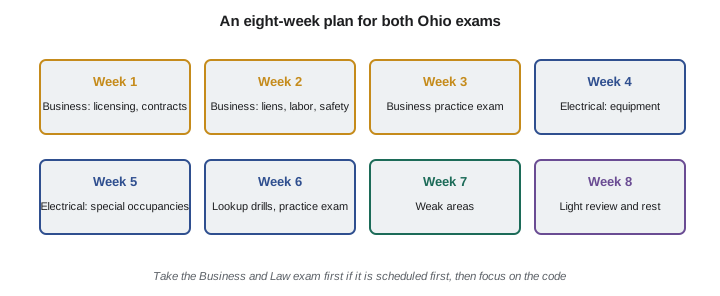
Start with the two dates and work backward. Most candidates who are already strong on the NEC, like those who completed the core courses, need six to eight weeks of focused review: about three weeks on the Business and Law material and four to five weeks on electrical code and calculations, with practice exams at the end of each block. If you have more time, spread the work out; if you have less, cut the topics you already know well, not the practice exams. Keisha's plan put the Business and Law block first because that exam came first.
Studying for Business and Law
The Business and Law exam is written from the NASCLA Ohio guide, so the guide is both the textbook and the reference. Read it once for understanding, then a second time with the bulletin's content outline beside it, tabbing chapters as the bulletin allows. Expect calculation questions on markup and margin, payroll taxes, depreciation, break-even points and financial ratios, and rule questions on lien deadlines, the licensing statute, employment law and OSHA recordkeeping. The Ohio chapters deserve extra attention, because they hold the state-specific details: the Chapter 4740 licensing rules from Lessons 1, 2, 7 and 11, the lien law and prompt payment rules from Lesson 9, and the workers' compensation system from Lesson 8.
Studying for the Electrical exam
The Electrical Contractor exam rewards speed with the NEC more than memory. Use lookup drills: pick twenty random topics, such as working space depth, GFCI locations, motor overload sizing, conductor ampacity adjustment, box fill or grounding electrode conductor sizing, and time how long it takes to find each one in your book. Repeat the drill until most lookups take under a minute. Mix in calculation sets from the core courses: dwelling and commercial load calculations, voltage drop, conduit fill, motor circuits and transformer protection. Use the 2023 edition named in the bulletin for all practice.
| Week | Business and Law | Electrical |
|---|---|---|
| 1 | Read the NASCLA guide chapters on business, licensing and contracts | Tab the NEC; review Articles 90 through 110 |
| 2 | Liens, prompt payment, employment law, safety | Wiring and protection; feeder and service calculations |
| 3 | Taxes, financial statements, ratios; timed practice exam | Wiring methods, conduit and box fill |
| 4 | Review missed topics | Equipment: motors, transformers, panelboards |
| 5 | Light review | Special occupancies and special equipment |
| 6 | Exam day for Business and Law | Lookup drills; timed practice exam |
| 7 | Weak areas from the practice exam | |
| 8 | Light review and rest before the exam |
Use practice exams like a coach
A practice exam is useful only if you learn from it. Take each one under real conditions: the same references, the same time limit and no interruptions. Afterward, sort every missed question into one of three groups: did not know the rule, knew the rule but could not find it in time, or misread the question. Each group needs a different fix. Unknown rules need study. Slow lookups need better tabs and more drills. Misreading needs slower, more careful reading of the stem and every answer choice. Keep a running tally by topic so you can see which areas are improving and which are not.
# Track practice exam misses by topic and cause (study aid)
misses = [
    ("liens", "did not know"), ("ratios", "math error"), ("liens", "misread"),
    ("motors", "slow lookup"), ("box fill", "slow lookup"), ("grounding", "did not know"),
    ("motors", "slow lookup"), ("payroll", "did not know"),
]
by_topic, by_cause = {}, {}
for topic, cause in misses:
    by_topic[topic] = by_topic.get(topic, 0) + 1
    by_cause[cause] = by_cause.get(cause, 0) + 1
print("misses by topic:", dict(sorted(by_topic.items(), key=lambda kv: -kv[1])))
print("misses by cause:", dict(sorted(by_cause.items(), key=lambda kv: -kv[1])))
score = 100 - 3 * len(misses)
print("practice score:", score, "out of 100", "(pass)" if score >= 70 else "(below 70)")misses by topic: {'liens': 2, 'motors': 2, 'ratios': 1, 'box fill': 1, 'grounding': 1, 'payroll': 1}
misses by cause: {'did not know': 3, 'slow lookup': 3, 'math error': 1, 'misread': 1}
practice score: 76 out of 100 (pass)Keisha's tally after her first electrical practice exam showed something she had not expected: most of her misses were slow lookups, not missing knowledge. She spent the next week on drills and retabbed her motor and box fill articles, and her second practice score went up by eleven points.
The two-pass method on test day
Both Ohio exams give a little more than two minutes per question. On the first pass, answer every question you can settle with confidence in that time, and flag any question that needs a long lookup or a long calculation. Do not leave flagged questions blank; enter your best guess so that an unanswered question never costs you a point if time runs out. On the second pass, return to the flagged questions in order, using the time you saved. Keep about one eighth of the total time for the second pass, and check the clock at the quarter, half and three-quarter points against the checkpoints from Lesson 4.
Read the question twice
Many wrong answers on code exams come from reading too fast. Watch for words that change the question: minimum versus maximum, permitted versus required, dwelling versus commercial, copper versus aluminum, and continuous versus noncontinuous loads. Check whether a question asks for a conductor size, an overcurrent device rating or a number of conductors, and whether it asks about the NEC or about Ohio law. On Business and Law questions, check whether the question is about a general rule or the Ohio-specific rule; the lien deadlines in Lesson 9, for example, are Ohio rules and may differ from the examples in a general business chapter.
Test-day logistics
The day before each exam, pack the approved references, checking them against the bulletin's list and rules on markings, your identification, and the PSI confirmation. Get a normal night's sleep. Arrive at the test center early, because check-in includes identity verification and a review of your references. Use the tutorial at the start of the session to learn how to flag questions and review unanswered ones. If something goes wrong at the center, such as a computer problem, tell the proctor immediately and ask for it to be documented.
After the results
You will learn whether you passed each exam at the end of the session. If you pass both, request your license as described in Lesson 3: the score reports, the issuance fee and the insurance certificate, with the license assigned to your contracting company. If you fail one part, review the score report for weak areas, wait the required sixty days, and schedule the retake inside your eligibility year; you do not repeat a part you passed. Keisha passed both on the first try, and the day her license was assigned she called Dale, who was already at the lake.
Mixed Ohio review
The questions in this lesson's quiz and the course exam draw on all twelve lessons. Before test day, make sure you can answer these quickly: which buildings are excluded from the state license requirement and what the low-voltage exemption covers; the experience routes and the documents that prove them; the exam formats, references and retake wait; the NEC edition adopted by the Ohio Building Code and the Ohio amendment to 210.8(F); who enforces the code where no local department is certified; the duties of the license holder and the ninety-day assignment rule; the insurance minimum and Ohio's monopolistic workers' compensation system; the notice of furnishing, lien affidavit and prompt payment deadlines; OSHA jurisdiction and reporting deadlines; and the renewal fee, continuing education hours and late renewal window.
Worked problem
Reading a tricky stem
A practice question asks: A subcontractor last furnished materials to a two-family house on August 14. What is the latest day to record an affidavit for mechanic's lien? Keisha's first instinct is to count seventy-five days. Is that right?
Show solution
- The stem says two-family house, which triggers the shorter residential deadline.
- For a one- or two-family dwelling, the deadline is sixty days after last furnishing, not seventy-five.
- Sixty days after August 14 is October 13.
- If October 13 fell on a weekend or legal holiday, filing on the next business day would generally be timely.
Answer: Sixty days, so October 13; the word two-family changes the answer.
Managing exam stress
Even well-prepared candidates feel pressure on exam day, and a plan for stress is part of a plan for passing. Sleep and normal meals in the days before the exam help more than late-night cramming. On the morning of the exam, a short review of formulas and tab locations is better than trying to learn anything new. During the exam, if a question causes panic, flag it, take a breath and move on; the two-pass method exists for exactly that moment. Remember that a passing score does not require a perfect exam, only 70 out of 100.
Keisha used a simple routine during the electrical exam: at each checkpoint, she sat back, rolled her shoulders, checked her pace against the plan and started again. The routine took less than a minute each time and kept her steady through four hours.
After you pass: the first months as license holder
Passing the exams is the start, not the end. In the first months after the license is assigned, a new license holder should learn the company's permit and inspection records, meet the building officials in the main jurisdictions, review the safety program and the insurance certificates, set up the renewal and continuing education calendar, and establish the supervision habits described in Lesson 7. The business and law material from the exam becomes daily work: contracts to review, lien deadlines to track, payroll classifications to check and safety records to keep.
Dale's last piece of advice to Keisha was practical. "Keep the study notes," he said. "The first time a customer asks about a lien or an inspector asks about the code edition, you'll want them." She still has the binder on the shelf behind her desk.
Common mistakes
MistakeStudying the code without practicing lookups under time.
InsteadRun timed lookup drills until most take under a minute.
MistakeTreating every missed practice question the same way.
InsteadSort misses into unknown rule, slow lookup and misreading, and fix each differently.
MistakeLeaving flagged questions blank on the first pass.
InsteadEnter a best guess for every question and return to flagged ones on the second pass.
MistakeUsing general business chapter examples for Ohio-specific rules.
InsteadCheck whether the question asks for the Ohio rule, such as Ohio lien deadlines.
Summary and key terms
- Plan backward from the exam dates, with separate blocks for Business and Law and for Electrical.
- Study the NASCLA Ohio guide for Business and Law and practice fast NEC lookups for the Electrical exam, using the 2023 edition.
- Take practice exams under real conditions and sort misses by cause to aim further study.
- Use the two-pass method, answer every question and check pace at set checkpoints.
- After passing both exams, request the license; after a failed part, wait sixty days and retake only that part.
- Lookup drill
- Timed practice finding code requirements in the reference book.
- Two-pass method
- Answering quick questions first and returning to flagged ones with saved time.
- Practice exam
- A timed, full-length rehearsal using the approved references.
- Stem
- The part of a question that sets up the situation and asks for the answer.
- Score report
- PSI's record of the exam result, needed to request the license.
Practice problems
Work each problem on paper first, then reveal the answer to check.
What are the three causes to sort practice exam misses into?
Show answer
Did not know the rule, knew it but could not find it in time, and misread the question.
How much time should you keep for the second pass?
Show answer
About one eighth of the total time.
You fail the Electrical exam but pass Business and Law. What do you retake?
Show answer
Only the Electrical exam, after waiting sixty days.
Why does the word two-family matter in a lien question?
Show answer
One- and two-family dwellings have a 60-day affidavit deadline instead of 75 days.
Lesson quiz · 5 questions
Score 60% or more to complete this lesson.
Create a free account to save your progress, take quizzes and earn a certificate.