
MELU-310 · Lesson 6 of 12 · 19 min
Permits, inspections and the inspection authority
▶ Video coming soon A video version of this lesson is on the way.
The Brookville warehouse had been under construction for three months when the first electrical inspection came due. Keisha's crew had set the underground conduits for the service and the site lighting, and the building department's electrical safety inspector arrived on a cold Thursday afternoon with a tablet and a tape measure. He checked the burial depth, the conduit type, the bonding of the metal sweeps and the permit card taped inside the job trailer window, then signed the underground inspection and reminded Keisha that the rough-in would need a separate request. "You'd be surprised how many crews backfill before I get here," he said. "Then we dig."
This lesson explains who enforces the electrical code in Ohio, how building departments and inspectors are certified, how permits are issued and inspections scheduled, how residential and commercial enforcement differ, and the contractor's role in each step. The structure comes from Chapters 3781 and 3791 of the Revised Code and the Board of Building Standards rules; individual departments set their own fees and procedures, so check each jurisdiction's current requirements.
Certified building departments
In Ohio, the Ohio Building Code and the Residential Code of Ohio are enforced by building departments certified by the Board of Building Standards. A city, county or township may operate its own department if the board certifies it, and the board's rules in Chapter 4101:7 of the Administrative Code set the standards for certification, including the qualified personnel the department must employ. A department may be certified for commercial enforcement, residential enforcement or both, and certification may be limited to certain types of work, such as electrical, plumbing or structural review.
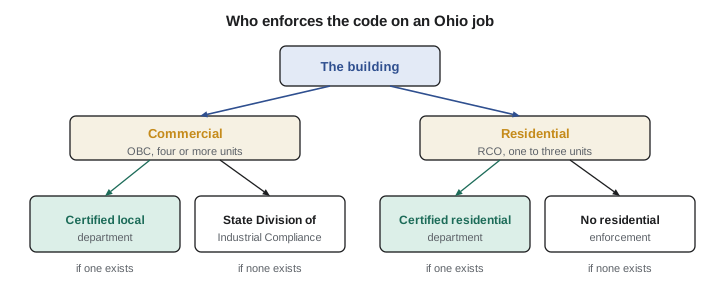
Where no local department is certified to enforce the Ohio Building Code, the state carries out commercial enforcement through the Department of Commerce's Division of Industrial Compliance, which reviews plans and performs inspections for commercial buildings in those areas. Residential enforcement works differently: the Residential Code of Ohio is enforced only where a local department is certified for residential work. In parts of rural Ohio, that means there may be no residential electrical permit or inspection at all, although utilities and lenders may still ask for proof of a safe installation before connecting a new service.
Certified inspectors and plans examiners
The people who review electrical plans and inspect electrical work in a certified department must hold certifications issued by the Board of Building Standards. The board's rules list certification categories, including electrical safety inspector and plans examiner categories for different types of work, with experience, training and examination requirements for each and continuing education to keep the certification. An electrical safety inspector is certified to inspect electrical installations for compliance with the adopted codes, and residential and commercial work may require different certifications.
This matters to contractors for two reasons. First, an inspector's decisions carry the authority of the certified department and the adopted code, so disagreements are resolved through the department's procedures and, if necessary, an appeal, not by arguing on site. Second, the same codes are enforced by inspectors across the state, which makes Ohio more uniform than states where every city writes its own electrical rules. Interpretations still differ from department to department, which is why Lesson 5 recommended reading each department's published policies.
Permits for commercial electrical work
Commercial construction in Ohio generally requires plan approval before work begins, and electrical work is part of that approval. For a new building, the design professional submits construction documents, including electrical drawings, to the building department for plan review. The department may issue a single building permit covering all trades or separate permits for each trade. For an alteration, such as a tenant fit-out, the same process applies at a smaller scale. Many departments require the electrical contractor to be identified on the permit and to be registered with the department, which in turn requires the state license under section 4740.12.
Approved plans govern the installation. If the field conditions require a change, such as relocating a panel or increasing a service size, the change usually needs approval by the department before the work is inspected. Inspectors check the work against the approved plans as well as the code, so a crew that improvises in the field can fail an inspection even if its work meets the NEC.
| Inspection | When to call | What the inspector checks |
|---|---|---|
| Underground or slab | Before backfill or concrete | Burial depth, conduit type, bonding, sleeves |
| Service | Before the utility connects | Service equipment, grounding electrode system, clearances |
| Rough-in | Before walls and ceilings are covered | Boxes, wiring methods, support, fill, conductor sizes |
| Above-ceiling | Before ceiling tiles go in | Supports, fire-rated penetrations, fixture whips |
| Final | When the work is complete | Devices, labeling, panel schedules, GFCI and AFCI, operation |
Inspections and approval to energize
Inspections follow the stages of construction, and each stage must be approved before the work is covered. The contractor or the general contractor requests each inspection through the department's system, often online, and the inspector records the result. A failed inspection lists the corrections, which must be completed before a re-inspection is requested; many departments charge a fee for re-inspections. Approval of the service inspection usually triggers the department's notice to the utility that the service may be connected, and approval of the final inspection is one of the conditions for a certificate of occupancy for the building.
Temporary power on construction sites follows the same pattern on a smaller scale: a permit, an inspection of the temporary service and its grounding, and approval before the utility energizes it. Keisha's crew sets temporary power poles early on every job, and she treats that first inspection as a preview of how the inspector will handle the rest of the project.
Residential permits
On one-, two- and three-family dwellings, permits and inspections follow the Residential Code of Ohio where a department is certified for residential work. Many departments require residential electrical permits for new houses, service changes, additions and major alterations, and some allow homeowners to pull their own permits for work on a house they occupy. Because the state license does not apply to residential work, the department's own registration rules decide who may pull a residential electrical permit, and those rules vary widely.
Stillwater does a handful of residential jobs each year, mostly for repeat commercial customers. For each one, Linda checks whether the township or city is certified for residential work and, if so, what registration it requires. In jurisdictions with no residential department, Stillwater still wires to the NEC and keeps photos and a short report for the customer and the utility.
# Who enforces the code on a job? (simplified study aid)
def authority(building_type, local_commercial_cert, local_residential_cert):
    if building_type == "commercial":
        if local_commercial_cert:
            return "local certified building department"
        return "state Division of Industrial Compliance"
    if local_residential_cert:
        return "local department certified for residential work"
    return "no residential enforcement; check utility and local rules"

jobs = [
    ("Brookville warehouse", "commercial", True, True),
    ("Rural grain dryer building", "commercial", False, False),
    ("Kettering duplex service change", "residential", True, True),
    ("Farmhouse rewire in an uncertified township", "residential", False, False),
]
for name, kind, com, res in jobs:
print(name, "->", authority(kind, com, res))Brookville warehouse -> local certified building department Rural grain dryer building -> state Division of Industrial Compliance Kettering duplex service change -> local department certified for residential work Farmhouse rewire in an uncertified township -> no residential enforcement; check utility and local rules
The two questions in the function, whether the building is commercial and whether a local department is certified for that kind of work, settle most enforcement questions. The real answer for a specific address comes from the Board of Building Standards' list of certified departments and the department itself.
The contractor's responsibilities
The electrical contractor's role in the permit process is to make sure the work is permitted before it starts, built to the approved plans and the adopted code, inspected at every required stage before it is covered, and corrected promptly when an inspection fails. Building departments generally hold the permit holder responsible for the work under the permit, and the license holder is responsible for supervising work done under the license. Starting work without a permit, covering work before inspection, or ignoring a correction notice can lead to stop-work orders, fines, removal of finished work, and complaints to the OCILB.
Appeals are available when a contractor or owner disagrees with a department's decision. A first step is often a meeting with the building official. Ohio law also provides an appeal to the Board of Building Appeals, and local departments may have their own appeal boards for certain matters. Appeals have deadlines, so a contractor who plans to challenge a decision should act quickly and in writing.
Worked problem
A failed rough-in inspection
At the Oakwood dental office, the inspector fails the rough-in because the panel location on site does not match the approved plans; the architect moved it two meters to make room for a cabinet, and nobody told the department. What should Keisha do?
Show solution
- The inspector checks work against the approved plans as well as the code.
- A field change of this kind generally needs approval by the department before re-inspection.
- Keisha asks the architect to submit a revised drawing showing the new panel location and any changes to working space or circuit lengths.
- Once the department approves the revision, she requests a re-inspection and pays any re-inspection fee.
- She also adds a step to her pre-inspection checklist: compare the field layout to the latest approved drawings.
Answer: Get the change approved by the department through a revised drawing, then request re-inspection.
Preparing for an inspection
Stillwater's foremen use a short checklist before every inspection request. The permit card is posted and the approved plans are on site. The work matches the plans, and any approved changes are marked on the field set. Boxes, raceways and cables are supported and secured, and conductor sizes and colors match the circuit schedule. Grounding and bonding connections are made and accessible. Required labels are in place. Covers are off where the inspector will need to look, and a ladder and a light are ready. The foreman walks the area with the checklist before calling, signs it and keeps it in the job file.
The checklist does two things. It catches problems before the inspector does, which saves re-inspection fees and schedule delays. And it shows the license holder's supervision in action, which is the point Lesson 7 makes about personal supervision. Keisha reviews the signed checklists each week and looks for patterns. If the same item keeps coming up, it becomes a toolbox talk topic.
Working with inspectors
Inspectors work for the building department and the public, not for the contractor, but a professional relationship makes every job easier. Be on site when the inspector arrives, answer questions directly, and take notes on corrections. If you disagree with a call, ask which code section the inspector is applying and whether the department has a written interpretation. If the disagreement remains, raise it with the building official in writing rather than on site. Most disagreements end when both sides look at the same code text and the approved plans.
Inspectors also notice patterns. A contractor whose work is consistently ready, neat and complete earns a reputation that speeds up future inspections. Dale used to say that the best advertising Stillwater ever had was an inspector telling a general contractor, "Their work is always ready when they call."
Common mistakes
MistakeAssuming every Ohio township has residential electrical inspections.
InsteadThe residential code is enforced only where a department is certified for residential work.
MistakeTreating approved plans as suggestions.
InsteadInspectors check the work against the approved plans; field changes usually need approval.
MistakeCovering work before the inspection is approved.
InsteadEach stage must be approved before it is covered, or the work may have to be exposed.
MistakeArguing a code interpretation on site.
InsteadRaise disagreements with the building official and use the appeal process if needed.
Summary and key terms
- The Board of Building Standards certifies local building departments and the inspectors and plans examiners who work in them.
- Commercial enforcement is done by certified local departments or, where none exists, by the state Division of Industrial Compliance.
- Residential enforcement happens only where a department is certified for residential work.
- Commercial electrical work usually needs plan approval, a permit and staged inspections, ending with a final inspection tied to occupancy.
- Contractors must work to approved plans, call inspections before covering work and use the appeal process for disputes.
- Certified building department
- A local department certified by the Board of Building Standards to enforce the state codes.
- Electrical safety inspector
- A person certified by the Board of Building Standards to inspect electrical installations.
- Plan approval
- The department's approval of construction documents before work begins.
- Division of Industrial Compliance
- The state agency that enforces the building code where no local department is certified, and runs OCILB operations.
- Board of Building Appeals
- The state board that hears appeals of building code decisions.
Practice problems
Work each problem on paper first, then reveal the answer to check.
Who enforces the Ohio Building Code where no local department is certified?
Show answer
The state Division of Industrial Compliance.
Is there always a residential electrical inspection in Ohio?
Show answer
No. Residential enforcement happens only where a local department is certified for residential work.
What must happen before underground conduit is backfilled?
Show answer
The underground inspection must be approved.
What document governs the installation besides the code?
Show answer
The approved construction documents (plans).
Lesson quiz · 5 questions
Score 60% or more to complete this lesson.
Create a free account to save your progress, take quizzes and earn a certificate.