
MELU-310 · Lesson 5 of 12 · 18 min
The NEC as adopted in Ohio and state amendments
▶ Video coming soon A video version of this lesson is on the way.
On a Saturday morning in February, Keisha walked the Brookville warehouse site with Ray Duncan, Stillwater's senior estimator, while the steel crew finished the roof. The general contractor's superintendent asked a question she would hear again on the exam in a different form: "Which code are we wiring this to, the 2023 or the new one?" Ray answered before she could. "Whatever the building department adopted on the day the permit application went in. For this job, that's the 2023 NEC through the Ohio Building Code." Keisha wrote it down, along with a note to find out exactly how Ohio adopts the NEC.
This lesson explains how the NEC becomes enforceable in Ohio: the Board of Building Standards, the Ohio Building Code and the Residential Code of Ohio, the 2023 NEC adoption dates, the Ohio amendment to the GFCI rules, how code editions change over time, and how the exam's code edition relates to the edition enforced on jobs. Adoption dates and amendments come from public notices and building department guidance as of late 2026; check the Board of Building Standards rules for the edition in force when you work.
The Board of Building Standards
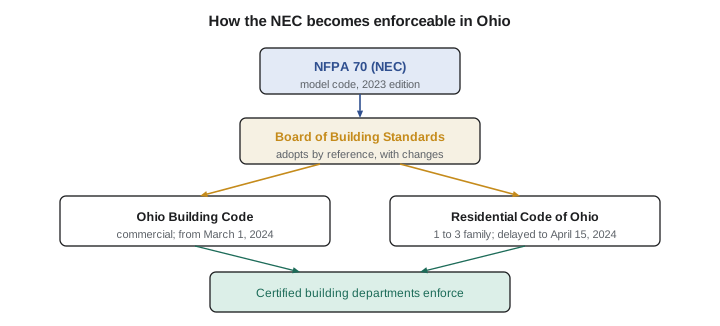
Ohio's building codes are adopted by the Board of Building Standards, a state board within the Department of Commerce that operates under Chapters 3781 and 3791 of the Revised Code. The board writes the Ohio Building Code for commercial buildings and the Residential Code of Ohio for one-, two- and three-family dwellings, adopts national model codes by reference with Ohio changes, and certifies local building departments and the people who work in them. The codes are published as rules in the Ohio Administrative Code, in Chapter 4101:1 for the building code and Chapter 4101:8 for the residential code.
This structure means the NEC is not enforced in Ohio on its own authority. It becomes enforceable because the Ohio Building Code and the Residential Code of Ohio adopt it by reference, sometimes with changes. When you look up an Ohio electrical requirement, the full answer includes the NEC article, the edition the Ohio code adopts, any Ohio amendment to that article and any local interpretation the building department has published.
The commercial side: the Ohio Building Code
The 2024 Ohio Building Code took effect on March 1, 2024. It is based on the 2021 International Building Code with Ohio changes, and its referenced standards adopt NFPA 70, the National Electrical Code, 2023 edition, for electrical work in buildings covered by the Ohio Building Code. A code alert from NEMA reported the 2023 NEC as adopted for commercial work on March 1 and noted one Ohio amendment: Exception No. 2 to section 210.8(F) does not expire. Section 210.8(F) in the 2023 NEC requires GFCI protection for outdoor outlets supplied by certain branch circuits, and its second exception, which relates to outlets for listed HVAC equipment, carries a sunset date in the model code; the Ohio amendment removes that sunset. Read the exact wording in your copy of the code, but remember the point for the exam and the field: Ohio has kept that exception in force.
Electrical work in commercial buildings covered by the Ohio Building Code, including apartment buildings with four or more units, is therefore wired to the 2023 NEC as amended by Ohio, unless the building department has a later adoption in force. Commercial plan review, permits and inspections are handled by certified building departments, which Lesson 6 describes.
The residential side: the Residential Code of Ohio
The Residential Code of Ohio covers one-, two- and three-family dwellings and is based on the International Residential Code with extensive Ohio changes. The NEMA alert reported that adoption of the 2023 NEC for residential work had been scheduled for March 1, 2024 and was delayed to April 15, 2024, and it referred readers to the residential code's own electrical provisions for Ohio's residential amendments. In the residential code, electrical requirements appear in a chapter that adopts the NEC for dwellings with Ohio changes, so residential electrical work is reviewed under the residential code by building departments certified for residential enforcement.
For the state license, the residential side matters less, because the state license is not required for work on one- to three-family dwellings. But a contractor like Stillwater that does both kinds of work must know both codes, and the exam's code questions follow the NEC itself, not the residential code's version of it.
| Code | Buildings covered | NEC adopted (as reported) | Notes |
|---|---|---|---|
| 2024 Ohio Building Code | Commercial buildings, including four or more dwelling units | 2023 NEC, from March 1, 2024 | Ohio keeps 210.8(F) Exception No. 2 in force |
| Residential Code of Ohio | One-, two- and three-family dwellings | 2023 NEC, delayed to April 15, 2024 | Residential amendments in the residential code itself |
| PSI electrical exam | Not a building code | 2023 NEC listed in the bulletin | Follows the bulletin, not local adoption |
How code editions change
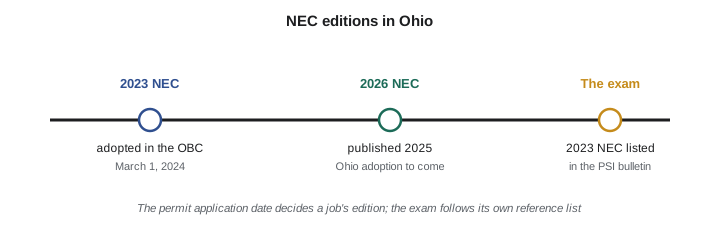
NFPA publishes a new NEC every three years. The 2026 edition was published in 2025, and states adopt each edition on their own schedule, often a year or more after publication. Ohio adopts a new edition by amending the Ohio Building Code and the Residential Code of Ohio through the Board of Building Standards rulemaking process, which includes public notice, comment and a stated effective date. Until the board adopts a newer edition, the 2023 NEC as amended remains the enforced code in Ohio, even though a newer edition exists. As of late 2026, contractors should watch the board's rulemaking notices for a 2026 NEC adoption and check with their building departments before relying on any 2026 change.
Which edition applies to a particular job depends on timing. The usual rule in Ohio, as in most states, is that the code in effect when the complete permit application is submitted governs the project. Code adoptions also usually include a transition period in which an applicant may choose the old or new edition for a short time. Check the adoption notice for the exact rule when an edition changes during your project's design.
The exam edition versus the enforced edition
The PSI bulletin lists the 2023 NEC for the Electrical Contractor exam. That is a separate decision from the code adopted by the Board of Building Standards, and the two can drift apart. If Ohio adopts the 2026 NEC before PSI updates the bulletin, the exam will still test the 2023 edition, and a candidate who studies the 2026 changes may choose wrong answers on renumbered articles. The safest approach is to study and bring the edition listed in the current bulletin, and to learn the newer edition for field work as your jurisdiction adopts it.
Keisha's core courses had flagged the main 2026 changes, such as the move of the load calculation article from Article 220 to Article 120 and the consolidation of some equipment articles. She made a one-page list of those changes and kept it out of her exam book, so she would not confuse the two editions under time pressure.
Local amendments and interpretations
Ohio building departments enforce the state codes; they do not write their own electrical codes for commercial buildings. They may, however, publish interpretations, policies and submittal requirements that affect how a job is designed and inspected, such as required panel schedules, load calculation formats, temporary power rules or inspection request procedures. Some departments also publish lists of common rejections. Reading those documents before starting work in a new jurisdiction saves failed inspections.
Electric utilities add another layer. Utilities in Ohio, such as the investor-owned utilities that serve Dayton, Columbus, Cleveland and Cincinnati, publish service requirements for metering, service entrance equipment, clearances and the process for connecting new services. These are utility rules, not building code requirements, but a service that ignores them will not be energized. Ray keeps the current utility service handbook for each utility Stillwater works with on the estimating shelf.
# Which NEC edition applies to a job? (simplified study aid)
from datetime import date
adoptions = [   # (effective date, edition) for Ohio Building Code work, as reported
    (date(2017, 11, 1), "2017 NEC"),
    (date(2024, 3, 1), "2023 NEC"),
]
def edition_for(permit_application_date):
    current = None
    for effective, edition in adoptions:
        if permit_application_date >= effective:
            current = edition
    return current
for d in (date(2023, 9, 15), date(2024, 2, 28), date(2024, 3, 4), date(2026, 10, 1)):
print(d.isoformat(), "->", edition_for(d))2023-09-15 -> 2017 NEC 2024-02-28 -> 2017 NEC 2024-03-04 -> 2023 NEC 2026-10-01 -> 2023 NEC
The table of adoptions is the important idea. Each job is tied to the edition in force on its permit application date, subject to any transition period, so two Stillwater jobs running side by side can legally follow different editions.
Worked problem
Two jobs, two editions
Stillwater has two commercial jobs underway in 2026. The Oakwood dental office permit application was submitted in January 2024. The Brookville warehouse application was submitted in May 2025. Assuming no transition choices were made, which NEC edition governs each job, and what does that mean for the electricians?
Show solution
- The 2024 Ohio Building Code, adopting the 2023 NEC, took effect March 1, 2024.
- The dental office application predates that date, so it was reviewed under the earlier adopted edition.
- The warehouse application came after March 1, 2024, so the 2023 NEC as amended by Ohio governs it.
- Crews should know which edition each job follows, because some requirements, such as GFCI and surge protection rules, changed between editions.
Answer: The dental office follows the earlier edition in force when its application was filed; the warehouse follows the 2023 NEC as amended by Ohio.
Reading the code in layers
When Keisha looks up a requirement for an Ohio commercial job, she follows the same four steps. First, she finds the rule in the 2023 NEC, including any exceptions and informational notes. Second, she checks whether the Ohio Building Code changes that section; for 210.8(F), it does. Third, she checks whether the building department has published an interpretation or policy on the topic. Fourth, she checks the approved plans and the specifications, which may require more than the code. The answer that matters on the job is the strictest of the four that applies.
On the exam, the answer usually comes from the first step alone, because the questions are written from the NEC listed in the bulletin. Ohio-specific code questions are less common on the trade exam than on the job, but knowing the layers helps a license holder answer field questions correctly and explain them to crews and customers.
Keisha also learned to keep the code edition in mind when reading older documents. Specifications written several years earlier may cite an older NEC edition, and manufacturers' installation instructions may assume a newer one. When documents disagree, the adopted code and the approved plans govern, and the designer should resolve conflicts in writing.
Common mistakes
MistakeAssuming the newest NEC is automatically enforced in Ohio.
InsteadOhio enforces the edition adopted by the Board of Building Standards, currently the 2023 NEC as amended.
MistakeForgetting the Ohio amendment to 210.8(F).
InsteadOhio keeps Exception No. 2 to 210.8(F) in force without the model code's sunset.
MistakeStudying the 2026 NEC for the exam.
InsteadThe PSI bulletin lists the 2023 NEC; study and bring the edition the bulletin names.
MistakeIgnoring the utility's service requirements.
InsteadUtilities set metering and service rules that must be met before a service is energized.
Summary and key terms
- The Board of Building Standards adopts the Ohio Building Code and the Residential Code of Ohio, which adopt the NEC by reference.
- The 2024 Ohio Building Code took effect March 1, 2024 and adopts the 2023 NEC for commercial work, with Ohio keeping 210.8(F) Exception No. 2 in force.
- The 2023 NEC adoption for residential work was reported as delayed to April 15, 2024, with residential amendments in the residential code.
- The edition in force on the permit application date generally governs a job; newer editions apply only after Ohio adopts them.
- The exam follows the 2023 NEC listed in the PSI bulletin, regardless of later local adoptions.
- Board of Building Standards
- The state board that adopts Ohio's building codes and certifies building departments and inspectors.
- Ohio Building Code
- The state commercial building code, which adopts the NEC for commercial electrical work.
- Residential Code of Ohio
- The state code for one-, two- and three-family dwellings.
- Adoption by reference
- Making a model code enforceable by naming it in a state rule, with any listed amendments.
- Transition period
- A short time after a new code takes effect when an applicant may choose the old or new edition.
Practice problems
Work each problem on paper first, then reveal the answer to check.
Which board adopts Ohio's building codes?
Show answer
The Board of Building Standards.
Which NEC edition does the 2024 Ohio Building Code adopt?
Show answer
The 2023 edition, as reported in public notices, effective March 1, 2024.
What Ohio amendment to the 2023 NEC was reported for commercial work?
Show answer
Exception No. 2 to section 210.8(F) does not expire.
Ohio adopts the 2026 NEC but the PSI bulletin still lists the 2023 edition. Which do you bring to the exam?
Show answer
The 2023 edition listed in the bulletin.
Lesson quiz · 5 questions
Score 60% or more to complete this lesson.
Create a free account to save your progress, take quizzes and earn a certificate.