
MELU-310 · Lesson 4 of 12 · 18 min
The exam format and the references allowed
▶ Video coming soon A video version of this lesson is on the way.
The week her approval letter arrived, Keisha sat at the kitchen table with the PSI bulletin, a highlighter and a fresh softcover copy of the 2023 National Electrical Code. Dale had told her that the Ohio exams were open book, and she had heard other electricians say that open book meant easy. Dale shook his head when she repeated that. "Open book means you're allowed to look," he said. "It doesn't mean you'll have time to look everything up. The people who pass know where things are before they walk in."
This lesson describes the two Ohio exams an electrical contractor applicant must pass, the references allowed for each, and a pacing method for a long open-book computer exam. The figures come from the PSI Ohio Contractor Trade Examinations Candidate Information Bulletin as of late 2026. PSI and the board revise the bulletin, so download the current version from the link in your approval materials and check every number before test day.
Two exams, both required
Every Ohio contractor license classification requires the Contractor's Business and Law Examination in addition to the trade examination for that license. For an electrical contractor applicant, that means two separate exams: the Business and Law exam and the Electrical Contractor exam. Each is scheduled, paid for and scored separately, and a candidate must pass both to request the license. A candidate who already passed the Business and Law exam for another OCILB license should ask the board whether that pass can be used again, rather than assuming it can.
According to the bulletin, the Business and Law exam has 50 scored questions, plus 5 unscored pretest questions mixed in among them, and a time limit of 2 hours. The Electrical Contractor exam has 100 scored questions, plus 10 unscored pretest questions, and a time limit of 4 hours. Both require a score of 70 out of every 100 possible points to pass, and both are open book. The pretest questions are being tried out for future exams and do not count toward the score, but you cannot tell which ones they are, so answer every question as if it counts.
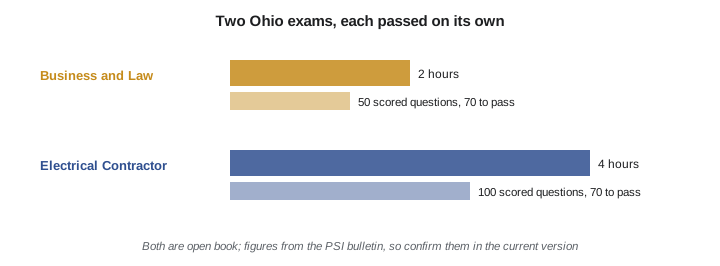
| Exam | Scored questions | Pretest questions | Time | Passing score | Book policy |
|---|---|---|---|---|---|
| Contractor's Business and Law | 50 | 5 | 2 hours | 70 out of 100 | Open book |
| Electrical Contractor | 100 | 10 | 4 hours | 70 out of 100 | Open book |
The Business and Law reference
The Business and Law exam has a single approved reference: the Contractor's Guide to Business, Law, and Project Management, Ohio edition, published by NASCLA. The bulletin lists the fourth edition. The book covers business organization, licensing law, contracts, estimating and bidding, project scheduling, risk management and insurance, the lien law, labor and employment law, safety, tax law, and financial management, with Ohio-specific chapters on topics such as the licensing statute and the mechanics' lien law. Exam questions are written from this book, so the fastest way to an answer is usually to know which chapter covers the topic.
The bulletin states that no highlighting or notes may be added during the exam. Read the bulletin's rules carefully about what may already be in the book when you bring it, such as permanent tabs or highlighting, because test centers enforce them and a book that does not comply may not be allowed into the room. When in doubt, follow the bulletin's wording exactly, or ask PSI before test day.
The Electrical Contractor references
The bulletin lists the references allowed for the Electrical Contractor exam. They include Ugly's Electrical References, 2023 edition; the 2023 edition of NFPA 70, the National Electrical Code, or the NEC Handbook for the same edition, with the bulletin noting that either one alone is enough; and a field reference handbook, either the Electrical Field Reference Handbook listed in the bulletin or the IBEW-NECA field reference book. Note that the exam is written to the 2023 NEC. Even when local jurisdictions adopt a newer edition, the exam follows the edition named in the bulletin until PSI and the board change it.
Prep companies sell the NEC already tabbed and highlighted for the Ohio exam, and the bulletin's rules on tabs and markings decide what you may bring. Many candidates add their own permanent tabs to the NEC for the articles they use most: Article 100, 110, 210, 215, 220, 230, 240, 250, 300, 310, 314, 430, 450, 500 through 517, 680, 690, 700 and the Chapter 9 tables. Keisha tabbed her book the way her core course had taught: one color for the general chapters, another for special occupancies and equipment, and a third for the tables she used in calculations.
What the exams test
The bulletin includes a content outline for each exam with the approximate number of questions in each area. For the Business and Law exam, expect questions across the chapters of the NASCLA guide: business organization and licensing, contracts and bidding, scheduling and project management, insurance and bonds, lien law, employment and wage law, safety and OSHA recordkeeping, taxes and financial statements. For the Electrical Contractor exam, expect questions on general requirements, wiring and protection, wiring methods and materials, equipment for general use, special occupancies and equipment, calculations, and some field-reference topics such as conductor properties and motor data. Use the outline in the current bulletin to weight your study time.
Many questions are calculations or lookups wrapped in a short job scenario: sizing a feeder, finding a grounding electrode conductor, applying adjustment factors, sizing motor branch-circuit protection or counting box fill. Others ask what a rule requires in a given location, such as which receptacles need GFCI protection or what clearance applies in front of equipment. The core courses prepared you for these question types; the Ohio exam simply puts them under time pressure.
Pacing an open-book exam
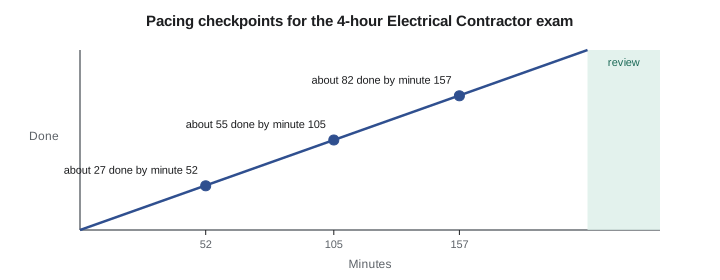
Both exams allow the same average time per question. The Business and Law exam gives 120 minutes for 55 questions, including pretest items, and the Electrical Contractor exam gives 240 minutes for 110 questions. That is a little more than two minutes per question in each case. A candidate who spends ten minutes hunting through the NEC for one answer is spending the time of four other questions. The two-pass method helps: on the first pass, answer every question you can settle quickly and mark the rest; on the second pass, return to the marked questions with the time you saved.
# Pacing checkpoints for the Ohio exams (study aid)
exams = [("Business and Law", 55, 120), ("Electrical Contractor", 110, 240)]
for name, questions, minutes in exams:
    review = round(minutes * 0.125)          # keep about one eighth for review
    first_pass = minutes - review
    per_q = first_pass / questions
    print(name)
    print(f"   first pass: {per_q:.2f} minutes per question, {review} minutes kept for review")
    for checkpoint in (0.25, 0.5, 0.75):
        t = round(first_pass * checkpoint)
print(f" by minute {t:3d} aim to have answered about {round(t / per_q)} questions")Business and Law first pass: 1.91 minutes per question, 15 minutes kept for review by minute 26 aim to have answered about 14 questions by minute 52 aim to have answered about 27 questions by minute 79 aim to have answered about 41 questions Electrical Contractor first pass: 1.91 minutes per question, 30 minutes kept for review by minute 52 aim to have answered about 27 questions by minute 105 aim to have answered about 55 questions by minute 158 aim to have answered about 83 questions
The checkpoints matter more than the exact numbers. If Keisha reaches minute sixty of the electrical exam with only fifteen questions answered, she knows she is spending too long on lookups and needs to mark more questions for the second pass. If she is ahead, she has time to double-check calculations.
Using the computer interface
PSI exams are delivered on a computer at a test center. The bulletin and the tutorial at the start of the session explain how to move between questions, how to flag a question for review and how to see which questions remain unanswered. Use the tutorial time to learn the controls, because fumbling with the interface wastes minutes later. An on-screen calculator or an approved handheld calculator may be available; check the bulletin for the calculator policy before you bring one. Unanswered questions count as wrong, so make sure every question has an answer before time expires, even if it is your best guess.
Worked problem
Spending the time wisely
Halfway through the Electrical Contractor exam, at minute 120, Keisha has answered 51 questions and flagged 9 more. She has 120 minutes left for 59 questions, including the flagged ones. Is she on pace, and what should she do?
Show solution
- Her first-pass target is about 1.91 minutes per question for 110 questions over 210 minutes.
- At minute 120 she should have answered about 63 questions, so she is about 12 questions behind.
- She has 120 minutes for 59 questions, which is about 2.03 minutes each if she uses all of the remaining time.
- She should stop spending long lookups on the first pass, flag anything that needs more than two minutes, and finish the unanswered questions first.
- Then she can return to the flagged questions with whatever time remains.
Answer: She is slightly behind; she should speed up the first pass and save hard lookups for the end.
Preparing the references
Because both exams are open book, preparing the references is part of studying. For the Electrical exam, a good tab system lets you open the NEC to the right article in seconds. Start with the articles and tables you used most in the core courses, then add tabs for topics that came up in practice questions. Keep tab labels short and consistent. If the bulletin allows highlighting before the exam, use it sparingly for words that change answers, such as exceptions, minimum dimensions and table notes, rather than whole paragraphs.
Ugly's Electrical References and the field reference book are useful for formulas, conductor properties and motor data, but on many questions the NEC is the faster source because the question is written from it. Practice with all three before test day so you know which one answers which kind of question.
For the Business and Law exam, the NASCLA Ohio guide is long, and many candidates read it once for understanding and a second time to note where each topic lives. The table of contents and index become the main tools during the exam. Practice using the index under time pressure: look up a term, find the page and locate the answer in under a minute.
Calculations on the exams
Calculation questions appear on both exams. On the Electrical exam they include load calculations, conductor sizing with adjustment and correction, voltage drop, conduit and box fill, motor circuit sizing and transformer protection. On the Business and Law exam they include markup and margin, payroll taxes, depreciation, ratios and simple scheduling. Write down the formula, plug in the numbers carefully and check the units. A quick sanity check, such as whether a conductor size or a profit margin looks reasonable, catches many errors.
Common mistakes
MistakeThinking open book means you can look up every answer.
InsteadKnow where topics are in the references; there are only about two minutes per question.
MistakeBringing a newer NEC edition than the bulletin lists.
InsteadThe exam follows the edition named in the bulletin, currently the 2023 NEC.
MistakeWriting notes in the Business and Law book during the exam.
InsteadThe bulletin prohibits adding highlighting or notes during the exam.
MistakeLeaving hard questions blank.
InsteadUnanswered questions count as wrong; flag them and always enter a best answer.
Summary and key terms
- Electrical contractor applicants must pass both the Contractor's Business and Law exam and the Electrical Contractor exam.
- Business and Law: 50 scored questions plus 5 pretest questions in 2 hours; Electrical: 100 scored plus 10 pretest questions in 4 hours.
- Both exams are open book and require 70 out of 100 to pass.
- The Business and Law reference is the NASCLA Ohio guide; the electrical references include the 2023 NEC or its handbook, Ugly's and a field reference book.
- With about two minutes per question, knowing the references and using a two-pass method are essential.
- Pretest question
- An unscored question being tried out for future exams; it cannot be identified during the exam.
- Open book
- An exam that allows approved references, subject to the bulletin's rules on markings and tabs.
- NASCLA guide
- The Contractor's Guide to Business, Law, and Project Management, Ohio edition, the Business and Law reference.
- Two-pass method
- Answering quick questions first, flagging slow ones, and returning to them with saved time.
- Content outline
- The bulletin's list of exam topics and the approximate number of questions in each.
Practice problems
Work each problem on paper first, then reveal the answer to check.
How many scored questions are on the Electrical Contractor exam?
Show answer
100, plus 10 unscored pretest questions.
Which NEC edition do the exam references name?
Show answer
The 2023 edition.
What is the time limit for the Business and Law exam?
Show answer
2 hours.
Why answer every question even if you are unsure?
Show answer
Unanswered questions are scored as wrong, and pretest questions cannot be identified, so every answer may count.
Lesson quiz · 5 questions
Score 60% or more to complete this lesson.
Create a free account to save your progress, take quizzes and earn a certificate.