
MELU-310 · Lesson 1 of 12 · 20 min
How electrical licensing works in Ohio
▶ Video coming soon A video version of this lesson is on the way.
Dale Hoffmann founded Stillwater Electric Company in Dayton in 1991 with a used bucket truck, two journeymen and a state electrical contractor license he had earned the year the Ohio licensing law was rewritten. Thirty-five years later the company has nineteen electricians, three estimators and a steady stream of commercial work across Montgomery, Greene and Miami counties: warehouses along the interstate, medical office fit-outs, school renovations and a growing list of EV charger installations. On a gray Tuesday in January, Dale asked his foreman, Keisha Morgan, to stay after the morning meeting. "I'm sixty-six," he said. "Every commercial job we do runs on my license. If Stillwater is going to outlast me, you need to pass the state exam and have your license assigned to the company." He slid a printout of the Ohio Construction Industry Licensing Board's testing application across the desk, along with the PSI candidate bulletin he had printed the night before.
Keisha had ten years in the trade: a four-year registered apprenticeship, three years as a journeyman wiring retail and light industrial jobs, and three years running crews for Stillwater. She had worked through the master electrician core courses on the National Electrical Code, load calculations, grounding, motors and transformers, special occupancies, and business and law. This course applies that preparation to Ohio: who licenses electrical contractors, what kind of work needs a state license, how the two exams work, which code edition applies, how permits and inspections are handled, and the Ohio law on contracts, liens, insurance, workers' compensation, safety and renewal that the business and law exam tests.
The agency and the board
Ohio licenses five kinds of construction trade contractors through a single board: electrical, heating, ventilating and air conditioning, plumbing, hydronics and refrigeration contractors. The board is the Ohio Construction Industry Licensing Board, usually shortened to OCILB, and it is created by Chapter 4740 of the Ohio Revised Code. The board sits within the Ohio Department of Commerce, and its day-to-day work, such as processing applications, issuing licenses, collecting fees and handling complaints, is carried out by the department's Division of Industrial Compliance in Reynoldsburg. The board's detailed rules are in Chapter 4101:16 of the Ohio Administrative Code.
The board works through specialty sections, one for each licensed trade. The electrical section decides questions that belong to electrical contractors: which applicants are qualified to test, what continuing education counts for electrical licensees, and how disciplinary cases against electrical contractors are resolved. Some decisions, such as general administrative rules, are made by the board as a whole. When you read Chapter 4740, you will see phrases such as "the appropriate section of the board" or "the electrical section," and those phrases tell you that the decision belongs to the trade-specific group rather than the full board.
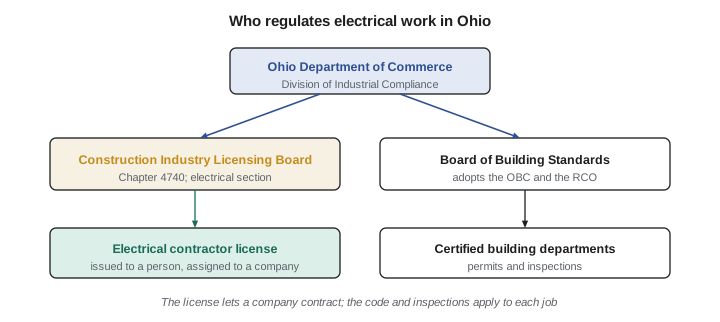
One license, several licensed trades
The license this course prepares you for is the Ohio electrical contractor license. Ohio does not divide it into unlimited and restricted classes the way some states do, and it does not issue a separate master electrician license at the state level. The electrical contractor license is the state credential that allows a contracting company to take responsibility for electrical work on commercial construction projects. Other OCILB licenses cover HVAC, plumbing, hydronics and refrigeration work, and each has its own trade exam. A person may hold more than one OCILB license if they qualify and pass each trade exam, and some mechanical contractors hold several.
The licenses are issued to individuals, not companies. An individual who passes the exams and meets the insurance requirement asks the board to assign the license to a contracting company. While the license is assigned, the company may contract for work in that trade, and the law treats work done under the license as done under the personal supervision of the license holder. Lesson 7 covers the license holder's duties in detail, and Lesson 8 covers the insurance requirement that must be in place before the license can be assigned.
What work needs a state license
The Ohio license is tied to construction projects. Chapter 4740 defines a contractor as a person or contracting company that has responsibility for the means, method and manner of construction and either performs construction work itself or employs tradespersons who do. The definition of a construction project in the same chapter excludes residential buildings as defined in the building code statutes, which are one-, two- and three-family dwellings, and industrialized units. In practice, this means the state electrical contractor license is required for commercial work, such as offices, stores, factories, schools, apartment buildings with four or more units and public buildings, but not for work on one-, two- and three-family homes.
That does not mean residential work is unregulated. Cities and counties may regulate the installation of electrical systems in homes, require permits and inspections, and register or license residential contractors and tradespersons under their own ordinances. Dayton, Columbus, Cincinnati and many suburbs do some combination of these. A company like Stillwater that does both commercial and residential work needs the state license for the commercial side and must satisfy each local jurisdiction for the residential side. Keisha's cousin Andre, who wires new houses for a builder in Springboro, has never held a state license and does not need one for that work, but he does hold the registrations the townships he works in require.
| Kind of work | State electrical contractor license? | Local rules? |
|---|---|---|
| New office building or retail store | Yes | Permit and inspection by the building department |
| Six-unit apartment building | Yes (four or more units is not a residential building) | Permit and inspection |
| Rewiring a single-family house | No | Local permit, registration or license where required |
| Fire alarm, data cabling or sound under 50 volts | No, under the low-voltage exemption | Local permit where required |
| Control wiring under 25 volts on licensed HVAC equipment | The HVAC licensee may install it | Local permit where required |
The low-voltage exemptions
Two provisions in section 4740.13 limit what counts as electrical contracting. First, a person is not an electrical contractor required to be licensed for work limited to fire alarm, burglar alarm, cabling, tele-data, sound, communication, landscape lighting and irrigation systems that use less than fifty volts. Second, a contractor licensed in another trade, such as HVAC or refrigeration, may install and service control wiring of less than twenty-five volts that is related to the equipment covered by that contractor's license. These exemptions are common exam topics because they draw the boundary between licensed electrical work and work that other trades and low-voltage specialists may do.
The exemptions do not remove local rules or the building code. A data cabling installer working in a new hospital still needs whatever permits the building department requires, and the installation still has to meet the NEC articles on communications and limited-energy circuits. The exemption only means the installer does not need an OCILB electrical contractor license for that limited work.
Local governments and the state license
Ohio cities, villages, townships and counties have a limited role in contractor licensing for commercial work. Under section 4740.12, a political subdivision may require contractors to register with it and pay a registration fee only if it also requires that those contractors hold the appropriate state license. Local governments keep their authority to regulate how electrical systems are installed, through permits and inspections, and to register tradespersons and charge them fees. The result is that a licensed electrical contractor can work across Ohio on commercial projects without passing a separate local exam for each city, but may have to register with many building departments and pay their fees.
Stillwater's office manager, Linda Pruitt, keeps a spreadsheet of every jurisdiction where the company is registered, with renewal dates, the license number on file and the insurance certificate each department holds. Dayton, Kettering, Beavercreek, Huber Heights and the Montgomery County building department each have their own forms. Linda's rule is simple: no crew starts a commercial job until the license, the registration and the permit are all in place.
# Does a job need the Ohio electrical contractor license? (simplified study aid)
jobs = [
    ("New 40,000 square foot warehouse", "commercial", 480),
    ("Service change on a duplex", "two-family", 240),
    ("Fiber and data cabling in an office", "commercial", 48),
    ("Six-unit apartment building", "multi-family 6", 240),
    ("Fire alarm devices in a school", "commercial", 24),
]
def needs_state_license(kind, volts):
    residential = kind in ("one-family", "two-family", "three-family")
    if residential:
        return "no (residential building; local rules apply)"
    if volts < 50:
        return "no (low-voltage exemption)"
    return "yes"
for name, kind, volts in jobs:
    print(name)
print(" state license:", needs_state_license(kind, volts))New 40,000 square foot warehouse state license: yes Service change on a duplex state license: no (residential building; local rules apply) Fiber and data cabling in an office state license: no (low-voltage exemption) Six-unit apartment building state license: yes Fire alarm devices in a school state license: no (low-voltage exemption)
The calculator captures the two filters that decide most license questions on the exam: is the building a residential building of one to three units, and is the work limited to one of the listed systems under fifty volts? Real situations can be more detailed. A low-voltage system tied into a 120-volt power supply, for example, still needs the power side installed by someone allowed to do that work.
Worked problem
Sorting Stillwater's spring jobs
Dale lists four jobs for the spring: a 1,200-ampere service for a distribution warehouse in Brookville, a dental office fit-out in Oakwood, a new service and panel for a three-family house in Dayton's Oregon District, and a structured cabling job for a credit union branch. Which jobs require the state electrical contractor license?
Show solution
- The warehouse is a commercial construction project with power wiring, so it needs the license.
- The dental office is commercial, so it needs the license.
- The three-family house is a residential building as the statute uses the term, so the state license is not required, although Dayton's own permit and registration rules apply.
- Structured cabling under fifty volts is covered by the low-voltage exemption, so the state electrical license is not required for that scope alone.
Answer: The warehouse and the dental office need the state license; the three-family house and the cabling job do not, but local permits still apply.
Unlicensed contracting
Acting as or claiming to be a licensed electrical contractor without holding or being assigned the license is prohibited by section 4740.13. At the request of the electrical section, the attorney general may ask a court for an injunction to stop unlicensed activity, and the chapter also provides penalties for violations. Contracts and payment rights can be at risk for unlicensed work, and building departments generally will not issue a commercial electrical permit to a company without a properly assigned license. A licensed contractor who lets an unlicensed company use the license to pull permits is exposed to discipline, which Lesson 7 covers.
Where the rules live
Ohio electrical contractors work under several layers of law, and the exam expects candidates to know which layer answers which question. The Revised Code sets the framework: Chapter 4740 for contractor licensing, Chapters 3781 and 3791 for the building code system, Chapter 1311 for mechanics' liens, section 4113.61 for prompt payment and Chapter 4123 for workers' compensation. Board rules in Chapter 4101:16 of the Administrative Code fill in licensing details such as fees, renewal and continuing education. The Board of Building Standards adopts the Ohio Building Code and the Residential Code of Ohio, which in turn adopt the NEC. Local ordinances and building departments handle permits, fees, registrations and inspections. When a question comes up, start by asking which layer it belongs to.
Common mistakes
MistakeAssuming the state license is needed to wire a new house.
InsteadOne-, two- and three-family dwellings are excluded from the definition of a construction project; local rules govern residential work.
MistakeThinking a city can make a licensed contractor pass its own exam to work there.
InsteadA city may require registration and a fee, but only if it also requires the state license; it may still regulate installations through permits.
MistakeTreating low-voltage alarm and data work as licensed electrical contracting.
InsteadWork limited to the listed systems under fifty volts is exempt from the electrical contractor license.
MistakeBelieving the license belongs to the company.
InsteadThe license is issued to an individual and assigned to one contracting company at a time.
Summary and key terms
- Ohio licenses electrical, HVAC, plumbing, hydronics and refrigeration contractors through the Ohio Construction Industry Licensing Board under Chapter 4740, with rules in Chapter 4101:16.
- The board works through specialty sections, and the Department of Commerce's Division of Industrial Compliance runs its daily operations.
- The state license is required for commercial construction projects; one- to three-family dwellings are excluded and regulated locally.
- Work limited to listed systems under fifty volts is exempt, and other licensed trades may install related control wiring under twenty-five volts.
- Local governments may require registration only if they also require the state license, and they keep their permit and inspection authority.
- OCILB
- The Ohio Construction Industry Licensing Board, which licenses electrical and four other kinds of trade contractors.
- Electrical section
- The specialty section of the board that handles electrical contractor licensing matters.
- Construction project
- The statutory term for the work that requires a license; it excludes one- to three-family residential buildings.
- Contracting company
- A company in the construction industry working on construction projects, to which a license is assigned.
- Low-voltage exemption
- The rule that work limited to listed systems under fifty volts does not require an electrical contractor license.
Practice problems
Work each problem on paper first, then reveal the answer to check.
Which chapter of the Revised Code creates the OCILB?
Show answer
Chapter 4740.
Does a company need the state electrical license to rewire a two-family house?
Show answer
No. Two-family dwellings are residential buildings excluded from the definition of a construction project, although local permits and registration may apply.
Name three systems covered by the under-fifty-volt exemption.
Show answer
Any three of fire alarm, burglar alarm, cabling, tele-data, sound, communication, and landscape lighting and irrigation systems.
What must a city also require if it requires contractor registration and charges a fee?
Show answer
That the contractor hold the appropriate state license under Chapter 4740.
Lesson quiz · 5 questions
Score 60% or more to complete this lesson.
Create a free account to save your progress, take quizzes and earn a certificate.