
MELU-310 · Lesson 8 of 12 · 19 min
Contractor licensing, insurance and bonding
▶ Video coming soon A video version of this lesson is on the way.
The day Keisha's exam results came back, Linda called Stillwater's insurance agent, Tom Becker, to ask for a new certificate of liability insurance. Tom had prepared dozens of them for the board over the years, and he knew exactly what the Division of Industrial Compliance wanted to see. "Named insured is Stillwater Electric Company," he said, reading from his screen. "General liability, each occurrence one million, which is well over the state minimum. Certificate holder is the Division. I'll have it to you in an hour." Then he added the question that Linda had been expecting: "Do any of the cities you're registering with this year need a bond?"
This lesson covers the business requirements that come with an Ohio electrical contractor license: the contractor liability insurance the board requires, how it ties the license to one company, bonds required by local registrations and public projects, workers' compensation through the Ohio Bureau of Workers' Compensation, and the business registrations and taxes a contracting company must handle. Insurance and bond amounts come from the board's application, rules and public sources as of late 2026; confirm current requirements before you rely on them.
The insurance requirement
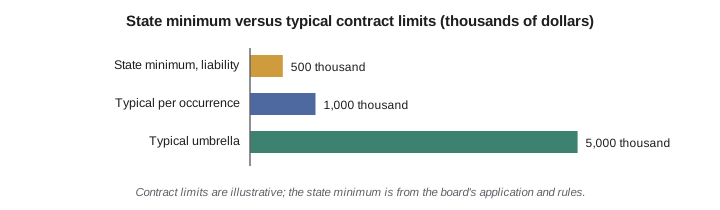
Section 4740.06 requires an applicant to carry contractor's liability insurance in an amount the specialty section sets, held under only one contracting company name. The board's testing application and renewal rule state the amount: at least 500,000 dollars of contractor liability insurance. When requesting a new license, the applicant sends a certificate of liability insurance showing that coverage, and at each renewal the license holder certifies that the coverage is in place. Because the license and the insurance must be assigned to the same contracting company, the certificate should name that company as the insured.
The 500,000-dollar figure is a floor. Most commercial customers and general contractors require far higher limits in their contracts, often one or two million dollars per occurrence with an umbrella policy above that, and they ask to be named as additional insureds. Stillwater carries one million dollars per occurrence and a five-million-dollar umbrella, because its warehouse and school customers require it. The state minimum is what keeps the license valid; the contract minimums are what keep the company working.
What the policy covers
Commercial general liability insurance pays for bodily injury and property damage to others caused by the contractor's operations or completed work, and for the legal defense of covered claims. It does not cover injuries to the contractor's own employees, which are covered by workers' compensation, or damage to the contractor's own tools and vehicles, which need other policies. It also generally does not pay to fix the contractor's own faulty work, although it may cover damage that faulty work causes to other property. Contractors also typically carry commercial auto insurance, an inland marine or tool policy, and an umbrella policy, and some carry professional liability coverage if they provide design services.
If the required insurance is canceled or lapses, the license holder has a problem with the board as well as with customers. Failure to maintain the required insurance is a ground for discipline, and a license without coverage cannot be properly renewed. Linda keeps the policy expiration dates on the same calendar as license renewal and asks Tom for renewal certificates thirty days before each policy ends.
| Coverage | What it protects against | Required by |
|---|---|---|
| Commercial general liability | Injury and property damage to others | OCILB (at least 500,000 dollars), customers, general contractors |
| Workers' compensation | Injuries to the contractor's own employees | Ohio law, through the BWC |
| Commercial auto | Accidents involving company vehicles | Ohio vehicle law, customers |
| Umbrella | Claims above the primary policy limits | Customers and general contractors |
| Surety bonds | Performance and payment obligations, or registration duties | Public owners, some private owners, some local registrations |
Bonds
A bond is different from insurance. In a surety bond, a surety company guarantees to a third party that the contractor will meet an obligation; if the contractor fails and the surety pays, the contractor must repay the surety. The OCILB license itself does not require a bond. Bonds come from three other places in an Ohio electrical contractor's business.
First, some local governments require a registration bond or license bond when a contractor registers with their building department, guaranteeing that the contractor will follow local rules and pay fees. Second, public construction projects in Ohio generally require bid security and performance and payment bonds under the public improvement statutes in Chapter 153 of the Revised Code and similar laws for other public owners. The payment bond protects subcontractors and suppliers on public projects, where mechanics' liens on public property are not available in the usual way. Third, private owners and general contractors may require performance and payment bonds from subcontractors on large projects. Each bond requires underwriting by a surety, which looks at the contractor's financial statements, experience and credit.
Workers' compensation through the BWC
Ohio is one of a small number of states with a monopolistic state fund for workers' compensation. Most Ohio employers must obtain workers' compensation coverage from the Ohio Bureau of Workers' Compensation, and private insurance companies cannot sell standard workers' compensation coverage for Ohio employees. Some large employers that meet strict financial requirements are approved to self-insure instead. The program is governed by Chapters 4121 and 4123 of the Revised Code.
For a contractor, this has practical effects. Premiums are paid to the BWC based on payroll in each classification and the employer's experience. General contractors and public owners often ask subcontractors for a BWC certificate of coverage before they start work, and some owners check coverage online. Because the state fund does not include the employer's liability coverage that private workers' compensation policies usually include, many Ohio employers buy separate stop-gap or employer's liability coverage from a private insurer, often as part of the general liability policy. Ask your agent to confirm the coverage is in place for Ohio operations.
# Rough BWC premium estimate by classification (illustrative rates only)
payroll = {"electrical wiring": 1450000, "clerical office": 210000}
rate_per_100 = {"electrical wiring": 1.85, "clerical office": 0.12}   # dollars per 100 of payroll, illustrative
experience_mod = 0.92
total = 0
for cls, pay in payroll.items():
    base = pay / 100 * rate_per_100[cls]
    total += base
    print(f"{cls:<18} payroll {pay:9d}  base premium {base:9.2f}")
print("base total", round(total, 2))
print("after experience modifier", round(total * experience_mod, 2))electrical wiring payroll 1450000 base premium 26825.00 clerical office payroll 210000 base premium 252.00 base total 27077.0 after experience modifier 24910.84
The calculation shows why classification matters: payroll in the field classification costs many times more than office payroll, so putting an office worker's wages in the wrong class, or a field worker's in the office class, changes the premium and can be an audit finding. The experience modifier rewards employers with fewer and less costly claims.
Business registrations
A contracting company must exist as a legal business before a license can be assigned to it. Corporations and limited liability companies register with the Ohio Secretary of State, and a business using a trade name files a trade name or fictitious name registration. Out-of-state companies register as foreign corporations or foreign limited liability companies with an in-state statutory agent, which section 4740.06 mentions for the out-of-state license route. The company also registers with the Ohio Department of Taxation for withholding and any other applicable taxes, with the BWC for workers' compensation, and with the Ohio Department of Job and Family Services for unemployment insurance.
Ohio has an unusual tax feature that contractors notice quickly: many cities and villages levy a municipal income tax on wages earned and business income generated within their limits. Employers may need to withhold for the city where an employee works, and companies working in several cities may owe net profit tax in several places. Ohio also has a commercial activity tax on gross receipts above a threshold. These rules are detailed and change; Stillwater's accountant handles them, and the NASCLA Ohio guide covers the basics for the exam.
Worked problem
Getting ready to bid a public school
A school district in Greene County invites bids for a new elementary school, and the electrical package is bid separately. What business requirements should Stillwater confirm before submitting a bid?
Show solution
- The license: Keisha's license must be assigned to Stillwater and current.
- Insurance: the bid documents will list required limits, likely above the state minimum, with the district as additional insured.
- Bid security: the bid will need a bid guaranty, such as a bid bond, under the public improvement statutes.
- Performance and payment bonds: if awarded, Stillwater must provide bonds for the contract amount from its surety.
- Workers' compensation: a current BWC certificate, and prevailing wage or other public contract requirements stated in the documents.
Answer: Confirm the license, insurance limits, bid security, performance and payment bonds, BWC coverage and any public contract requirements.
Certificates of insurance in daily practice
Certificates of insurance travel constantly in a contracting business. General contractors ask for them before a subcontractor starts work, owners ask for them before a prime contract is signed, and building departments ask for them at registration. Each certificate lists the insured, the policies, the limits, the policy periods and the certificate holder, and many contracts require additional insured endorsements and waivers of subrogation to be shown. A certificate is only evidence of coverage; the policy and its endorsements control what is actually covered.
Linda keeps a log of every certificate issued, with the recipient and the expiration date, and asks Tom to send updated certificates automatically when policies renew. She also collects certificates from Stillwater's own lower-tier subcontractors, such as a trenching company or a fire alarm installer, because an uninsured subcontractor's claim can end up on Stillwater's policy and affect its premiums.
Financial statements and surety credit
A surety decides how much bonding to offer a contractor, called the surety program or bonding capacity, by reviewing the contractor's financial statements, work in progress, experience and character. Contractors who bid bonded work usually prepare annual financial statements reviewed or audited by an accountant familiar with construction, with a work-in-progress schedule showing each job's contract amount, costs to date, estimated costs to complete and billings. A strong balance sheet and accurate job costing increase bonding capacity. The NASCLA Ohio guide covers financial statements and ratios, and these topics appear on the Business and Law exam.
Keisha had never paid much attention to Stillwater's financial statements as a foreman. As license holder, she started attending the annual meeting with the surety and the accountant, because the company's ability to bid public work depended on it.
Reviewing coverage each year
Once a year, before the main policies renew, Keisha and Linda meet with Tom to review coverage against the work the company actually does. New kinds of work, such as solar, battery storage or work on hospital systems, can raise questions about exclusions or limits. Larger contracts may require higher umbrella limits. A new truck or trailer must be added to the auto policy, and new equipment to the inland marine policy. The review also checks that the general liability limit still meets the board's minimum and that the certificate on file with the board is current.
Common mistakes
MistakeThinking the 500,000-dollar minimum is enough for every job.
InsteadIt keeps the license valid; most contracts require higher limits and additional insured status.
MistakeBuying private workers' compensation coverage for Ohio employees.
InsteadOhio's monopolistic system requires coverage through the BWC unless self-insured.
MistakeConfusing a bond with insurance.
InsteadA bond guarantees performance to a third party, and the contractor must repay the surety for claims it pays.
MistakeForgetting municipal income tax when working in several cities.
InsteadMany Ohio cities tax wages and business income earned within their limits.
Summary and key terms
- Ohio electrical contractors must carry at least 500,000 dollars of contractor liability insurance, under the same company to which the license is assigned.
- Customers usually require higher limits, umbrella coverage and additional insured status.
- The OCILB license does not require a bond, but local registrations, public projects and some private owners do.
- Ohio has a monopolistic workers' compensation system: most employers must insure through the BWC or qualify to self-insure.
- Contracting companies must register with the Secretary of State and tax agencies and handle Ohio's municipal income taxes.
- Contractor liability insurance
- Coverage for injury and property damage to others; the board requires at least 500,000 dollars.
- Additional insured
- A party, such as an owner or general contractor, added to the contractor's policy for claims arising from the work.
- Surety bond
- A guarantee by a surety to a third party that the contractor will meet an obligation.
- Monopolistic state fund
- A system in which workers' compensation must be obtained from the state rather than private insurers.
- Stop-gap coverage
- Employer's liability coverage bought separately because the state fund does not include it.
Practice problems
Work each problem on paper first, then reveal the answer to check.
What minimum contractor liability insurance does the board require?
Show answer
At least 500,000 dollars.
Can an Ohio electrical contractor buy standard workers' compensation from a private insurer?
Show answer
No. Ohio is a monopolistic state; coverage comes from the BWC unless the employer is approved to self-insure.
Does the OCILB license require a surety bond?
Show answer
No, but local registrations, public projects and some private contracts may.
What does a payment bond protect on a public project?
Show answer
Subcontractors and suppliers who are not paid.
Lesson quiz · 5 questions
Score 60% or more to complete this lesson.
Create a free account to save your progress, take quizzes and earn a certificate.