
MELU-304 · Lesson 9 of 12 · 20 min
Contracts and mechanics' liens in New Hampshire
▶ Video coming soon A video version of this lesson is on the way.
Every electrical job is a contract, and every contract carries the risk of not being paid. New Hampshire gives contractors, subcontractors and suppliers a remedy in RSA 447, the statute on liens for labor and materials that the trade calls the mechanic's lien law. It is short and it works differently from the lien laws of most states. A lien arises automatically when the work is done, lasts for 120 days, and must be secured during that time by attaching the property through the court. A subcontractor who does not have a contract with the owner must give the owner written notice to have a lien at all. On public work there is no lien on the building; instead, the contractor's payment bond and a lien on the public funds protect the people who did the work. This lesson explains these rules and the contract habits that keep a master out of lien disputes.
This is a summary of the statute for exam preparation, not legal advice. The facts come from RSA 447 as published by the General Court in November 2026. Deadlines in lien law are strict and the court procedures for attachment have their own rules; a contractor facing a real lien question should talk to a New Hampshire construction lawyer early.
Contracts first
Most payment disputes are really contract disputes. A good electrical contract states the scope of work, the price or the pricing method, the schedule, the payment terms, how changes will be priced and approved, who pulls the permit, what the warranty is and how disputes will be resolved. For residential customers it should be in plain language. For commercial work, the master should read the general contractor's subcontract carefully, especially the payment clauses, the retainage, any pay-if-paid language, the insurance requirements and any lien waiver forms the contractor will be asked to sign.
Change orders are where profit and payment disappear. Art's rule at Merrimack Bend is that no extra work starts without a signed change order, or at least an email from the customer approving the price, and Kayla has enforced it on her crews for four years. When the inevitable dispute comes, the company has a paper trail that shows what was asked for, what it cost and who approved it.
Who has a lien
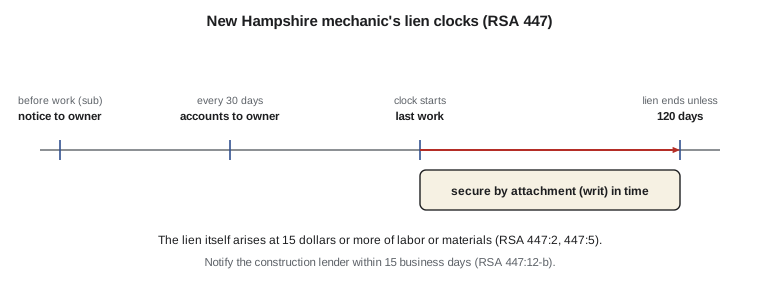
RSA 447:2 gives a lien to anyone who performs labor, provides professional design services or furnishes materials to the amount of fifteen dollars or more for erecting, altering or repairing a house, building or other structure, by virtue of a contract with the owner. The lien covers the materials furnished, the structure and the owner's interest in the land. An electrical contractor hired directly by the owner has a lien as soon as it performs, without filing anything.
RSA 447:5 extends the lien to those lower in the chain, such as an electrical subcontractor hired by a general contractor or a supplier selling to the electrical contractor. They have the same lien, but only if they give the owner written notice before performing the labor or furnishing the materials that they intend to claim a lien. RSA 447:6 allows notice to be given later, but then the lien is good only for the amount then due or later coming due from the owner to the general contractor. RSA 447:8 requires a lien claimant who has given notice to give the owner a written account of the labor and materials at least once every 30 days, and it lets the owner hold back enough of what he owes the general contractor to cover the claim.
The notice rule is the one that catches subcontractors. An electrical subcontractor that starts work on a general contractor's project without sending the owner a written notice has no lien for the work it has already done. If the general contractor fails, the subcontractor may be left with only a claim against a failing company. Merrimack Bend sends a written notice to the owner, by certified mail with return receipt, before starting any subcontract on private work, and it diaries the 30-day accounts.
How long the lien lasts and how to secure it
RSA 447:9 says the lien continues for 120 days after the services are performed or the materials are furnished, unless the claim is paid. During that time it takes priority over other claims, except tax liens. RSA 447:10 lets the lien be secured by an attachment of the property at any time while it continues; the writ and the officer's return must state that the purpose is to secure the lien. In practice, securing the lien means filing a petition in court to attach the property, obtaining the attachment and recording it at the registry of deeds within the 120 days. A lien that is not secured by attachment within 120 days is lost.
Contractors from other states expect to record a lien statement with the county and then sue months later. New Hampshire is different: the 120 days is the time to get the court attachment, not just to file a notice. Because the attachment needs a court order, and courts and lawyers take time, a contractor who waits until day 100 to call a lawyer may run out of time. Kayla's rule is to talk to the company's lawyer by day 60 on any account that is significantly overdue.
from datetime import date, timedelta
last_work = date(2026, 9, 18)
lien_ends = last_work + timedelta(days=120)
call_lawyer = last_work + timedelta(days=60)
print("Last work:", last_work)
print("Call the lawyer by:", call_lawyer)
print("Lien lost unless attachment secured by:", lien_ends)Last work: 2026-09-18 Call the lawyer by: 2026-11-17 Lien lost unless attachment secured by: 2027-01-16
Lenders and priority
RSA 447:12-a gives an attachment to secure a lien priority over a construction mortgage, except to the extent the lender shows that the loan money paid subcontractors and suppliers or was released on a completion affidavit. RSA 447:12-b adds a step for claimants: they should notify the construction lender within 15 business days after the later of the posting of a notice at the job site or the start of their work. Failing to notify the lender does not by itself invalidate the lien, but it can affect priority. On a project financed with a construction loan, Merrimack Bend sends the lender a copy of its owner notice.
Public work
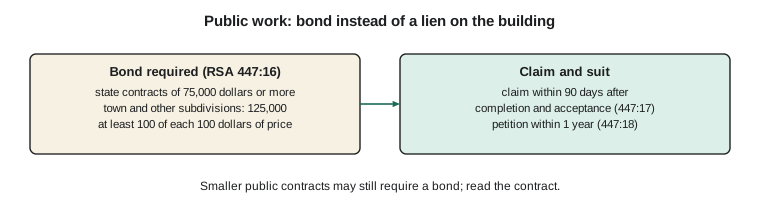
A mechanic's lien cannot attach to a public building. Instead, RSA 447:15 gives a lien on the money owed by the state or a political subdivision to the contractor, and RSA 447:16 requires payment security on larger contracts. On a state contract of 75,000 dollars or more, and on a contract of a town, city, county, school district or other political subdivision of 125,000 dollars or more, the contracting officer must obtain security of at least the full contract price, conditioned on payment for all labor, materials and subcontracts. Smaller public contracts may also require security.
The claim deadlines are firm. RSA 447:17 requires a claim against the bond to be filed within 90 days after the completion and acceptance of the project, with the office the statute names: the Secretary of State, the Department of Transportation or the Department of Administrative Services for state work, or the clerk of the superior court for work of a political subdivision. RSA 447:18 then requires the claimant to file a petition in superior court within one year after filing the claim. A subcontractor who misses either deadline loses the bond claim.
| Rule | Time or amount | Section |
|---|---|---|
| Lien threshold | 15 dollars or more | RSA 447:2, 447:5 |
| Subcontractor notice to owner | Before performing, or later for amounts then due | RSA 447:5, 447:6 |
| Written accounts to owner | At least every 30 days | RSA 447:8 |
| Lien duration | 120 days after services or materials | RSA 447:9 |
| Securing the lien | Attachment by writ within the 120 days | RSA 447:10 |
| Lender notice | 15 business days | RSA 447:12-b |
| Public bond threshold | 75,000 state; 125,000 subdivision | RSA 447:16 |
| Bond claim | 90 days after completion and acceptance | RSA 447:17 |
| Bond suit | 1 year after the claim | RSA 447:18 |
Lien waivers and notes
Lien waivers are contract documents, not statutory forms, in New Hampshire. General contractors and owners commonly ask for a partial waiver with each payment and a final waiver with the last one. A master should read each waiver before signing and should never sign an unconditional waiver for money not yet received. RSA 447:14 deals with a related trap: taking a promissory note for the debt does not defeat the lien unless the note was taken in discharge of the debt and the lien.
Worked problem
A subcontractor's lien
Merrimack Bend is the electrical subcontractor on a private dental office in Hooksett for a general contractor. It sent the owner a written notice before starting on June 2, 2026, sent accounts every 30 days, and finished its work on September 18, 2026. The general contractor has not paid the last 46,000 dollars. What must Kayla do to protect the lien?
Show solution
- The notice before work means the company has a lien under RSA 447:5.
- The lien lasts 120 days from September 18, 2026: to about January 16, 2027.
- To keep it, the company must secure it by attachment of the property within that time.
- Kayla should call the company's lawyer now, gather the notice, the accounts, the subcontract and the invoices, and keep sending the 30-day accounts.
- She should also confirm whether a construction lender was notified, and notify it if not.
Answer: Secure an attachment through the court before about January 16, 2027, with the paperwork ready.
A collections routine
Liens are a last resort. Most unpaid accounts are collected long before a lien is needed, by a routine that starts with the contract. Merrimack Bend invoices promptly, usually monthly on commercial work and at completion on service work, with the change orders attached. Denise reviews the aging report every Monday. At thirty days past due she calls; at forty-five she sends a letter; at sixty, Kayla reviews the account and, on a lien-protected job, calls the company's lawyer with the dates of the last work and the notice and accounts already sent.
The routine respects the statute's clocks. On a private subcontract the notice goes to the owner before work starts, the accounts go out every thirty days, and the 120-day date is diaried from the last day of real work, not from a punch-list visit months later. On public work, the completion and acceptance date is diaried as soon as the owner announces it, with the 90-day claim date beside it. The point is not to file liens but to keep the right to file one until the money is paid.
Common mistakes
MistakeStarting a private subcontract without notice to the owner.
InsteadRSA 447:5 requires written notice to the owner before performing to have a lien for that work.
MistakeRecording a lien statement and waiting.
InsteadThe lien must be secured by attachment within 120 days.
MistakeClaiming a lien on a public school.
InsteadPublic work is protected by payment security and liens on funds, not on the building.
MistakeMissing the 90-day bond claim deadline.
InsteadBond claims must be filed within 90 days after completion and acceptance.
MistakeSigning an unconditional final waiver before payment clears.
InsteadWaivers are contract documents; never waive rights to money not received.
Summary and key terms
- RSA 447:2 gives a lien for 15 dollars or more of labor or materials under a contract with the owner.
- Subcontractors and suppliers need written notice to the owner, ideally before performing, and must give accounts every 30 days.
- The lien lasts 120 days and must be secured by attachment in that time.
- Attachments take priority over construction mortgages except as RSA 447:12-a allows; notify the lender within 15 business days.
- Public work uses payment security: 75,000 dollars for the state, 125,000 for subdivisions.
- Bond claims are due within 90 days after completion and acceptance; sue within one year after the claim.
- Mechanic's lien
- The lien RSA 447 gives for labor and materials on a structure.
- Attachment
- A court-ordered claim against property that secures the lien.
- Owner notice
- A subcontractor's written notice that it intends to claim a lien.
- Payment security
- A bond or similar security on public work that pays labor, materials and subcontracts.
- Completion and acceptance
- The point on public work that starts the 90-day bond claim clock.
Practice problems
Work each problem on paper first, then reveal the answer to check.
Merrimack Bend contracts directly with a homeowner for a service upgrade. Does it need to send a notice to have a lien?
Show answer
No; a contractor with a contract with the owner has a lien under RSA 447:2.
How long after its last work does a lien last?
Show answer
120 days, unless secured by attachment.
A supplier sells 30 dollars of wire for a job. Could it have a lien?
Show answer
Yes in principle; the threshold is 15 dollars, with notice to the owner.
The town accepted a fire station project on May 1. When is the last day to file a bond claim?
Show answer
About July 30, 90 days after completion and acceptance.
After filing the bond claim on July 1, by when must the petition be filed?
Show answer
Within one year, by about July 1 of the next year.
Lesson quiz · 5 questions
Score 60% or more to complete this lesson.
Create a free account to save your progress, take quizzes and earn a certificate.