
MELU-304 · Lesson 11 of 12 · 20 min
Renewal and continuing education
▶ Video coming soon A video version of this lesson is on the way.
Earning a master license is the start of a cycle, not the end of one. A New Hampshire license must be renewed with OPLC on the cycle the Board sets, and it stays valid only while the holder completes the continuing education tied to each new edition of the National Electrical Code. The continuing education rule is unusual: it is not a fixed number of hours every renewal period but a 15-hour update course due within a twelve-month window after each new edition is published. A licensee who misses the window has an invalid license until the hours are done. This lesson explains renewal, the continuing education cycle, what happens to a lapsed license, how the firm license fits in, and how reciprocity works for New Hampshire electricians who also work in neighboring states.
Renewal terms and fees are one place where sources disagree. Secondary guides describe renewal periods of two and of three years and quote different fees, and the OPLC fee page lists fees without labeling the license types. This course therefore does not give a renewal term or fee as fact. Read the renewal notice OPLC sends, the current rules in Elec 401 and the fee schedule in Plc 1002 for your license.
Renewing the license
Renewal is online. The Board's rules in Elec 401 cover the renewal of the license and of the identification card, the renewal application and the grounds for denying renewal. OPLC sends a renewal reminder before the license expires, but a licensee who has moved or changed email can miss it, so the expiration date on the license is the one to diary. The renewal application asks the licensee to confirm that the continuing education required for the current code cycle is complete; OPLC audits a share of licensees, as this lesson explains below.
A master should treat renewal as a business task with a deadline, not a personal errand. Denise renews Art's license, Kayla's license and the firm's license from one calendar, months ahead, and keeps a copy of every confirmation. When Kayla becomes the master in charge, the firm's renewal will depend on hers.
Continuing education tied to the code
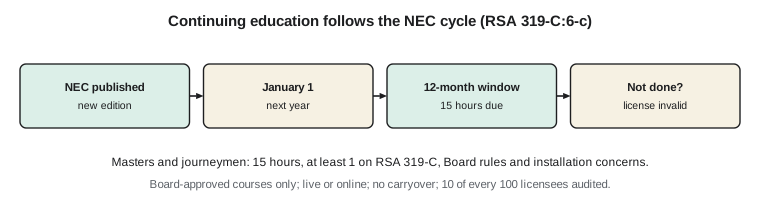
RSA 319-C:6-c requires every licensee to complete continuing education on the latest published edition of the National Electrical Code and to show proof of completion within 12 months from the January 1 following the publication date of that edition. The Board's continuing education page sets the hours: masters and journeymen must complete 15 hours, of which at least one hour must cover changes to RSA 319-C, changes to the Board's rules and installation concerns designated by the Board. The required subject area is a code update. Courses must be approved by the Board; sponsors apply through CE Broker and courses need preapproval. There is no restriction on whether a course is live or online, hours cannot be carried over, and under Plc 308.04 OPLC audits ten of every hundred licensees.
The consequence of missing the window is stated in the statute: a license becomes invalid if the required education is not completed, and it stays invalid until the licensee proves to the Board that the hours are done. An invalid license is not a minor paperwork issue. A master with an invalid license cannot pull permits or direct work, and a firm whose master in charge has an invalid license is without a qualified master.
The current cycle
The National Fire Protection Association publishes a new edition of the code every three years. The 2026 edition was published in 2025, so under the statute's wording the window for the 2026 update opened on January 1, 2026 and runs for twelve months. That means a licensee who has not yet completed the 15-hour update for the 2026 edition should do so before the end of 2026. Approved course providers advertise New Hampshire 15-hour courses on the 2026 changes for exactly this reason.
The cycle is tied to the publication of the code, not to the edition the state has adopted. The state building code still names the 2023 edition, but the continuing education rule follows the latest published edition. A licensee in late 2026 is therefore studying the 2026 changes for continuing education, working to the 2023 edition on the job and, if taking the master exam, answering from the 2020 or 2017 edition. Kayla has all three books on her shelf and keeps them straight by color tabs.
Worked problem
Will Kayla's journeyman license go invalid before her exam?
Kayla's exam is on January 12, 2027. In November 2026 she has not yet taken the 15-hour update for the 2026 code. What should she do?
Show solution
- The 2026 code was published in 2025, so the twelve-month window began January 1, 2026.
- The window closes at the end of 2026.
- If she misses it, her journeyman license becomes invalid until she completes the hours, which would leave her unable to work as a journeyman and complicate her master file.
- She books a Board-approved 15-hour course in early December, completes it and keeps the certificate.
Answer: Complete the 15-hour 2026 update before the end of 2026, then sit the exam in January.
from datetime import date
def ce_window(publication_year):
    start = date(publication_year + 1, 1, 1)
    end = date(publication_year + 1, 12, 31)
    return start, end

for edition, published in [(2023, 2022), (2026, 2025)]:
    s, e = ce_window(published)
print(f"{edition} NEC update: {s} to {e}")2023 NEC update: 2023-01-01 to 2023-12-31 2026 NEC update: 2026-01-01 to 2026-12-31
Apprentices and identification cards
Apprentices are on a different cycle. Their identification cards are valid for twelve months and renew on proof of the year's schooling. After the fifth renewal without a journeyman license, the apprentice must complete 30 hours of classroom instruction each year, including supplemental instruction on areas where recent journeyman exam results show weakness. A master who employs apprentices should track their card dates as closely as the licenses of journeymen, because work on an expired card is recorded in the apprentice's file.
Lapsed licenses and reinstatement
A license that expires without renewal is lapsed. The Board's rules in Elec 402 set a time limit and course requirements for reinstating a lapsed license, give inactive status to licensees on active military duty and deal separately with reinstating a revoked license. OPLC publishes reinstatement applications, including one for journeymen and a relicensing exam application. The longer a license has been lapsed, the more a licensee may have to do, up to retaking an exam. A lapsed or invalid license must never be used to pull permits, and a firm must not let a master with a lapsed license remain its master in charge.
| Item | Rule | Source |
|---|---|---|
| Master and journeyman CE | 15 hours, at least 1 on law, rules and concerns | OPLC CE page; RSA 319-C:6-c |
| CE window | 12 months from January 1 after NEC publication | RSA 319-C:6-c |
| Missed CE | License invalid until completed | RSA 319-C:6-c |
| Course approval | Board-approved through CE Broker | OPLC CE page |
| Carryover | Not allowed | OPLC CE page |
| Audit | 10 of every 100 licensees | Plc 308.04 |
| Apprentice card | 12 months; 30 hours after fifth renewal | OPLC apprenticeship page |
Working in neighboring states
Merrimack Bend takes some work across the borders. The Board's page describes two kinds of help for New Hampshire licensees. For journeymen, a regional agreement with other New England states lets a New Hampshire journeyman seek a reciprocal license if he or she has held a current New Hampshire journeyman license for at least a year, is active and in good standing, passed the New Hampshire journeyman exam with at least 70, completed at least 8,000 hours of practical experience in an apprenticeship or equivalent and completed at least 600 hours of electrical schooling. Holders of grandfathered licenses, and anyone who has not passed the New Hampshire journeyman exam, are not eligible.
For Maine, Massachusetts and Vermont, the Board issues a certified letter verifying the licensee's license and good standing, and the licensee applies through the other state's agency and pays its fees. Massachusetts requires an applicant for a reciprocal master license to also reciprocate the journeyman license. Each state decides for itself what it will accept, so a master planning work in another state should start with that state's licensing agency, not with New Hampshire.
Keeping the firm current
The firm license renews with OPLC and depends on its master in charge. If the master's license lapses or becomes invalid, the firm is effectively without a master; if the master leaves, the firm license is void and the firm must file a change within 30 days. The firm must also keep its Secretary of State registration current. A one-page calendar with the master's license expiration, the continuing education window, the firm license expiration, the Secretary of State annual report, the workers' compensation policy renewal and the safety program review date is the simplest protection a firm can have.
Choosing and documenting courses
Not every course labeled continuing education counts in New Hampshire. The course must be approved by the Board, which reviews sponsors through CE Broker, and it must be the right kind: for masters and journeymen, a code update that includes at least one hour on RSA 319-C, the Board's rules and the installation concerns the Board designates. A general safety course or a manufacturer's product seminar, however useful, does not satisfy the requirement unless it is approved for it. Before paying for a course, Kayla checks the Board's approved list and confirms the course number.
She keeps the completion certificate in two places, her own files and the company's, because an audit can come years later. Under Plc 308.04, OPLC audits ten of every hundred licensees, and a licensee selected for audit must produce proof of the hours. A licensee who cannot produce it faces the same consequence as one who never took the course. Providers send proof to OPLC as well, but a licensee should not rely on that alone.
She also plans ahead for the next cycle. The next edition of the code is expected in 2028, so the next 15-hour window would open on January 1, 2029. Kayla has put a reminder on the company calendar for the autumn of 2029, so that she and the company's journeymen take the update course in time, and she will check the Board's page for the current rule before then, because the rule itself can change.
For a master in charge, one more habit matters: tracking the continuing education of the company's journeymen. A journeyman whose license goes invalid on January 1 cannot work until the hours are done, and a crew that loses two journeymen in the first week of January loses a week of production. Denise's calendar lists each journeyman's course date for the cycle, and Kayla checks in October that everyone has a seat in a course.
Renewal also has a personal side. A master who plans to retire, as Art does, should decide what to do with the license. Some masters keep a license current for a few years to help a successor or do occasional work; others let it lapse. A master who lets a license lapse should first make sure no firm still names him as its master in charge, no open permits remain in his name and the company has filed its change of master. Art has a list of his open permits, and he will not let his license go until every one is closed or transferred.
Common mistakes
MistakeThinking continuing education follows the adopted edition.
InsteadRSA 319-C:6-c ties it to the latest published edition.
MistakeCarrying extra hours to the next cycle.
InsteadHours cannot be carried over.
MistakeWorking on a license that went invalid for missing CE.
InsteadThe license is invalid until the hours are completed and proven.
MistakeAssuming reciprocity is automatic in Massachusetts or Maine.
InsteadEach state decides; the Board issues a verification letter and you apply there.
MistakeIgnoring an apprentice's card date.
InsteadWork on an expired card is recorded in the apprentice's file.
Summary and key terms
- Renew online with OPLC on the cycle in the current rules; check the term and fee on OPLC's pages.
- Masters and journeymen complete 15 hours of Board-approved code update education each code cycle.
- The window is 12 months from the January 1 after the latest edition's publication.
- Missing it makes the license invalid until the hours are done.
- Apprentice cards last 12 months; after the fifth renewal, 30 hours a year.
- Journeyman reciprocity in New England has strict conditions; masters apply to each state.
- Code update course
- The 15-hour continuing education course on the latest NEC edition.
- CE Broker
- The system through which sponsors apply for course approval.
- Invalid license
- A license that may not be used until the required education is completed.
- Reciprocity
- Recognition of a license by another state under its own rules.
- Lapsed license
- A license that expired without renewal, reinstated under Elec 402.
Practice problems
Work each problem on paper first, then reveal the answer to check.
The 2026 NEC was published in 2025. When is the window for the 15-hour update?
Show answer
January 1 to December 31, 2026.
Art did 20 hours in 2026. Can he carry 5 forward?
Show answer
No; carryover is not allowed.
How many of every hundred licensees does OPLC audit?
Show answer
Ten.
Kayla's journeyman license goes invalid on January 1, 2027 for missing CE. Can she work on January 2?
Show answer
No; not until she completes the hours and proves it.
Does New Hampshire issue a reciprocal master license to a Maine master automatically?
Show answer
No; ask OPLC which route applies.
Lesson quiz · 5 questions
Score 60% or more to complete this lesson.
Create a free account to save your progress, take quizzes and earn a certificate.