
MELU-304 · Lesson 6 of 12 · 20 min
Permits, inspections and the inspection authority
▶ Video coming soon A video version of this lesson is on the way.
The state licenses the electrician and sets the code, but the permit is local. In New Hampshire a city or town that has adopted an enforcement mechanism for the state building code issues building and electrical permits, reviews plans where it requires them and inspects the work. Where a town has no enforcement mechanism, state law fills some of the gap through the State Fire Marshal. State electrical inspectors appointed by the Fire Marshal have their own powers under RSA 319-C:5, and towns may also use third-party inspectors approved by OPLC. This lesson explains who inspects in each situation, the usual permit and inspection cycle, what inspectors may order, and how a master handles a failed inspection.
Permit practice varies from town to town far more than the code does. Fees, forms, online portals, the inspections a town requires and the notice it wants for an inspection request are set locally. The facts in this lesson come from RSA 155-A, RSA 319-C:5 and 319-C:5-a and typical town permit forms. Before starting work, read the permit rules of the town where the job sits.
Towns with enforcement
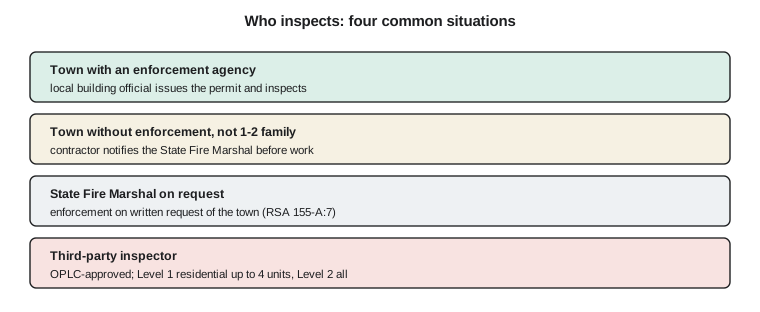
Most of New Hampshire's larger cities and many towns have a building department with a building official and inspectors. Under RSA 155-A the local enforcement agency enforces the state building code, and the local fire chief enforces the fire code. The building department issues the electrical permit, often on a separate electrical permit form, and its inspectors or contracted inspectors inspect the work. RSA 319-C:5, V lets a local building official performing electrical inspections check the license or identification card of the person doing the work, which is why many towns ask for the master's license number on the permit application.
A typical town electrical permit application asks for the property address and owner, a description of the work, the size of any new service, the estimated cost or number of devices, and the master electrician's name, license number and signature. Some towns allow a homeowner to apply for work in a single-family home the homeowner owns and occupies, matching the exemption in RSA 319-C:15, II, and require an affidavit to that effect. Fees are usually set by the town's fee schedule. Kayla has learned which towns in Merrimack Bend's area accept applications online, which still want paper, and which want a separate permit for a generator or a solar system.
Towns without enforcement
Some smaller towns have not adopted an enforcement mechanism for the state building code. The code still applies there; only the local enforcement is missing. RSA 155-A:2, VI requires the contractor, in a municipality that has not adopted an enforcement mechanism, to notify the State Fire Marshal of the type of construction before construction begins, except for one- and two-family dwellings. RSA 155-A:7, in the version in force from July 1, 2026, lets the State Fire Marshal or a designee enforce the building and fire codes in such a municipality on the written request of the municipality, subject to review by the board.
For a master, the practical lesson is that a missing permit office is not permission to skip the code. Merrimack Bend recently wired a small commercial garage in a rural town with no building department. Kayla filed the notice with the State Fire Marshal's office before work began, kept the design and the photographs in the job file, and arranged a voluntary inspection by an approved third-party inspector at the owner's request.
State electrical inspectors
RSA 319-C:5 lets the State Fire Marshal appoint state electrical inspectors. They may enter premises where installations are being made, order violations corrected, and order the utility to disconnect service until violations are fixed. When a state inspector orders a correction, the inspector must notify the local building authority, and the work stops until that authority approves it to resume. The State Fire Marshal's office also has a role in state-owned buildings and in fire investigations, and RSA 319-C:14-a lets the Electricians' Board investigate a licensee when the Fire Marshal finds that faulty wiring was a principal cause of a fire.
The power to order a disconnection is the one candidates remember. If an inspector finds a dangerous condition, the inspector can have the utility disconnect the service until the condition is corrected. That power exists to protect occupants and the public, and it is the reason a master should never treat an inspector's correction order as optional.
Third-party inspectors
RSA 319-C:5-a deals with third-party inspectors. Under the Board's rules, an entity that hires third-party electrical inspectors must use inspectors OPLC has approved. There are two levels: a Level 1 inspector may inspect residential buildings of up to four contiguous units, and a Level 2 inspector may inspect all types. OPLC publishes the approved list. Cities and towns may still contract with inspectors of their choice for their own inspections, and the rules do not apply to state inspectors working under the state permitting system. On the exam, expect a question that asks which level of inspector may inspect a six-unit apartment building; the answer is Level 2.
| Inspector | Who appoints or approves | Scope |
|---|---|---|
| Local building official or inspector | City or town | Permits and inspections where the town enforces |
| State electrical inspector | State Fire Marshal | Enter, order corrections, order disconnection |
| Third-party, Level 1 | OPLC approval | Residential up to four contiguous units |
| Third-party, Level 2 | OPLC approval | All types of inspections |
The permit and inspection cycle
On a typical job in a town with enforcement, the cycle runs in a predictable order. The master applies for the permit and the town checks the license. If the town requires plans, it reviews them. The permit is issued and posted at the job. Inspections follow the work: an underground or slab inspection for conductors in or under a slab, a rough-in inspection before walls and ceilings are covered, a service inspection before the utility energizes a new or upgraded service, and a final inspection when the work is complete. After the service passes, the town releases the service to the utility, and after the final passes, the town closes the permit. Each town sets its own list; some combine inspections, some add others for fire alarm interfaces or generators.
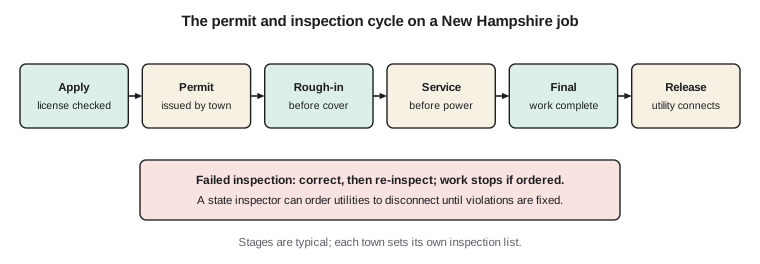
Timing matters. A rough-in inspection must happen before the work is covered, and covering work before inspection is the fastest way to lose a day of drywall. A service inspection must pass before the utility will connect, which means the inspection request must go in early enough to meet the utility's schedule. Kayla asks her crews for an inspection request two working days before they expect to be ready, because most towns in the area want at least a day's notice.
Failed inspections and appeals
When work fails, the inspector issues a correction notice or a list of deficiencies. The master corrects the work and requests a re-inspection. A good master reads every correction notice personally, because a pattern of failures by one crew or one journeyman is a supervision problem as well as a code problem; Elec 404.05 requires the master to inspect the journeyman's work periodically and to perform a final inspection of each journeyman's installation, and an inspector's notice is evidence of how well that duty is being performed.
Disagreements happen. If a master believes an inspector has misread the code, the first step is a calm conversation with the code section open. If that fails, the town's building code board of appeals, where one exists, hears appeals from the building official's decisions. Code interpretation questions with statewide reach can go to the state building code review board. The exam is more likely to ask who hears an appeal than how long the master has to file one, and appeal deadlines are set locally, so check the town's ordinance.
Worked problem
A failed service inspection
Merrimack Bend upgraded a service in Concord to 200 amperes. The inspector failed the service inspection because the grounding electrode conductor to the water pipe was not bonded around the water meter. The utility is scheduled to reconnect the next morning. What should Kayla do?
Show solution
- Read the correction notice and confirm the code section the inspector cited.
- Send the journeyman back the same day to install the bonding jumper around the meter.
- Photograph the correction and request a re-inspection, asking whether the town will accept the photograph or needs a site visit.
- Tell the utility and the customer that reconnection depends on the re-inspection.
- Note the miss in the crew's file and review grounding and bonding at the next toolbox talk.
Answer: Correct the work, request re-inspection, coordinate with the utility and the customer, and treat the failure as a supervision item.
Records
A master's job file should include the permit, any plans, inspection records, correction notices and their resolution, and the closing of the permit. Denise keeps the files for seven years in the company's system. Good records answer the questions that come later: a homeowner who sells the house, an insurer after a fire, or the Board investigating a complaint. They also make the next permit easier, because a building official who has seen clean files from a contractor tends to trust that contractor's work.
Working with inspectors
Inspectors are part of the job, and a master who treats them as partners has fewer failed inspections. Kayla's habits are simple. She calls for inspections only when the work is truly ready, so the inspector's time is not wasted. She is on site, or has the lead journeyman on site, for every inspection, with the permit, the plans and the code book. When an inspector raises a concern, she asks which section the inspector is relying on and reads it with the inspector, rather than arguing from memory. And she follows up corrections the same day when she can.
She also learns each town's preferences. One town wants all inspection requests by email the afternoon before; another wants a phone call by eight in the morning. One inspector likes to see the labels on every breaker before the final; another checks every box fill on rough-in. None of these preferences change the code, but knowing them saves days. Denise records them on each town's tab in the binder so that the knowledge stays with the company when an employee leaves.
Finally, Kayla never asks an inspector to pass work that does not meet the code, and she never covers work an inspector has not seen. An inspector who learns that a contractor's word can be trusted will often accept photographs of a small correction instead of a second visit, which saves the customer money. An inspector who learns otherwise will look at every box.
Permits also matter after the job is done. A homeowner selling a house, a lender financing a building or an insurer investigating a loss may ask whether the electrical work was permitted and passed. An open permit that was never closed can delay a sale, and work done without a permit may have to be opened up for inspection years later. Kayla closes every permit within a week of the final inspection and keeps the closing record in the job file, so that the company can answer those questions in minutes rather than days.
Common mistakes
MistakeSkipping the permit in a town without a building department.
InsteadThe code still applies; for buildings other than one- and two-family dwellings the contractor must notify the State Fire Marshal before work.
MistakeCovering work before the rough-in inspection.
InsteadRough-in must be inspected before walls and ceilings are closed.
MistakeUsing a Level 1 third-party inspector on a six-unit building.
InsteadLevel 1 covers residential up to four contiguous units; Level 2 covers all types.
MistakeTreating a correction order as advice.
InsteadWork stops until the local authority approves resumption, and a state inspector can order disconnection.
MistakeIgnoring a pattern of failed inspections.
InsteadFailures are evidence about supervision, which the master must provide.
Summary and key terms
- Towns with enforcement issue electrical permits and inspect; they may check the license.
- Where a town has no enforcement, the contractor notifies the State Fire Marshal before building anything other than a one- or two-family dwelling.
- State electrical inspectors may enter, order corrections and order the utility to disconnect.
- Third-party inspectors must be OPLC-approved: Level 1 for residential up to four units, Level 2 for all.
- Inspections follow the work: underground, rough-in, service and final.
- Correct failures promptly, request re-inspection and keep complete job records.
- Enforcement mechanism
- A town's adopted system for enforcing the state building code.
- State electrical inspector
- An inspector appointed by the State Fire Marshal under RSA 319-C:5.
- Level 1 inspector
- A third-party inspector approved for residential buildings of up to four contiguous units.
- Level 2 inspector
- A third-party inspector approved for all types of inspections.
- Correction notice
- An inspector's written list of deficiencies to be corrected before re-inspection.
Practice problems
Work each problem on paper first, then reveal the answer to check.
Who issues the electrical permit for a job in Manchester?
Show answer
The City of Manchester's building department.
Merrimack Bend is building a small warehouse in a town with no enforcement mechanism. What must it do before starting?
Show answer
Notify the State Fire Marshal of the type of construction.
Which level of third-party inspector may inspect a three-unit townhouse building?
Show answer
Level 1 or Level 2.
What happens when a state inspector orders a correction?
Show answer
The local building authority is notified and work stops until it approves resumption.
May a local building official ask to see a journeyman's identification card?
Show answer
Yes; RSA 319-C:5, V allows it.
Lesson quiz · 5 questions
Score 60% or more to complete this lesson.
Create a free account to save your progress, take quizzes and earn a certificate.