
MELU-304 · Lesson 3 of 12 · 18 min
Applying, approval and booking the exam
▶ Video coming soon A video version of this lesson is on the way.
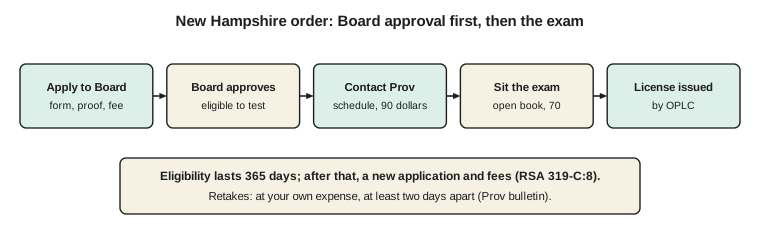
In many states a candidate books the exam first and applies with the score. New Hampshire runs the other way. The candidate applies to the Electricians' Board through OPLC, the Board reviews the application and approves the candidate to test, and only then does the candidate contact the testing company to schedule. The testing company's candidate information bulletin is explicit: submit the application to the Board, wait for the Board to approve you, and then contact the testing company. This lesson follows Kayla's application from the first form to a confirmed exam appointment, and it explains the clocks that start along the way.
The facts here come from RSA 319-C:8, the Board's rules in Elec 305, the OPLC application pages and the candidate information bulletin published by Prov, the company that delivers the New Hampshire electrical exams. The bulletin used in this course is dated August 6, 2026. Bulletins are revised several times a year, and fees, sites and procedures change, so download the current one before you book.
Step one: the application
The master application goes to OPLC, which processes applications for the Board through its online licensing system. The application asks for identification, the journeyman license number, a record of journeyman hours as Lesson 2 described, verification of those hours by a licensed master, and the application fee set in Plc 1002. RSA 319-C:8 requires a written application with the fee, and it lets the Board give the examination in written, oral or computerized form. In practice the New Hampshire exams are computer-based and open book.
Fees deserve a caution. OPLC publishes its electrician fees on a fee page, and secondary sources quote different numbers for the master application and for renewal. Rather than repeat a number that may be out of date, this course tells you where to find it: the current fee page and Plc 1002.13. Budget for two separate payments, the application fee to OPLC and the exam fee to the testing company.
Kayla submitted her application on September 8, 2026. Denise scanned the signed hour summary, a list of twelve representative jobs with permit numbers and a copy of Kayla's journeyman license and card. Art signed the verification as her supervising master. The application went in on a Tuesday, and Kayla set a reminder to check the online system every Monday.
Step two: Board approval
The Board reviews applications and approves candidates who meet the qualifications. If something is missing, OPLC or the Board will ask for it; if the Board finds the candidate is not qualified, the candidate can ask for a hearing under the OPLC rules. Approval is not automatic and it is not instant. The Board meets at least four times a year under RSA 319-C:6, and many routine approvals are handled by staff between meetings, but a candidate with an unusual file, such as out-of-state hours or a gap in licensure, should expect it to take longer.
Kayla's approval arrived on October 14, 2026. The notice told her she was eligible to test and gave her the information the testing company would need to find her record, including a candidate identification number. She saved the notice as a PDF and printed a copy for the binder.
Step three: scheduling with the testing company
Once the Board approves a candidate, the candidate schedules with Prov. The bulletin describes two ways: online through Prov's exam scheduler, using the known candidate ID and last name, or by telephone. The exam fee is paid when scheduling, by card or with a coupon code, and the invoice is emailed. The bulletin used in this course lists an exam fee of 90 dollars for a first attempt and the same for a retake, updated in February 2025. It also lists optional services: a hand score request, an exam review and practice exams sold by Prov.
Candidates can test in person or remotely. The August 2026 bulletin lists in-person sites in Concord, Nashua and Newington, with sites in bordering states as well, and remote testing through an online proctoring service. Remote testing has technical requirements: a Mac, Windows PC or Chromebook rather than a tablet, a supported browser, a working webcam and microphone, a stable upload speed, and a private, quiet room with a clear desk, covered windows and no one else present. An open book exam taken remotely still requires the books, and the proctor will check them on camera.
Kayla chose the Concord site because it is fifteen minutes from her house and because she wanted to spread her code book and references on a real desk. She booked Tuesday, January 12, 2027, at 8:00 in the morning, which gives her about three months to study from the date of approval. She chose a morning slot because the master exam runs five hours and she wanted to finish before her attention faded.
The one-year clock
RSA 319-C:8 contains the most important deadline in this lesson. An applicant who does not pass the examination within one year after the application must file a new application and pay the fees again. The bulletin describes the same rule from the testing company's side: eligibility vouchers are valid for 365 days, and a candidate whose voucher expires must reapply to the Board and pay the exam fee to get a new one. The practical lesson is to apply when you are ready to study and test, not a year early.
The clock is measured from the application, not from the approval, so a slow approval eats into the year. Kayla applied on September 8, 2026, so her year runs to about September 8, 2027. Her January exam leaves her about eight months of margin for a retake if she needs one.
from datetime import date, timedelta
applied = date(2026, 9, 8)
approved = date(2026, 10, 14)
exam = date(2027, 1, 12)
deadline = applied + timedelta(days=365)
print("Eligibility runs to about", deadline)
print("Days from approval to exam:", (exam - approved).days)
print("Days of margin after the exam:", (deadline - exam).days)Eligibility runs to about 2027-09-08 Days from approval to exam: 90 Days of margin after the exam: 239
Retakes and reviews
A candidate who fails may retake the exam at his or her own expense, as RSA 319-C:8 provides. The bulletin adds the testing company's rules. A failed exam can be retaken as often as scheduling allows, but the candidate must wait two days between attempts. A passed exam cannot be retaken unless the Board requires it. A candidate who fails an exam category twice, scoring within ten points of the passing score, may request an exam review, which lasts about an hour and a half under test conditions and lets the candidate see the questions missed. A hand score request checks that the computer scored the answers correctly.
The two-day minimum is not a study plan. A candidate who fails should read the score report, find the content areas where the score was lowest, study those areas and take a timed practice test before booking again. Lesson 12 covers that process.
Cancellations, lateness and identification
The bulletin's rules on test day are strict, and candidates lose fees every year by ignoring them. Rescheduling or canceling is free online if done at least three days before the test date; missing the appointment or rescheduling late forfeits the fee. Emergencies require written documentation to the testing company. At the site, doors open at least fifteen minutes before the appointment, and a candidate who arrives after the session starts is turned away and forfeits the fee.
Identification must be current, government-issued and show both a photo and a signature, such as a driver's license, passport or military identification. If the photo identification has no signature, the candidate may also present a signed credit card or student identification. In person, candidates sign a log and are photographed; refusing either means dismissal. Remote candidates go through an identity check and photograph by the proctor. Only a simple four-function calculator is allowed in person. The remote rules list calculators among electronics that must be removed from the room, so a remote candidate should confirm with the testing company before test day whether any calculator is allowed.
| Rule | What the bulletin says | Kayla's plan |
|---|---|---|
| Approval | Board first, then schedule | Approved October 14, 2026 |
| Fee | 90 dollars per attempt, paid to Prov | Paid at booking |
| Eligibility | 365 days | Runs to about September 2027 |
| Reschedule | Free online 3 or more days ahead | Calendar reminder set |
| Arrival | Doors open at least 15 minutes early | Arrive 30 minutes early |
| Identification | Government photo ID with signature | Driver's license |
| Calculator | Simple four-function only, in person | Buy one and practice with it |
After the exam
Passing the exam does not make the candidate a master; the license does. After a pass, the score goes to the Board, and OPLC issues the license and identification card once any remaining fees are paid and the file is complete. RSA 319-C:7, III requires the license to be displayed at the principal place of business or carried and shown on request to an inspector. For a firm like Merrimack Bend, issuing Kayla's license is only the first step; the firm must then file the change of master under Elec 404.02, which Lesson 8 covers.
Kayla and Art have agreed on the order. Kayla will not be named as the master in charge until her license is issued and in her wallet, and Art will stay on until the Board has the change-of-master letter and the firm's new license documents. Until then, Art remains the master directly in charge of all the company's installations.
Keeping the application moving
Applications stall for predictable reasons, and a candidate can prevent most of them. The most common is an incomplete verification of hours: a missing signature, a summary that does not add up, or hours listed under an employer who cannot be reached. The second is a license problem, such as a journeyman license that lapsed or went invalid for missing continuing education while the application was pending. The third is a mismatch between the name on the application and the name on the identification the candidate will bring to the test site. The fourth is simply silence: a request from OPLC for one more document that sits unanswered in an old email account.
Kayla avoided all four. She used the same legal name on the application, her license and her driver's license. She checked that her journeyman license and continuing education were current before applying. She gave OPLC an email address she reads every day and set a filter so nothing from the state went to a spam folder. And she asked Art to sign the verification in front of her, with the summary and the permit list attached, so there was no back and forth.
If a candidate is denied, the denial is not the end. The OPLC rules give an applicant who is denied the right to an administrative hearing before the Board. A denial for missing documents is usually fixed by supplying them and reapplying. A denial on the merits, such as hours the Board will not credit, calls for a careful look at the rule and, often, a conversation with OPLC staff before deciding whether to request a hearing. The one-year clock in RSA 319-C:8 keeps running in the meantime, which is another reason to apply only with a complete file.
Common mistakes
MistakeBooking the exam before applying to the Board.
InsteadNew Hampshire requires Board approval first; the testing company schedules only approved candidates.
MistakeMeasuring the one-year clock from approval.
InsteadRSA 319-C:8 measures it from the application.
MistakeRescheduling the day before the exam and expecting a refund.
InsteadFree rescheduling requires at least three days' notice; late changes forfeit the fee.
MistakeBringing a programmable calculator.
InsteadOnly a simple four-function calculator is allowed in person.
MistakeAssuming a passing score is the license.
InsteadOPLC issues the license after the pass; the firm then files any change of master.
Summary and key terms
- Apply to the Board through OPLC first; schedule with Prov only after approval.
- Pay the application fee to OPLC and the exam fee, 90 dollars in the August 2026 bulletin, to Prov.
- Eligibility lasts one year from the application; after that, reapply and pay again.
- Retakes are allowed at your expense, at least two days apart; reviews and hand scoring are available.
- Follow the bulletin's rules on rescheduling, arrival, identification and calculators.
- The license, not the score, makes you a master; display or carry it.
- Prov
- The testing company that delivers the New Hampshire electrical exams.
- Candidate information bulletin
- The testing company's booklet of exam rules, content and references.
- Known candidate ID
- The identification the testing company uses to find an approved candidate's record.
- Eligibility voucher
- The approval to test, valid for 365 days.
- Exam review
- A timed session to see missed questions, available after two failures within ten points of passing.
Practice problems
Work each problem on paper first, then reveal the answer to check.
Kayla applied September 8, 2026. About when does her eligibility end?
Show answer
About September 8, 2027, one year from the application.
Can she schedule with the testing company before the Board approves her?
Show answer
No; approval comes first.
She fails on a Tuesday. What is the earliest she could retest?
Show answer
Two days later under the bulletin, though she should study first.
She wants to move her exam from Tuesday to Thursday of the same week, telling the company on Monday. Is that free?
Show answer
No; free changes require at least three days' notice before the test date.
What must she do with her license once issued?
Show answer
Display it at the principal place of business or carry it and show it to an inspector on request.
Lesson quiz · 5 questions
Score 60% or more to complete this lesson.
Create a free account to save your progress, take quizzes and earn a certificate.