
MELU-304 · Lesson 2 of 12 · 21 min
Eligibility for the Master Electrician License
▶ Video coming soon A video version of this lesson is on the way.
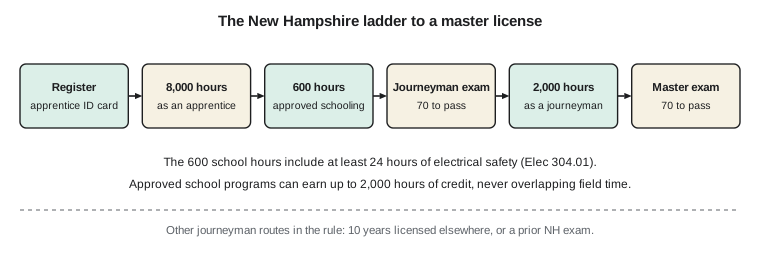
Kayla's first real question was simple: am I eligible yet? In New Hampshire the answer depends on two sources that must be read together. RSA 319-C:7 sets the statutory floor for both the journeyman and the master license: 8,000 hours of service as an apprentice electrician, at least 600 hours of education approved by the Board, and a passing grade on an examination the Board approves under RSA 319-C:8. The Board's rule, Elec 304.01, fills in the details and adds the step that separates a master from a journeyman: before a candidate may sit for the master exam, he or she must have passed the journeyman exam and completed 2,000 hours of field experience as a journeyman performing electrical installations.
This lesson works through each piece of that ladder: the apprentice hours, the schooling, the credit the Board gives for approved programs, the journeyman exam, the journeyman hours and the other routes the rule allows. It ends with the paperwork Kayla gathered to prove each piece, because eligibility is only as good as the evidence behind it.
The apprentice years
Every New Hampshire electrician starts as a registered apprentice. RSA 319-C:7, IV requires apprentices to register with OPLC, and the Board's apprenticeship page explains what that means in practice. The apprentice must be employed by a New Hampshire master electrician or by an employer that employs one, must hold an identification card issued by the Board, and must have a high school diploma or the equivalent. The application includes references, a schooling history, a recent photograph and the license number of the supervising master. The card is valid for twelve months and is renewed for another twelve months on proof of schooling, such as a certificate, transcript or enrollment letter.
The hours that count toward the 8,000 are hours of field experience as an apprentice under a New Hampshire licensed journeyman or master. Hours worked without a valid identification card, or without the direct supervision the rules require, do not help an apprentice and can hurt: Elec 404.05 says that installations made by an apprentice without direct supervision, or while holding an expired card, are recorded in the apprentice's file, and the Board considers those records when the apprentice later applies for a license.
Kayla kept a simple log from her first week. Each pay period she recorded her hours, the employer, the supervising journeyman or master and the kind of work, and once a year she had her employer sign a summary. By early 2022 the log showed a little over 8,300 hours across five years with two employers. That habit saved her weeks when she applied for the journeyman exam, and she has kept the same log as a journeyman.
The schooling
The second requirement is schooling. Under Elec 304.01 a journeyman applicant must complete 600 hours of electrical education, including at least 24 hours on electrical safety. The education is delivered in courses of 150 hours, each with at least 6 hours of safety content, and a student may take more than one course in a year. An associate degree or higher in an electrical curriculum also satisfies the schooling requirement. The apprenticeship page adds a related rule for apprentices still on the ladder: 150 hours of approved schooling in each twelve-month period the identification card is valid, which is how most apprentices reach 600 hours in four years.
Apprentices who stay on the ladder a long time face an extra step. After the fifth renewal of an apprentice card without a journeyman license, the apprentice must complete 30 hours of classroom instruction each year, including supplemental instruction on the areas where recent journeyman exam results show weakness. The rule is meant to move long-term apprentices toward the exam, and it appears on the exam as a number question.
Credit for approved programs
The Board can credit some schooling toward the 8,000 field hours. Elec 304.01 lets the Board credit documented practical experience from approved programs, up to 2,000 hours. The rule lists the kinds of programs that qualify: New Hampshire community and technical colleges, the state's technical institute, national joint apprenticeship schools, state-approved vocational schools and out-of-state schools accredited by a recognized agency. Part-time work for a master electrician during full-time post-secondary study can also count if the apprentice documents the dates, the type of work and the master's signature. One limit matters: school credit and field time cannot be counted for the same period. A student who works full time while enrolled cannot claim both the work hours and the school credit for those same months.
Military experience can also count. RSA 319-C:7, II lets the Board credit experience received in military service under its rules. A veteran who did electrical work in the service should gather the service records and job descriptions early, because the Board decides how much to credit.
| Requirement | Amount | Source |
|---|---|---|
| Apprentice field hours | 8,000 hours under a NH journeyman or master | RSA 319-C:7, II; Elec 304.01 |
| Electrical schooling | 600 hours, at least 24 on safety | RSA 319-C:7, II; Elec 304.01 |
| School credit toward field hours | Up to 2,000 hours, no overlap | Elec 304.01 |
| Journeyman exam | Pass with 70 | Elec 305; Prov bulletin |
| Journeyman field hours before master exam | 2,000 hours | Elec 304.01 |
| Master exam | Pass with 70 | Elec 305; Prov bulletin |
Other routes to the journeyman level
Elec 304.01 gives two alternatives to the schooling requirement for a journeyman applicant who has the 8,000 field hours. The first is ten years of experience as a journeyman or master licensed in another jurisdiction. The second is having previously taken the New Hampshire journeyman or master exam. These routes are for experienced electricians moving into the state, not shortcuts for apprentices, and the Board decides whether the evidence is sufficient.
Reciprocity is a separate question. The Board's page describes a regional agreement for journeymen, which Lesson 11 covers, and certified letters the Board issues to support applications in Maine, Massachusetts and Vermont. It does not describe a reciprocal master license for out-of-state masters coming into New Hampshire; a master licensed elsewhere should ask OPLC which route applies before assuming one.
The journeyman hours
The step that defines the master is the 2,000 hours of field experience as a journeyman performing electrical installations, completed after passing the journeyman exam. Three points deserve attention. First, the hours must be as a licensed journeyman; hours as an apprentice beyond the 8,000 do not count toward the 2,000. Second, they must be hours performing electrical installations, so time spent as an estimator or office manager who happens to hold a journeyman license may not count. Third, the rule does not set a calendar minimum. A journeyman working full time typically reaches 2,000 hours in about a year, but a part-time journeyman takes longer.
Kayla's log made this easy. From April 2022 to the end of August 2026 she recorded about 8,900 hours as a licensed journeyman at Merrimack Bend, all on installation work: services, commercial fit-outs, a school renovation, generators and motor controls at a water treatment plant. She needed 2,000. She also kept copies of permits she had worked under, because the application asks the supervising master to verify the hours and the permits are the easiest independent proof of the kind of work.
Worked problem
Counting hours for a part-time journeyman
Marcus Bell, another Merrimack Bend electrician, passed the journeyman exam in May 2026 and was licensed in June. He works 32 hours a week, about 48 weeks a year. When will he reach 2,000 journeyman hours?
Show solution
- Hours per year: 32 times 48 is 1,536 hours.
- 2,000 divided by 1,536 is about 1.30 years.
- 0.30 of a year is about 3.6 months, so roughly one year and four months after June 2026.
- He should plan to apply no earlier than about October 2027, and only after his log shows 2,000 installation hours.
Answer: About 1.3 years, around October 2027, if his hours stay at 32 a week.
# Journeyman hours toward the 2,000-hour master requirement (illustrative)
needed = 2000
hours_per_week = 32
weeks_per_year = 48
per_year = hours_per_week * weeks_per_year
years = needed / per_year
print(f"Hours per year: {per_year}")
print(f"Years to {needed} hours: {years:.2f}")
print(f"About {round(years * 12)} months")Hours per year: 1536 Years to 2000 hours: 1.30 About 16 months
Character and the application file
Beyond hours and exams, the Board considers an applicant's record. RSA 319-C:15 makes obtaining a license wrongfully or by fraud a violation, and the Board's rules on unprofessional conduct in Elec 405 apply to applicants as well as licensees. An applicant with a history of unsupervised work, expired cards or prior discipline should expect questions and should answer them honestly. The application asks the supervising master to verify hours under oath, and a false verification is a problem for the master as well as the applicant.
Kayla's file, which Lesson 3 follows through the Board, contained her journeyman license number, a summary of her journeyman hours by year signed by Art, a list of representative jobs with permit numbers, and the fee. Her apprentice hours and schooling were already on file from her journeyman application, so she did not need to prove them again, but she kept copies.
Where candidates go wrong
Most eligibility problems in New Hampshire come from one of four mistakes. The first is counting the wrong hours: apprentice hours beyond 8,000, or journeyman hours that were not installation work. The second is relying on hours worked without a valid card or without direct supervision. The third is forgetting that the eligibility to test is time-limited; Lesson 3 explains the one-year rule in RSA 319-C:8. The fourth is assuming an out-of-state master license transfers automatically. Each is avoidable with a log, a calendar and a call to OPLC.
A final point concerns the high or medium voltage license, which is a separate credential rather than a step on the master ladder. RSA 319-C:7, II-a lets the Board license a high or medium voltage electrician who completes a state, national or employer certification program the Board approves; electricians employed as high or medium voltage electricians for five years before January 1, 2003, at a company with an approved training program, were also eligible. A firm doing work over 600 volts needs a master or a high or medium voltage electrician in charge of that work.
A checklist before you apply
Before Kayla filled in a single form she ran a short checklist with Art at his kitchen table, and it is worth copying. Is the journeyman license current, with no lapse since it was issued? A lapse does not erase earlier hours, but hours worked while the license was invalid may not count as hours as a licensed journeyman. Do the journeyman hours add to at least 2,000, counted only from the date the license was issued? Were they installation hours, with permits or job records to show it? Is there a master willing to verify the hours, and does that master hold a current New Hampshire license? Is the continuing education for the current code cycle complete, so the journeyman license will not go invalid while the application is pending? Lesson 11 explains why that last question matters in a year when the 15-hour update course is due.
The checklist also covers money and time. The application fee is paid to OPLC and the exam fee is paid separately to the testing company, as Lesson 3 explains. The eligibility to test lasts one year from the date of the application under RSA 319-C:8, so a candidate who applies and then waits a year to study will have to reapply. Kayla applied only once she had cleared her calendar for four months of study, which is the order this course recommends: get eligible on paper, block the study time, then apply.
Finally, the checklist asks whether the candidate understands what the license will mean. A master is responsible for the work of every journeyman and apprentice he or she directs, signs permit applications, carries the firm's license if named as the master in charge, and answers to the Board for violations. Art made a point of walking Kayla through a disciplinary decision the Board had published, so she would understand that the license is a responsibility as well as a credential.
Common mistakes
MistakeCounting apprentice hours beyond 8,000 toward the master.
InsteadThe master requirement is 2,000 hours as a licensed journeyman after passing the journeyman exam.
MistakeClaiming school credit and field hours for the same months.
InsteadElec 304.01 says school credit and field time cannot overlap.
MistakeAssuming the schooling can be any 600 hours.
InsteadIt must be Board-approved and include at least 24 hours of safety.
MistakeTreating hours worked on an expired card as good hours.
InsteadThose installations are recorded in the file and the Board considers them.
MistakeThinking the high or medium voltage license is a step toward master.
InsteadIt is a separate credential with its own certification route.
Summary and key terms
- The statutory floor is 8,000 apprentice hours, 600 hours of approved schooling and a passing exam.
- The schooling includes at least 24 hours of safety, in 150-hour courses with at least 6 safety hours each.
- Approved programs can earn up to 2,000 hours of credit toward field hours, without overlap.
- A master candidate must pass the journeyman exam and complete 2,000 field hours as a journeyman.
- Apprentices must be registered, carry a current card and be directly supervised.
- Keep a log of hours, supervisors and work types from the first week.
- Identification card
- The card OPLC issues to a registered apprentice, valid for twelve months.
- Elec 304.01
- The Board rule on journeyman and master qualifications.
- School credit
- Credit of up to 2,000 hours toward field hours for approved programs.
- Journeyman hours
- Field hours performing installations while licensed as a journeyman.
- High or medium voltage electrician
- A separate license for work over 600 volts up to a building's first disconnecting means.
Practice problems
Work each problem on paper first, then reveal the answer to check.
Kayla has 8,300 apprentice hours and 600 school hours but has not passed the journeyman exam. Can she sit for the master?
Show answer
No; she must pass the journeyman exam and then complete 2,000 journeyman hours.
How many safety hours must the 600 school hours include?
Show answer
At least 24.
Can a full-time student count both school credit and full-time work hours for the same semester?
Show answer
No; they cannot overlap.
What happens to installations an apprentice made on an expired card?
Show answer
They are recorded in the apprentice's file and considered when the apprentice applies for a license.
Does a master license from Maine automatically become a New Hampshire master license?
Show answer
No; ask OPLC which route, if any, applies.
Lesson quiz · 5 questions
Score 60% or more to complete this lesson.
Create a free account to save your progress, take quizzes and earn a certificate.