
MELU-304 · Lesson 10 of 12 · 20 min
Workplace safety law and OSHA for electrical contractors
▶ Video coming soon A video version of this lesson is on the way.
Electrical work is dangerous, and safety law reaches a master from three directions. Federal OSHA sets and enforces the workplace safety standards that apply to private employers in New Hampshire, because the state does not run an OSHA-approved state plan for the private sector. State law, in RSA 281-A, requires workers' compensation coverage, sets the deadline for reporting injuries and requires larger employers to keep a written safety program and a joint loss management committee. And the electrical code itself, together with NFPA 70E, shapes how energized work is done. This lesson explains each layer and how Merrimack Bend, with seventeen employees, meets them.
The sources are 29 CFR Parts 1904, 1910 and 1926, RSA 281-A:53 and 281-A:64, and the New Hampshire Department of Labor's safety program rules in Lab 600. The figures for OSHA penalties are adjusted each year and are not given here.
Federal OSHA in New Hampshire
New Hampshire private employers are covered by federal OSHA through its Concord area office. The construction standards in 29 CFR Part 1926 apply to construction work, including new installations, renovations and most of what an electrical contractor does on a building site; the general industry standards in Part 1910 apply to maintenance and other work. For electricians the key parts are Subpart K of Part 1926 on electrical safety, the lockout and tagout standard in 1910.147, the electrical safety-related work practice standards in 1910.331 through 1910.335, fall protection in Subpart M of Part 1926, ladders and scaffolds, excavation in Subpart P and the hazard communication standard. Because there is no state plan for private employers, there is no New Hampshire version of those standards to learn; the federal text governs.
OSHA's construction electrical standards require, among other things, ground-fault protection for receptacle outlets used by employees on construction sites, either by ground-fault circuit interrupters or by an assured equipment grounding conductor program; safe use of extension cords and portable equipment; and de-energizing and locking out circuits before work unless de-energizing creates a greater hazard or is infeasible. Energized work, where it is justified, must be done by qualified persons using appropriate protective equipment and procedures, and NFPA 70E is the consensus standard most employers use to meet those general duties.
Reporting serious injuries
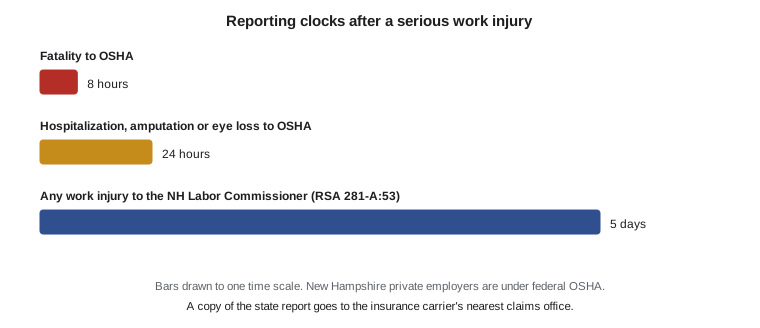
OSHA's recordkeeping rule in 29 CFR 1904.39 sets two short clocks. An employer must report a work-related fatality to OSHA within 8 hours of learning of it, and must report an in-patient hospitalization, an amputation or the loss of an eye within 24 hours. These clocks run in hours, not days, and they apply to every employer, including small ones exempt from keeping injury logs. An employer with more than ten employees in most industries, including construction, must keep the OSHA 300 log of recordable injuries and illnesses and post the annual summary.
New Hampshire adds its own clock for workers' compensation. RSA 281-A:53 requires an employer to report any injury sustained by an employee in the course of employment to the Commissioner of Labor as soon as possible, but no later than 5 days after the employer learns of it, with a copy to the nearest claims office of the employer's insurance carrier. In practice the employer files the first report of injury, often through the carrier. The state rule covers every work injury, not just serious ones.
Worked problem
A shock and a hospital stay
On a Tuesday afternoon a Merrimack Bend journeyman is shocked while working on a panel that was thought to be de-energized. He is taken to the hospital and admitted overnight for observation. What reports are due, and when?
Show solution
- An in-patient hospitalization must be reported to OSHA within 24 hours of the employer learning of it: by Wednesday afternoon.
- The injury must be reported to the New Hampshire Labor Commissioner, with a copy to the carrier, within 5 days: by Sunday.
- The injury must be recorded on the OSHA 300 log within 7 calendar days, since the company keeps the log.
- Kayla should secure the panel, preserve the lockout devices and notes, and begin an investigation of how the circuit was verified.
Answer: OSHA within 24 hours, the state within 5 days, the log within 7 days, and an investigation.
Workers' compensation
RSA 281-A requires employers to secure compensation for their employees, by insurance or by approved self-insurance. A worker injured on the job receives medical care and wage replacement under the statute, and in return the employer is generally protected from being sued by the employee for negligence. Coverage must be in place from the first day an employee works. Towns, general contractors and public owners regularly ask for a certificate of coverage, and a master who lets coverage lapse risks penalties and personal liability for injuries.
Return to work matters too. The statute and the Department of Labor's rules encourage employers to offer injured workers temporary alternative work, and the joint loss management committee described below is meant to oversee such programs. Merrimack Bend has a short list of light-duty tasks, such as prefabricating assemblies in the shop, updating the tool inventory and helping estimate, so injured electricians can return sooner.
Safety programs and committees
RSA 281-A:64 adds a state requirement that many contractors overlook. Every employer with 15 or more employees must prepare a written safety program, file it with the Commissioner of Labor, and review and update it at least every two years. Every employer of 15 or more employees must also establish and administer a joint loss management committee, with equal numbers of employer and employee representatives, which meets regularly to develop and carry out workplace safety programs, oversee alternative work programs and support continuing safety education. The Department of Labor's rules in Lab 600 set out what the program and the committee must contain.
Merrimack Bend crossed the 15-employee line in 2024, and Art set up both. The written program covers lockout and tagout, energized work, ground-fault protection on job sites, fall protection, ladders and lifts, trenching, hazard communication, personal protective equipment, injury reporting and return to work. The committee has two members chosen by management and two chosen by the employees, meets monthly, keeps minutes and reviews every injury and near miss. When Kayla becomes the master in charge she will become one of the management members.
| Requirement | Applies to | Source |
|---|---|---|
| OSHA standards | All private employers | 29 CFR 1910 and 1926 |
| Report fatality to OSHA | 8 hours | 29 CFR 1904.39 |
| Report hospitalization, amputation, eye loss | 24 hours | 29 CFR 1904.39 |
| Report any work injury to the state | 5 days | RSA 281-A:53 |
| Workers' compensation | Employers with employees | RSA 281-A |
| Written safety program | 15 or more employees | RSA 281-A:64 |
| Joint loss management committee | 15 or more employees | RSA 281-A:64 |
Lockout, verification and energized work
Most serious electrical injuries happen on circuits that someone believed were off. OSHA's work practice standards require that circuits be de-energized and locked out, that the absence of voltage be verified with a tester that has been checked on a known source, and that energized work be limited to cases where de-energizing creates a greater hazard or is infeasible. NFPA 70E adds an energized electrical work permit, arc flash and shock risk assessments, approach boundaries and the selection of arc-rated clothing and other protective equipment.
Art's rule, which Kayla will keep, is that every journeyman carries a personal lock and tag, verifies absence of voltage with a tester checked before and after, and never works a panel live to save time. Energized troubleshooting is allowed only with the right protective equipment and a second qualified person present, and energized installation work requires Art's written approval. After the shock in the example, the committee reviewed the verification step and changed the procedure to require a test of each phase, phase to phase and phase to ground.
Training and documentation
OSHA requires training appropriate to the hazards: qualified persons must be trained in the skills to distinguish exposed live parts, determine voltages and keep approach distances, and other employees must be trained in the hazards they face. Training must be documented. A master should keep records of who was trained, when, on what and by whom, and should repeat training when procedures change or an employee's work shows a gap. The state's continuing education rule for licensees, covered in Lesson 11, is separate from employer safety training.
Documentation also protects a master in an OSHA inspection. An inspector who finds a written program, current training records, lockout procedures, inspection records for ground-fault protection and a committee that meets will see a contractor that takes safety seriously. An inspector who finds none of that will look harder at everything.
# Which state safety rules apply as a contractor grows (RSA 281-A:64)
for employees in (4, 12, 15, 17, 30):
    program = employees >= 15
    committee = employees >= 15
print(f"{employees} employees: written program {program}, joint loss committee {committee}")4 employees: written program False, joint loss committee False 12 employees: written program False, joint loss committee False 15 employees: written program True, joint loss committee True 17 employees: written program True, joint loss committee True 30 employees: written program True, joint loss committee True
A safety culture, not just a binder
A written program and a committee satisfy the statute, but they do not by themselves keep anyone safe. What keeps electricians safe is a culture in which stopping work to lock out a circuit is expected, a journeyman who reports a near miss is thanked, and an apprentice who asks a question is answered. Art built that culture at Merrimack Bend over many years, and Kayla intends to keep it. Every job starts with a short briefing on the day's hazards. Every near miss goes to the joint loss management committee. Every new employee spends the first morning on lockout, verification and the company's energized work rules before touching a tool.
The committee's minutes show how the culture works. In the past year it reviewed two minor injuries and seven near misses, changed the voltage verification procedure, replaced a set of worn rubber gloves on a schedule rather than when they failed, added a ladder inspection to the weekly master visit and arranged refresher training on trench safety before a site work season. None of those changes cost much. Together they are why the company's injury record is good and its workers' compensation premium has come down.
For a master, the lesson is that the law sets a minimum. OSHA standards, the state reporting rules and RSA 281-A:64 tell a contractor what it must do. A good master treats them as the floor and builds a routine above it, because the master's name is on the work and the people doing it are the master's responsibility.
Kayla also plans for the day an OSHA compliance officer arrives. The company has a short written procedure: greet the officer politely, check credentials, call the master in charge, ask the scope of the inspection, accompany the officer at all times, take the same photographs and notes the officer takes, and correct any hazard identified on the spot where it is safe to do so. Records such as the safety program, training logs and the 300 log are kept in one folder so they can be produced quickly. Being prepared does not mean being defensive; it means being able to show what the company already does.
Common mistakes
MistakeLooking for a New Hampshire OSHA plan for private employers.
InsteadPrivate employers in New Hampshire are under federal OSHA.
MistakeReporting a hospitalization to OSHA a week later.
InsteadIn-patient hospitalization must be reported within 24 hours.
MistakeReporting only serious injuries to the state.
InsteadRSA 281-A:53 covers any work injury, within 5 days.
MistakeSkipping the safety committee because the company is small.
InsteadEmployers with 15 or more employees need a written program and a joint loss management committee.
MistakeTrusting a breaker label instead of testing.
InsteadVerify the absence of voltage with a tester checked on a known source.
Summary and key terms
- Federal OSHA standards apply to New Hampshire private employers; there is no state plan for them.
- Report fatalities to OSHA within 8 hours, and hospitalizations, amputations and eye losses within 24.
- Report any work injury to the Labor Commissioner within 5 days, with a copy to the carrier.
- Employers must carry workers' compensation from an employee's first day.
- Employers with 15 or more employees need a written safety program and a joint loss management committee.
- Lock out, verify absence of voltage and limit energized work; train and document.
- 29 CFR 1904.39
- The OSHA rule on reporting fatalities and severe injuries.
- RSA 281-A:53
- The New Hampshire rule requiring injury reports within 5 days.
- Joint loss management committee
- A labor and management safety committee required for employers of 15 or more.
- Lockout and tagout
- Procedures to isolate energy sources and prevent re-energizing during work.
- NFPA 70E
- The consensus standard for electrical safety in the workplace.
Practice problems
Work each problem on paper first, then reveal the answer to check.
Who enforces workplace safety standards for Merrimack Bend?
Show answer
Federal OSHA, through its Concord area office.
An apprentice cuts his hand and gets stitches but is not admitted. Must the company tell OSHA within 24 hours?
Show answer
No, unless there is an amputation, eye loss or admission; but it must report to the state within 5 days and record it if recordable.
Merrimack Bend has 17 employees. Does it need a joint loss management committee?
Show answer
Yes; 15 or more employees.
How often must the written safety program be reviewed?
Show answer
At least every two years.
Who files the state injury report?
Show answer
The employer, to the Labor Commissioner, with a copy to the carrier's claims office.
Lesson quiz · 5 questions
Score 60% or more to complete this lesson.
Create a free account to save your progress, take quizzes and earn a certificate.