
MELU-304 · Lesson 4 of 12 · 19 min
The exam format and the references allowed
▶ Video coming soon A video version of this lesson is on the way.
The New Hampshire master electrician exam is a long, open book, computer-based test. In the August 2026 candidate information bulletin it comes in two versions, one built on the 2017 National Electrical Code with 125 questions and one built on the 2020 edition with 126 questions. Both allow five hours, both require a score of 70 to pass, and both are open book: the bulletin says plainly that all of its exams are open book and timed. This lesson explains the content outline, the reference list, the rules for marking and tabbing books, and how Kayla built a set of references that will work for her on January 12, 2027.
One point surprises candidates every year and deserves to be stated at the start. The state building code has named the 2023 edition of the National Electrical Code since July 1, 2025, as Lesson 5 explains, but the bulletin used in this course still lists exam versions built on the 2017 and 2020 editions. Exams lag the adopted code because questions must be written, tested and approved before they go live. The exam you sit is the version in the bulletin, and you answer from the edition that version names. The bulletin does not explain how a candidate is assigned to one version or the other, so the safe step is to ask OPLC and the testing company which version you are scheduled for, and to bring the matching books.
The content outline
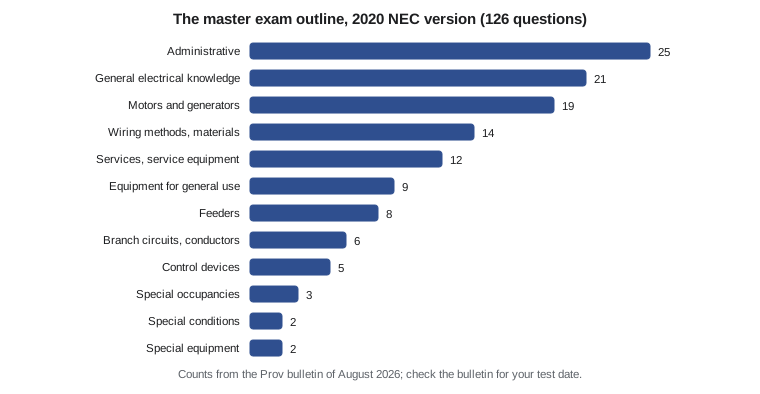
The bulletin lists the number of questions in each content area. For the 2020 version the counts are: general electrical knowledge, 21; equipment for general use, 9; motors and generators, 19; control devices, 5; special conditions, 2; special equipment, 2; special occupancies, 3; services and service equipment, 12; branch circuits and conductors, 6; feeders, 8; wiring methods and materials, 14; and administrative, 25. The 2017 version differs by a question here and there: general electrical knowledge has 22, control devices 4 and special occupancies 2, for a total of 125.
Two numbers stand out. Administrative questions are the largest single area, about one question in five, and they draw on RSA 319-C and the Board's rules as well as the administrative parts of the code. Motors and generators, with 19 questions, is the third-largest area, larger than services or feeders. A candidate who studies only calculations and wiring methods will leave a large share of the points on the table. Kayla's plan gives about a fifth of her study hours to law and rules and a sixth to motors, matching the outline.
| Exam | Version | Questions | Time | Pass |
|---|---|---|---|---|
| Master | 2017 NEC | 125 | 5 hours | 70 |
| Master | 2020 NEC | 126 | 5 hours | 70 |
| Journeyman | 2017 or 2020 NEC | 110 | 4.5 hours | 70 |
The journeyman exam, which Kayla passed in 2022, has 110 questions in four and a half hours with the same content areas. The difference is almost entirely in the administrative area, which has 10 questions on the journeyman exam and 25 on the master. That tells a candidate what the Board expects a master to know that a journeyman does not: the statute, the rules, firm licensing, supervision, permits and the business side of the trade.
The reference list
The bulletin lists the references allowed for each version. For the 2020 version they are the 2020 edition of NFPA 70, the National Electrical Code; the New Hampshire laws and rules, which the bulletin lists as RSA 319-C and Elec 100 through 400; the American Electrician's Handbook, 17th edition; Ugly's Electrical References, 2020; a 2017 legislative chapter, HB 85, chapter 157, which concerned the New Hampshire adoption of the code; and a state amendment concerning section 210.12. For the 2017 version the list adds the 2017 National Electrical Code Handbook and two numbered state amendments to the 2017 code, one of them concerning section 210.5. The journeyman list names the Elec 300 and 400 rules rather than Elec 100 through 400.
The state-published items, such as the statute, the rules and the amendments, are available from the OPLC website, and the bulletin allows candidates to bring printed versions to the site. That is a real advantage. A candidate who prints the current RSA 319-C, the Elec rules and the amendment documents, tabs them and knows where each rule sits will answer administrative questions in a minute each. A candidate who tries to remember them will not.
Note what the list does not include. Study guides, practice exams, photocopied books or pages, and formula sheets are not allowed. The code handbook is on the 2017 list but not the 2020 list in the August 2026 bulletin, so a candidate on the 2020 version should not plan to rely on it.
Marking and tabbing rules
The bulletin is specific about what may be in the books. Highlighting is allowed. Underlining is allowed in pen only. Permanent tabs are allowed. Handwritten notes are not allowed and must be erased before use, which in practice means a candidate should never write in the margins. Removable tabs, sticky notes, photocopied pages, added formula sheets and stickers are not allowed. Candidates may not mark their books during the test. Proctors check books, and a candidate whose books do not comply may have them taken away or be turned away.
Kayla bought a new copy of the 2020 code rather than use the one she had written in as an apprentice. She used permanent printed tabs for each chapter and the articles she uses most: 90, 100, 110, 210, 215, 220, 225, 230, 240, 250, 300, 310, 314, 320 through 358, 400, 404, 408, 422, 430, 440, 445, 450, 500, 517, 680, 690, 700 and 750. She tabbed the printed statute at 319-C:2, 319-C:2-a, 319-C:3, 319-C:7, 319-C:8, 319-C:10 and 319-C:15, and the rules at Elec 304, 305, 401, 403, 404 and 405. She highlighted the first sentence of each section she expects to look up, so her eye lands on it.
How long each question can take
Five hours for 126 questions is 300 minutes, or about 2.4 minutes a question on average. That sounds generous until a candidate meets a motor feeder calculation that takes six minutes. The averages only work if the quick questions are quick. Definition questions, rules questions and many administrative questions should take a minute or less with good tabs; that leaves time for the calculation and lookup questions that need four or five.
# Time budget for the 2020 version of the master exam
questions = 126
minutes = 5 * 60
print(f"Average: {minutes / questions:.2f} minutes per question")
quick = 70      # illustrative: answered in about 1 minute each
long_q = questions - quick
left = minutes - quick * 1
print(f"Time left for {long_q} longer questions: {left} minutes")
print(f"That is {left / long_q:.2f} minutes each")Average: 2.38 minutes per question Time left for 56 longer questions: 230 minutes That is 4.11 minutes each
The calculation shows why tabs matter. If seventy questions take a minute each, the remaining fifty-six questions have more than four minutes each, enough for real calculations and a final check. If the quick questions take two minutes each because the candidate is hunting for rules, the long questions get barely a minute and a half. Lesson 12 turns this into a three-pass plan.
What the questions look like
The bulletin does not publish sample questions, and this course does not reproduce exam items. From the content outline and the references, though, the kinds of questions are predictable. General electrical knowledge questions use Ohm's law, power, voltage drop and the basics of single-phase and three-phase systems. Motors and generators questions use the motor articles of the code to size conductors, overcurrent protection and overload protection, and the handbook for motor theory. Services, feeders and branch circuits questions combine load calculations with conductor sizing. Wiring methods questions ask about specific raceway and cable articles. Administrative questions draw on the statute, the rules and the administrative parts of the code: definitions, scope, approval of equipment and the general requirements of Chapter 1.
Worked problem
A rules question, answered from the book
A question asks how many apprentices a journeyman in the first year after initial licensure may directly supervise. How should Kayla answer it?
Show solution
- Recognize it as an administrative question about supervision.
- Go to the printed rules, tab Elec 404, and find the supervision section, Elec 404.05.
- Read the ratio for a journeyman in the first year after initial licensure.
- Confirm it against RSA 319-C:2-a, which states the same ratios in the statute.
Answer: One apprentice; from the first anniversary of licensure, up to two.
Remote testing and the books
A candidate who tests remotely must still follow the reference rules, and must be able to show the proctor the books and the desk on camera. The bulletin's remote rules require a clear desk, which conflicts in practice with a stack of tabbed references; candidates who choose remote testing should read the remote section carefully, ask the testing company how references are inspected, and test their camera angle before the day. The bulletin also lists calculators among the electronics to remove from a remote testing room, so a remote candidate who needs a calculator should confirm the rule before booking. Kayla chose the Concord site for these reasons.
Whatever the setting, the candidate is responsible for bringing the right edition. A candidate scheduled for the 2020 version who brings only a 2023 code book will find section numbers that do not match and rules that have changed. If you are unsure which version you are scheduled for, ask before test day, not at the door.
Building a reference kit
A reference kit is more than a stack of books. Kayla's kit has five parts. The first is the code book for her exam version, new and clean, with permanent tabs. The second is a printed, bound copy of RSA 319-C and the Elec rules, printed from the official sites in the month before the exam so that it is current, with permanent tabs at the sections she uses most. The third is the state amendment documents the bulletin lists, printed and tabbed the same way. The fourth is the American Electrician's Handbook and the reference book on the list, each with a few tabs at the motor, transformer and conductor tables she uses for theory questions. The fifth is a four-function calculator she has used for every practice test, so her fingers know where the keys are.
She practiced with the kit exactly as she will use it. Her practice tests were taken with the same books on the same side of the desk, and she learned to keep the code open on her right and the printed rules on her left. That sounds trivial, but on a five-hour exam the seconds saved on every lookup add up to many minutes. She also wrote nothing in the books, ever, so there would be nothing to erase at the site.
Finally, she checked the kit against the bulletin one week before the exam. She removed two sticky notes she had forgotten in the handbook, replaced a torn tab, confirmed that her printed rules carried no handwritten notes, and put the calculator in the bag with a new battery. A candidate whose books are rejected at the door loses the advantage of an open book exam before it begins.
Common mistakes
MistakeAnswering from the 2023 code because it is the adopted code.
InsteadAnswer from the edition your exam version names; the August 2026 bulletin lists 2017 and 2020 versions.
MistakeWriting notes in the code margins.
InsteadHandwritten notes are not allowed and must be erased before use.
MistakeUsing removable tabs or sticky notes.
InsteadOnly permanent tabs are allowed.
MistakeSpending equal time on every question.
InsteadAnswer quick questions quickly to leave four or more minutes for calculations.
MistakeSkipping law and rules study.
InsteadAdministrative questions are the largest area on the master exam.
Summary and key terms
- The master exam is open book and computer-based, 125 or 126 questions in five hours, passing at 70.
- The August 2026 bulletin lists 2017 and 2020 NEC versions; answer from your version's edition.
- Administrative questions, 25 of them, are the largest area; motors and generators has 19.
- References include the NEC, RSA 319-C and the Elec rules, the American Electrician's Handbook, Ugly's and state amendments.
- Highlighting, pen underlining and permanent tabs are allowed; notes, removable tabs and photocopies are not.
- Average time is about 2.4 minutes per question; quick questions must be quick.
- Open book
- An exam that allows the listed references in the room.
- Content outline
- The bulletin's list of questions per content area.
- Permanent tab
- A tab fixed to the page that cannot be moved, allowed under the bulletin.
- Version
- The edition of the code an exam is built on, such as the 2020 NEC version.
- Administrative questions
- Questions on the statute, rules and administrative parts of the code.
Practice problems
Work each problem on paper first, then reveal the answer to check.
How many administrative questions are on the 2020 version of the master exam?
Show answer
25.
May Kayla bring a photocopy of the motor tables from her old code book?
Show answer
No; photocopied pages are not allowed.
She underlined in pencil. Is that a problem?
Show answer
The bulletin allows underlining in pen only; pencil marks should be erased.
What is the average time per question on the 2020 version?
Show answer
About 2.4 minutes.
Which edition should she answer from if scheduled for the 2020 version?
Show answer
The 2020 NEC.
Lesson quiz · 5 questions
Score 60% or more to complete this lesson.
Create a free account to save your progress, take quizzes and earn a certificate.