
MELU-304 · Lesson 1 of 12 · 21 min
How electrical licensing works in New Hampshire
▶ Video coming soon A video version of this lesson is on the way.
Kayla Thibodeau has been in the electrical trade in central New Hampshire for nine years. She registered as an apprentice in 2017, worked her 8,000 hours under licensed electricians while she took evening classes at a community college, and passed the journeyman exam in March 2022. Since April 2022 she has held a New Hampshire journeyman license and has run service and commercial crews for Merrimack Bend Electric, LLC, a seventeen-person contractor based in the Penacook part of Concord. The company is invented for this course, but the questions it faces are real. Its owner, Arthur Gagnon, known to everyone as Art, has held a New Hampshire master license since 1991 and is the master in charge of the company's corporate electrical license. Art is sixty-six and wants to retire within two years. He has asked Kayla to earn her master license so the company can keep its license and its customers, and this course follows her from her first question to exam day.
This is the New Hampshire course in the HSM University master electrician exam prep series. The core courses, MELU-101 through MELU-107, teach the National Electrical Code skills that every master-level exam tests: navigating the code, load calculations, conductors and overcurrent protection, grounding and bonding, motors and transformers, special occupancies, and business and law. This course adds what is specific to New Hampshire: the Electricians' Board and the Office of Professional Licensure and Certification, the statute and rules that govern the trade, the state building code and the edition of the code it adopts, permits and inspections, the master's duties, firm licensing, liens, safety law and renewal.
Two cautions apply to every lesson. First, licensing rules change. The facts in this course were checked in November 2026 against RSA 319-C, the Electricians' Board rules in Elec 300 and Elec 400, the Office of Professional Licensure and Certification pages, the candidate information bulletin of the testing company, RSA 155-A, RSA 447 and RSA 281-A. The lessons say so when a fact comes from a secondary source or could not be confirmed. Before you apply, pay a fee or book an exam, check the current pages yourself. Second, electrical codes are copyrighted. This course cites code articles and sections by number and explains them in plain words, but it never reproduces their text, tables or figures. Keep your own copy of the code your exam uses open beside you.
One state license
New Hampshire is a state-license state. A single board, the Electricians' Board, examines and licenses electricians for the whole state, and a master or journeyman license issued in Concord is good in every city and town from Nashua to Pittsburg. That is different from states where each city decides whether to license, and it shapes everything in this course. Kayla will take one exam, receive one license and renew it with one agency. The towns where Merrimack Bend works do not issue their own electrician licenses; instead they check the state license when they issue a permit.
The governing statute is RSA 319-C. Its first section says, in substance, that electrical installations made for compensation must be made by a licensed electrician or another person licensed by the Office of Professional Licensure and Certification, unless the chapter itself provides otherwise. The chapter defines an electrical installation broadly: installing, repairing, altering or maintaining conductors, fittings, devices and fixtures for heating, lighting or power, at any voltage. Plugging a portable appliance into a receptacle is not an installation. The breadth matters on the exam. A question that asks whether repairing an existing circuit needs a license should be answered from the definition, not from a feeling that small jobs are exempt.
Licensing currently covers installations for heat, light and power. The Board's own page says that signaling circuits, such as fire alarm installations, do not currently require an electrician's license, although other rules, such as the fire code and local permits, may still apply. Low-voltage and signaling questions are therefore a place where an exam can test whether you know the scope of the license rather than the code.
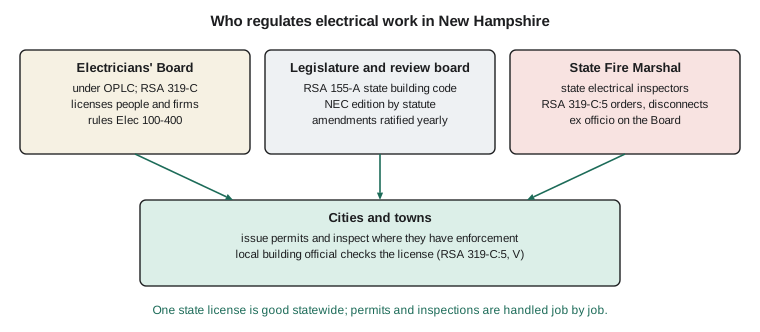
The Electricians' Board and OPLC
The Electricians' Board is a five-member board appointed by the governor with the approval of the Executive Council. RSA 319-C:4 sets its make-up: two master electricians, one journeyman electrician and two public members who have no ties to the trade. The State Fire Marshal sits on the Board as a nonvoting member. Members serve five-year terms, no more than two terms, and the Board must meet at least four times a year. A quorum is a majority of the appointed members and must include a public member.
Since the state consolidated its licensing boards, the Office of Professional Licensure and Certification, known as OPLC, provides the staff, the online licensing system, the fee collection and the records for the Board. In practice that means Kayla files her application with OPLC through its online system, OPLC processes it, the Board decides eligibility and discipline, and OPLC issues the license and identification card. Fee amounts are set in the OPLC rules in Plc 1002, and some procedures, such as audits of continuing education, are in other Plc rules. On the exam, the safe answer to who licenses electricians in New Hampshire is the Electricians' Board, acting through OPLC.
The Board's powers come from RSA 319-C:6-a. It adopts rules, by a vote of at least three of its five members, on the qualifications of applicants, the conduct of examinations, renewal and continuing education, ethics and discipline, and the version of the National Electrical Code and any changes to it, which must be at least as strict as the state building code. Its rules are published as Elec 100 through Elec 400, and the master exam lists those rules and RSA 319-C among its references. Lesson 4 explains how to tab them.
| Body | Main role | Where it comes from |
|---|---|---|
| Electricians' Board | Examines, licenses and disciplines electricians and firms | RSA 319-C:4, 319-C:6-a |
| OPLC | Staff, online applications, fees, records and audits | RSA 310 and Plc rules |
| State building code review board and Legislature | Review and ratify the code edition and amendments | RSA 155-A:1, IV and 155-A:10 |
| State Fire Marshal | Appoints state electrical inspectors; nonvoting Board member | RSA 319-C:4, 319-C:5 |
| City or town | Issues permits and inspects where it has enforcement | RSA 155-A and local ordinance |
The license types
RSA 319-C:2 and 319-C:7 create a short list of credentials. An apprentice electrician learns and assists with installations under the direct supervision of a master or journeyman and must register with OPLC and carry an identification card. A journeyman electrician installs wiring, conduit and equipment and must be employed by a licensed master or by a firm licensed under RSA 319-C:10. A master electrician employs others to make installations or makes them for his or her own account. In other words, the master license is the license to run an electrical business. A high or medium voltage electrician works on systems over 600 volts from the supply source to the first disconnecting means of a building, including metering, controls and certain pole and pad-mount transformer connections, and high or medium voltage trainees register as apprentices do.
The exam tests these definitions closely. A common trap describes a journeyman who wants to take side jobs on weekends for his own customers. The definition answers it: performing installations for one's own account is what a master does, so a journeyman may not contract for work in his own name. Another trap describes a master who wants to hire a helper who is not registered. RSA 319-C:15 makes employing an unlicensed person who is not a registered apprentice a violation.
Firms and the master in charge
New Hampshire licenses electrical firms as well as people. Under RSA 319-C:10 and Elec 303.01, a corporation or partnership that makes electrical installations must hold its own license from OPLC, must be registered with the Secretary of State, and must have a currently licensed New Hampshire master directly in charge of all aspects of its electrical installations. For high or medium voltage work, a licensed master or high or medium voltage electrician must be in charge of that work. RSA 319-C:7 adds a sharp rule: a firm's license becomes void if the named licensee dies or leaves the company, and Elec 404.02 requires the firm to tell the Board within 30 days when its master changes.
That is the problem Art has asked Kayla to solve. Merrimack Bend is a limited liability company, registered with the Secretary of State, and its OPLC license names Art as the master in charge. If Art retired tomorrow without a successor, the company's license would be void, and its journeymen could no longer work under it. Kayla's master license, earned before Art leaves, lets the company file the change and keep working. Lessons 7 and 8 return to these rules.
What stays with each job
A state license does not make every job the same. The city or town where the work sits decides who issues the permit, who inspects and what paperwork it wants, within the limits of state law. The edition of the National Electrical Code is set statewide by the state building code in RSA 155-A, and since July 1, 2025 that code has named the 2023 edition, with amendments the Legislature has ratified. Towns that enforce the code issue permits and inspect; in places without local enforcement, state law gives the State Fire Marshal a role. Lessons 5 and 6 work through code adoption, permits and inspections.
Denise Royer, Merrimack Bend's office manager, keeps a binder with a tab for every town the company works in. Each tab lists the permit portal or form, the inspection request line, the inspector's name, the fee schedule and any local quirks, such as a town that wants a copy of the master's license with every permit. When Kayla becomes the master in charge, the binder becomes her responsibility.
Who is exempt
RSA 319-C:3 lists work the chapter does not cover, and RSA 319-C:15 adds one more. The main exemptions are employees of regulated utilities doing utility work; plant employees doing work at industrial, manufacturing or generating facilities; work on property owned by an operator under the supervision of an electrical engineer the operator employs; mines, pipelines, ships, rail stock and automotive equipment; manufacturers working on equipment they make or repair; exposed experimental wiring in laboratories; regular property employees doing incidental work that needs no calculations; gas, propane and oil burner equipment and controls; supervised vocational students; highway employees working on traffic devices; irrigation systems at 30 volts or less; licensed elevator mechanics for their equipment; and persons licensed under RSA 153 for the work their license covers. RSA 319-C:15, II lets a homeowner make installations in a single-family residence he or she owns and occupies or will occupy as a personal home.
Exemptions are narrow. The homeowner exception covers a single-family home the owner lives in, not a rental duplex, and it does not let the homeowner hire an unlicensed friend. A maintenance worker's exemption covers incidental work that arises by chance and needs no calculations, not a new panel. On the exam, read the facts closely and ask whether every condition of the exemption is met.
Enforcement
RSA 319-C:15 lists the core violations: making installations without a license, employing an unlicensed person who is not a registered apprentice, obtaining a license wrongfully or by fraud, violating the chapter or the Board's rules, and falsely claiming to be licensed. A violation is a misdemeanor for a natural person and a felony for any other person, such as a corporation. The Board can also discipline a licensee under its rules in Elec 405, and RSA 319-C:14-a lets the Board investigate when the State Fire Marshal finds that faulty wiring was a principal cause of a fire. Fine amounts and discipline ranges change, so this course does not give numbers for them; check the current statute and rules.
For a master, enforcement is personal. Art has told Kayla that the best protection is dull paperwork: a current license and identification card carried on every job, a current firm license, apprentices registered and supervised within the ratios, permits pulled before work starts, inspections called on time, a final check of every journeyman's work, and a file for every job. Lesson 7 returns to these habits.
How this course is organized
The lessons follow Kayla's path. Lesson 2 covers eligibility for the master license, Lesson 3 the application and booking process, and Lesson 4 the exam format and references. Lesson 5 explains the code as adopted in New Hampshire and Lesson 6 permits and inspections. Lesson 7 covers the duties of the master, Lesson 8 firm licensing, insurance and bonding, and Lesson 9 contracts and mechanic's liens. Lesson 10 covers safety law, OSHA and workers' compensation, Lesson 11 renewal and continuing education, and Lesson 12 a practice review and test-day strategy. Every lesson ends with a quiz that mixes multiple choice, true or false, number, ordering and matching questions, and the course ends with a final exam.
The calculator below shows the first planning Kayla did. Art wants to retire in about twenty months. Kayla needs time to document her journeyman hours, apply to the Board, wait for approval, study, sit the exam, possibly retake it, receive the license and let the company file the change of master. Change the numbers to fit your own plan.
# Kayla's planning check (illustrative months)
months_until_art_retires = 20
steps = {
    "document journeyman hours and apply": 1,
    "Board review and approval to test": 2,
    "study for the master exam": 4,
    "sit the exam": 1,
    "retake allowance, if needed": 2,
    "license issued; firm files change of master": 1,
}
needed = sum(steps.values())
for step, months in steps.items():
    print(f"{step}: {months} months")
print(f"Total: {needed} months; margin: {months_until_art_retires - needed} months")document journeyman hours and apply: 1 months Board review and approval to test: 2 months study for the master exam: 4 months sit the exam: 1 months retake allowance, if needed: 2 months license issued; firm files change of master: 1 months Total: 11 months; margin: 9 months
Common mistakes
MistakeAssuming each town issues its own electrician license.
InsteadNew Hampshire licenses electricians statewide through the Electricians' Board and OPLC; towns issue permits and check the license.
MistakeThinking a journeyman may contract small jobs in his own name.
InsteadWorking for one's own account is what a master does; a journeyman must be employed by a master or a licensed firm.
MistakeTreating the master's license as the firm's license.
InsteadA corporation or partnership needs its own license and a master directly in charge.
MistakeBelieving the homeowner exception covers any home the owner owns.
InsteadIt covers a single-family residence the owner occupies or will occupy as a personal home.
MistakeAssuming fire alarm wiring always needs an electrician's license.
InsteadThe Board says signaling circuits such as fire alarm currently do not; other rules may still apply.
Summary and key terms
- New Hampshire licenses electricians statewide under RSA 319-C through the Electricians' Board and OPLC.
- The credentials are apprentice registration, journeyman, master and high or medium voltage electrician.
- A master may employ others or work for his or her own account; a journeyman must be employed by a master or licensed firm.
- Corporations and partnerships need their own license and a master directly in charge; the license is void if that person leaves.
- The code edition is set statewide in RSA 155-A; towns issue permits and inspect.
- Violations are misdemeanors for people and felonies for companies; check current rules before relying on a detail.
- OPLC
- The Office of Professional Licensure and Certification, which staffs the Electricians' Board.
- RSA 319-C
- The New Hampshire statute that governs electricians.
- Master in charge
- The licensed master directly in charge of a firm's electrical installations.
- Electrical installation
- Installing, repairing, altering or maintaining conductors and equipment for heat, light or power, at any voltage.
- Elec rules
- The Electricians' Board administrative rules, Elec 100 through Elec 400.
Practice problems
Work each problem on paper first, then reveal the answer to check.
Does Kayla need a separate license to work in Nashua after she becomes a master?
Show answer
No; the state license is good statewide, though Nashua issues its own permits.
Who issues Kayla's master license?
Show answer
OPLC, on the Electricians' Board's approval.
A journeyman wants to wire a garage for his neighbor for cash. Is that allowed?
Show answer
No; contracting work for his own account is what a master does.
What happens to Merrimack Bend's license if Art leaves without a successor?
Show answer
It becomes void; the firm must have a master in charge and notify the Board within 30 days of a change.
Is a property maintenance worker who installs a new subpanel exempt?
Show answer
No; the exemption covers incidental work that needs no calculations.
Lesson quiz · 5 questions
Score 60% or more to complete this lesson.
Create a free account to save your progress, take quizzes and earn a certificate.