
MELU-304 · Lesson 12 of 12 · 20 min
Practice exam review and test-day strategy
▶ Video coming soon A video version of this lesson is on the way.
Kayla has eight weeks left before January 12, 2027. She knows the code well from nine years of work, she has tabbed her books, and she has read the statute and the rules. What she does not yet have is the habit of answering 126 questions in five hours with an open book and a four-function calculator. This last lesson covers that habit: how to use timed practice tests, how to review them so the next one improves, how to divide the five hours on the day, and how to handle the questions that seem impossible. It ends with a checklist for the night before and the morning of the exam.
Nothing here is specific to a single question bank. The testing company sells practice exams, and other publishers sell New Hampshire practice books and online tests; this course does not endorse any of them, and it does not reproduce exam questions. Whatever materials you use, check that they are built on the same edition as your exam version, as Lesson 4 explained.
Why timed practice matters
Most candidates who fail an open book exam do not fail for lack of knowledge. They fail because they run out of time, usually after spending eight or ten minutes hunting for a rule or redoing a calculation. Five hours for 126 questions sounds generous; it is about 2.4 minutes a question. The only way to know whether you can keep that pace is to practice at it, with the same books, the same calculator and the same clock.
Kayla's plan has three full-length timed practice tests, one every two weeks, with shorter timed sets in between. For each full test she sits at her kitchen table with the books, the calculator and a timer, no phone, for the full five hours. She does not look anything up online, she does not pause for coffee, and she marks the questions she guessed on, even if she guessed right.
Reviewing a practice test
The review is where the improvement comes from. After each practice test, Kayla goes through every question she missed or guessed on and classifies the cause. Did she not know where to look? Did she find the wrong section? Did she misread the question, for example missing the word not or confusing a feeder with a branch circuit? Did she make a calculation error? Did she run out of time? Each cause has a different fix. A lookup problem calls for better tabs or practice drills. A misreading problem calls for slowing down on the question stem. A calculation problem calls for written steps and a check. A time problem calls for the three-pass plan below.
She also tracks her scores by content area, using the bulletin's outline from Lesson 4. After her first full practice test she scored well on services, feeders and wiring methods, but poorly on motors and on administrative questions. The fix was clear: three evenings on the motor articles, working every motor sizing example in the handbook, and two evenings on the statute and the rules with her printed and tabbed copies. On the second practice test her motors score rose sharply and her administrative score rose more.
Worked problem
Turning a review into a plan
On her first full practice test Kayla missed 31 questions. Her review showed 11 lookup problems, 7 misreadings, 6 calculation errors, 4 guesses on administrative rules and 3 unanswered at the end. What should she work on first?
Show solution
- Total misses: 11 plus 7 plus 6 plus 4 plus 3 is 31.
- Lookup problems are the largest group at 11, so better tabs and index drills come first.
- Misreadings are next at 7: read the last sentence of each question first and underline key words on the scratch paper.
- Calculations: write each step and check units.
- The 3 unanswered questions and the 4 administrative guesses point to time management and rules study.
Answer: Start with tabbing and index drills, then reading discipline, then written calculation steps and rules review.
Lookup drills
Speed in an open book exam comes from knowing where things are. A good drill is to pick ten topics at random, such as the minimum size of a grounding electrode conductor, the receptacle requirements for a bathroom, the overload protection for a motor, the cover requirements for a direct-buried cable, the working space in front of a panel, the rule on the master's final inspection, the apprentice ratio for a first-year journeyman, the one-year eligibility rule, the code in effect at permit application and the arc-fault limit, and find each in under a minute. Kayla does this drill every evening for ten minutes. In her first week she averaged about two minutes a lookup. By her fourth week she was under forty seconds.
The index of the code is the most underused tool in the room. Many candidates flip through articles looking for a rule when the index would take them to the section in seconds. Before the exam, practice using the index for every lookup until it is a reflex. For the statute and rules, use the tabbed printed copies; Lesson 4 listed the sections Kayla tabbed.
The three-pass plan
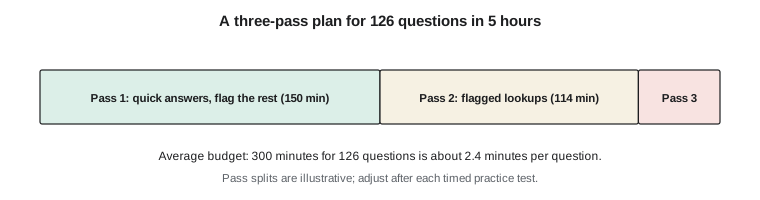
On the day, Kayla will work in three passes. In the first pass she will read every question in order. If she knows the answer or can find it in about a minute, she answers it. If not, she flags it and moves on. The goal of the first pass is to bank every quick point in about half of the time. In the second pass she will return to the flagged questions, starting with those she thinks she can solve, and work them properly: the lookups that need several sections, the calculations, the motor questions. In the third pass, with whatever time remains, she will review flagged answers, check calculations and make sure every question has an answer, because an unanswered question is always wrong.
# Checkpoints for a 300-minute, 126-question exam (illustrative)
total_min = 300
questions = 126
pass1 = 0.50 * total_min
print(f"Pass 1 budget: {pass1:.0f} minutes for {questions} questions")
for frac in (0.25, 0.5, 0.75, 1.0):
    q = round(questions * frac)
    t = pass1 * frac
print(f"By question {q}: about {t:.0f} minutes elapsed")Pass 1 budget: 150 minutes for 126 questions By question 32: about 38 minutes elapsed By question 63: about 75 minutes elapsed By question 94: about 112 minutes elapsed By question 126: about 150 minutes elapsed
The checkpoints tell her whether she is on pace. If she reaches question 63 after about 75 minutes, she is on pace for the first pass. If she is far behind, she is spending too long on questions she should be flagging. The proportions are examples; Kayla will adjust them after each practice test, and the computer interface will show her the time remaining.
Hard questions
Every candidate meets questions that seem impossible. Some are poorly worded, some test obscure rules, and some are simply hard. A few habits help. Read the last sentence of the question first, so you know what is being asked. Identify the subject, then the article or rule. Eliminate answers that are clearly wrong. If two answers remain, look for the word that separates them, such as minimum or maximum, feeder or branch circuit, master or journeyman. If you still cannot decide, choose the better answer, flag it and move on; you can come back in the third pass.
Calculation questions deserve special care. Write the formula, the values and the units on the scratch paper before touching the calculator. Check whether the question wants the answer rounded up to the next standard size or the exact value. For motor questions, decide early whether the question is about conductors, short-circuit and ground-fault protection, or overload protection, because each uses a different rule. A calculation that is set up correctly is rarely wrong; most calculation errors are setup errors.
The day before and the morning of the exam
Kayla's checklist for the day before: confirm the appointment time and the Concord site address; check that her identification is current and has a signature; pack the tabbed 2020 code, the printed statute and rules, the handbook, the reference book and the state amendments; pack a four-function calculator with a fresh battery and a spare; check that nothing in the books violates the bulletin's rules, with no notes, no sticky notes and no loose pages; and go to bed at a normal hour. She will not study new material the night before.
On the morning of the exam she will eat breakfast, leave early enough to arrive thirty minutes ahead, and expect to sign the log and be photographed. She will use the restroom before the exam starts. In the room she will spend a minute arranging the books so the code is at her right hand and the rules at her left, write the checkpoint times on the scratch paper and begin.
| When | Task |
|---|---|
| Eight weeks out | Full timed practice test; review and classify misses |
| Each evening | Ten-minute lookup drill; one weak area |
| Six weeks and four weeks out | Second and third full timed tests |
| Early December | Complete the 15-hour CE update for the 2026 code |
| One week out | Check books against the bulletin rules; confirm appointment |
| Day before | Pack books, ID, calculator; rest |
| Exam morning | Arrive 30 minutes early; three-pass plan |
After the exam
The score report will arrive after the exam. If Kayla passes, the score goes to the Board, OPLC issues the master license once the file is complete, and Merrimack Bend starts the change-of-master process from Lesson 8. If she fails, the score report shows her results by content area. She can retake the exam at her own expense after waiting at least two days, within the one-year eligibility from her September 2026 application, and if she fails twice within ten points of passing she can request an exam review. Either way, she will spend the first week after the exam reviewing her weakest areas, because the master license is the beginning of her responsibility for the company's work, not the end of her learning.
Managing nerves and energy
Five hours is a long time to concentrate, and many candidates lose focus in the fourth hour. Kayla practiced for that as well. During her full-length practice tests she noticed that her accuracy dropped after about three and a half hours, so she built a short reset into her plan: at the end of the first pass, she will close her eyes for thirty seconds, roll her shoulders, drink some water if the site allows it, and look at the checkpoint times before starting the second pass. It is a small routine, but it marks the change from quick answers to careful work.
She also decided how to handle a bad stretch. If she meets three hard questions in a row, she will flag them all and move on rather than let them shake her confidence; the next question is usually easier. If she finds a question she is certain is wrong, with no answer that fits, she will choose the closest answer, flag it and move on. The score depends on the total, and no single question is worth ten minutes of worry.
One more habit helps on the day: trust the first careful answer. Candidates often change correct answers in the third pass because a second reading raises doubt. Kayla's rule is to change an answer only when she finds a specific reason in the book, such as a section she misread or a calculation step she skipped. A vague feeling that another answer looks better is not a reason. Her practice tests showed that her changed answers were wrong more often than right when she had no specific reason, and that pattern is common.
Common mistakes
MistakePracticing without a clock.
InsteadTake full five-hour timed practice tests with your real books and calculator.
MistakeReviewing only wrong answers.
InsteadReview guesses too, and classify each miss by cause.
MistakeFlipping through articles instead of using the index.
InsteadPractice index lookups until they are fast.
MistakeLeaving questions blank.
InsteadAn unanswered question is always wrong; answer every question in the third pass.
MistakeStudying new material the night before.
InsteadRest, check your books and arrive early.
Summary and key terms
- Most open book failures are timing failures; practice at full length with a clock.
- Classify every miss and guess by cause, and fix the largest cause first.
- Track scores by the bulletin's content areas and study the weakest.
- Drill lookups daily and use the code index.
- Use a three-pass plan with checkpoints; answer every question.
- Prepare books, identification and calculator the day before, and arrive early.
- Timed practice test
- A full-length practice exam under real time and reference conditions.
- Error log
- A record of practice misses classified by cause.
- Three-pass plan
- Answer quick questions, then flagged ones, then check.
- Checkpoint
- A planned elapsed time at a given question number.
- Flag
- A mark on a question to return to it later.
Practice problems
Work each problem on paper first, then reveal the answer to check.
How many minutes per question, on average, does the 2020 master exam allow?
Show answer
About 2.4.
Kayla is at question 40 after 90 minutes. Is she on pace for a 150-minute first pass?
Show answer
No; at that rate she would need about 280 minutes, so she should flag more and move faster.
Her review shows most misses are lookup problems. What is the fix?
Show answer
Better tabs and daily index drills.
May she bring a spare four-function calculator?
Show answer
A simple four-function calculator is allowed; confirm any spare with the site.
She failed by four points. When can she retake?
Show answer
After at least two days, at her own expense, within her one-year eligibility.
Lesson quiz · 5 questions
Score 60% or more to complete this lesson.
Create a free account to save your progress, take quizzes and earn a certificate.