
MELU-304 · Lesson 5 of 12 · 19 min
The NEC as adopted in New Hampshire and state amendments
▶ Video coming soon A video version of this lesson is on the way.
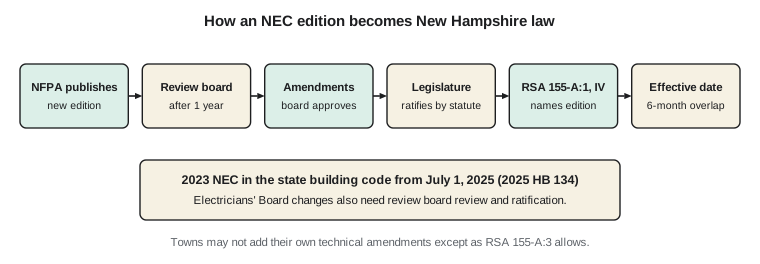
In some states each city picks its own edition of the National Electrical Code. In New Hampshire the edition is set by state statute. RSA 155-A:1, IV defines the state building code as the adoption by reference of a list of model codes, including the National Electrical Code published by the National Fire Protection Association, together with the amendments the state building code review board has approved and the Legislature has ratified. Every city and town in the state is subject to the same code, and since July 1, 2025 the electrical part of it has been the 2023 edition. This lesson explains how an edition becomes law, what the concurrency period means, how state amendments work, why towns cannot add their own, and how the adopted code relates to the edition on the exam.
The facts come from RSA 155-A as in force in November 2026, from the legislative record of the bill that moved the state to the 2023 edition, and from a city's published summary of the amendments in force in July 2024. Specific amendments change from year to year, and this course does not list them section by section. Before relying on any amendment, read the current state building code amendments published by the State Fire Marshal's office and the review board.
How an edition becomes law
The state building code review board, created by RSA 155-A:10, is responsible for keeping the code current. When the National Fire Protection Association publishes a new edition of the National Electrical Code, the board must review it once it has been published for a year, preparing a summary of the changes, estimates of cost and a statement of need. Amendments to the code that apply statewide must be reviewed and approved by the board and then submitted to the Legislature for ratification before they take effect. The edition itself is named in the statute, so moving to a new edition takes a bill.
The move to the 2023 edition followed that path. A 2025 bill, House Bill 134, amended RSA 155-A:1, IV to name the 2023 National Electrical Code and updated the other model codes, with the board-approved amendments current as of April 11, 2025. It was signed in June 2025 as chapter 135 of the laws of that year and took effect July 1, 2025. Before that, the state code named the 2020 edition; a city summary of the code in force on July 1, 2024 lists the 2020 edition of NFPA 70. A further bill in 2026, House Bill 1159, updates the international codes in the state building code to their 2024 editions and keeps the 2023 National Electrical Code; it became law in 2026. If your exam or your job turns on the exact effective date of a provision, read the chaptered law.
The concurrency period
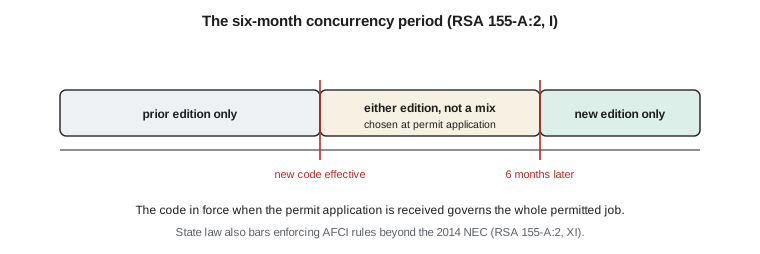
A new edition does not take over overnight. RSA 155-A:2, I provides a six-month concurrency period after a newly adopted code takes effect. During those six months an applicant may show compliance with either the prior code or the new code, but not with a combination of the two. The same paragraph also says that the code in effect when the permit application is received governs the work covered by that permit for the duration of the work. Together these rules let a designer finish a project begun under the old code, and they stop a contractor from picking the easier rule from each edition.
For the 2023 edition, the concurrency period ran from July 1, 2025 to about the end of December 2025. A permit application received in October 2025 could be designed to the 2020 or the 2023 edition, entirely one or the other. A permit application received in February 2026 had to follow the 2023 edition. A permit issued under the 2020 edition in November 2025 for a project that is still under construction in late 2026 is still governed by the 2020 edition, because the code in effect at application governs the whole permitted job.
Worked problem
Which edition governs?
Merrimack Bend applied for a permit for a medical office fit-out in Bow on November 3, 2025 and designed it to the 2020 edition. Work started in January 2026 and the final inspection is scheduled for December 2026. A new inspector says the job must meet the 2023 edition. Who is right?
Show solution
- The 2023 edition took effect July 1, 2025, with a six-month concurrency period running to about the end of December 2025.
- The application was received on November 3, 2025, inside the concurrency period.
- During that period an applicant may use either the prior or the new edition, not a mix.
- The code in effect when the application was received governs the work under that permit for its duration.
Answer: Merrimack Bend is right, provided the design follows the 2020 edition throughout; Kayla should show the inspector the application date and the design basis.
State amendments
The state building code includes the amendments that the review board has approved and the Legislature has ratified. Some of them change the electrical code. The best known is a statutory limit on arc-fault circuit interrupter protection: RSA 155-A:2, XI says that no requirement for arc-fault protection beyond the requirements of the 2014 National Electrical Code may be enforced under the state building code. In practice that means a New Hampshire inspector cannot enforce the expanded arc-fault requirements of later editions of section 210.12. The exam references reflect this history: the bulletin lists a state amendment concerning section 210.12 among the references for both versions.
Other amendments come and go. The 2017 version of the exam lists two numbered state amendments to the 2017 code, one of them concerning section 210.5, and the 2017 legislative chapter that dealt with the adoption of that edition. The amendments to the 2023 edition are published with the state building code amendments; this course does not list them, because they are revised as the board reviews them and the Legislature ratifies them each year. A candidate should read the amendments that go with the exam version, and a master should read the amendments in force for each job.
| Rule | What it does | Source |
|---|---|---|
| Edition by statute | Names the NEC edition in the state building code | RSA 155-A:1, IV |
| Review after one year | Board reviews a new edition once published a year | RSA 155-A:10 |
| Ratification | Statewide amendments need Legislature ratification | RSA 155-A:10 |
| Concurrency | Six months of either edition, not a mix | RSA 155-A:2, I |
| Code at application | Governs the permitted work for its duration | RSA 155-A:2, I |
| Arc-fault limit | No AFCI rule beyond the 2014 NEC enforced | RSA 155-A:2, XI |
| Local amendments | Barred except as the statute permits | RSA 155-A:3 |
Why towns cannot add their own
Older versions of RSA 155-A let towns adopt stricter local requirements, and some did. The version in force from July 1, 2026 sharply limits that. RSA 155-A:3 provides that no local legislative body may enact or enforce an ordinance or adopt or enforce a rule that deviates from the state building code, except as the statute permits; technical amendments are generally barred, with a narrow exception when the state code is more than two editions behind the model codes, and any local ordinance needs the review board's confirmation before it can be enforced. RSA 155-A:2, VIII still preserves local requirements that are not less stringent than the state code where the statute allows them. The practical result for an electrician is a single code across the state, with the same amendments in Concord and Keene.
That single code is one of the strongest reasons New Hampshire's statewide license works. A master licensed in Concord can work in Portsmouth or Lebanon without learning a new edition. What changes from town to town is administration: who issues permits, how inspections are requested, what fees are charged. Lesson 6 covers that side.
The Board and the code
The Electricians' Board also has a role. RSA 319-C:6-a lets the Board adopt rules on the version of the National Electrical Code and any changes to it, which must be at least as strict as the state building code. RSA 155-A:2, X preserves the Board's authority to administer its program but requires any code changes it proposes to be reviewed by the state building code review board and ratified by the Legislature before they can be enforced. On the exam, the answer to who sets the electrical code edition in New Hampshire is the Legislature, through RSA 155-A, on the review board's recommendation; the Board administers licensing and can propose changes.
The adopted code and the exam
Lesson 4 explained that the exam versions in the August 2026 bulletin are built on the 2017 and 2020 editions, while the adopted code is the 2023 edition. Candidates sometimes find this confusing, but the rule is simple. On the exam, answer from the edition your version names, using the references on its list. On the job, follow the edition that governs the permit, which since early 2026 is almost always the 2023 edition with state amendments. Kayla keeps two code books for this reason: a clean, tabbed 2020 edition for the exam and a worn 2023 edition in her truck.
Section numbers and rules move between editions. The ground-fault and arc-fault rules in Article 210, the surge-protection and emergency-disconnect rules for dwelling services in Article 230, the receptacle rules in Article 406 and the requirements for energy storage and solar systems all changed between 2017 and 2023. A candidate who studies from one edition and tests on another will miss questions. Before studying, check which edition the practice materials use.
from datetime import date
effective = date(2025, 7, 1)
concurrency_end = date(2025, 12, 31)   # about six months later
for applied in [date(2025, 6, 15), date(2025, 10, 1), date(2026, 2, 1)]:
    if applied < effective:
        rule = "2020 NEC (prior edition)"
    elif applied <= concurrency_end:
        rule = "either 2020 or 2023, not a mix"
    else:
        rule = "2023 NEC"
print(applied, "->", rule)2025-06-15 -> 2020 NEC (prior edition) 2025-10-01 -> either 2020 or 2023, not a mix 2026-02-01 -> 2023 NEC
Reading an amendment
A state amendment changes a specific section of the model code, and reading it correctly takes care. Each amendment names the section it changes and says whether it deletes the section, replaces it, adds to it or adds a new exception. Kayla reads every amendment beside the section it changes, with both books open, and writes a short summary in her job notes, not in her exam books. On the job, the amended rule is the rule; the unamended section in the code book is not.
When a question on the job turns on an amendment, she checks three things: that the amendment is ratified and in force, that it applies to the edition that governs the permit, and that no later amendment has changed it again. The arc-fault limit in RSA 155-A:2, XI is easy to apply because it is in the statute itself. Other amendments live in the amendment documents published with the state building code, and they change more often. A master who works from last year's amendment list will eventually be wrong.
Common mistakes
MistakeThinking each town picks its own NEC edition.
InsteadRSA 155-A sets one edition statewide; towns may not adopt their own technical amendments except as the statute permits.
MistakeMixing rules from two editions during the concurrency period.
InsteadApplicants may use either edition but not a combination.
MistakeSwitching a permitted job to the new edition midway.
InsteadThe code in effect at application governs the permitted work for its duration.
MistakeEnforcing the expanded arc-fault rules of later editions.
InsteadRSA 155-A:2, XI bars enforcing AFCI requirements beyond the 2014 NEC.
MistakeStudying the 2023 edition for a 2020 version exam.
InsteadAnswer from the edition your exam version names.
Summary and key terms
- RSA 155-A:1, IV names the NEC edition in the state building code; since July 1, 2025 it is the 2023 edition.
- The review board reviews new editions after a year; statewide amendments need legislative ratification.
- A six-month concurrency period allows either edition but not a mix.
- The code in effect at permit application governs that permit's work.
- State law bars enforcing arc-fault requirements beyond the 2014 NEC.
- Towns are barred from most local technical amendments; one code applies statewide.
- State building code
- The codes adopted by reference in RSA 155-A:1, IV, with ratified amendments.
- Review board
- The state building code review board created by RSA 155-A:10.
- Concurrency period
- The six months after a new code takes effect when either edition may be used.
- Ratification
- Legislative approval that makes a board-approved amendment enforceable.
- Arc-fault limit
- The RSA 155-A:2, XI rule that caps enforceable AFCI requirements at the 2014 NEC.
Practice problems
Work each problem on paper first, then reveal the answer to check.
A permit application was received August 1, 2025. Which editions could it use?
Show answer
Either the 2020 or the 2023 edition, not a mix.
A permit application was received March 2, 2026. Which edition applies?
Show answer
The 2023 edition with state amendments.
Can a town require arc-fault protection in every room of a new house?
Show answer
Not under the state building code beyond the 2014 NEC requirements; RSA 155-A:2, XI bars enforcing more.
Who must ratify a statewide amendment before it is enforced?
Show answer
The Legislature.
Can the Electricians' Board change the electrical code on its own?
Show answer
No; its proposed changes need review board review and legislative ratification.
Lesson quiz · 5 questions
Score 60% or more to complete this lesson.
Create a free account to save your progress, take quizzes and earn a certificate.