
MELU-304 · Lesson 8 of 12 · 20 min
Contractor licensing, insurance and bonding
▶ Video coming soon A video version of this lesson is on the way.
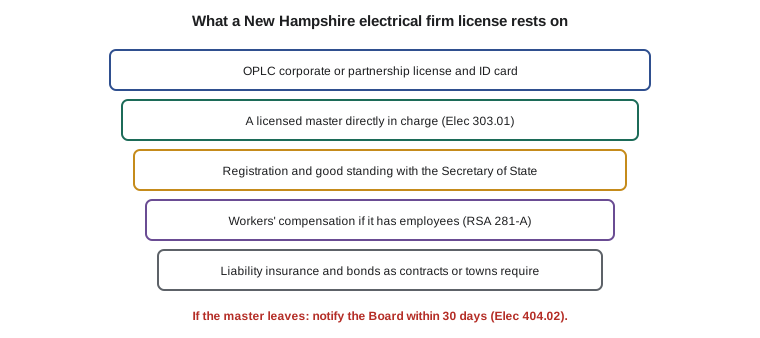
New Hampshire does not have a general contractor license, and it has no separate electrical contractor license of the kind many states issue. What it has instead is a firm license under the electricians' statute. A master electrician may run an electrical business in his or her own name. A corporation or partnership that makes electrical installations must hold its own license from OPLC and must have a licensed master directly in charge of its electrical installations. Around that license sit the ordinary requirements of any New Hampshire business: registration with the Secretary of State, workers' compensation for employees, and the insurance and bonds that customers, towns and public owners require. This lesson explains each layer and follows Merrimack Bend through the change of its master in charge.
The sources are RSA 319-C:7 and 319-C:10, the Board's rules in Elec 303.01 and Elec 404, RSA 281-A on workers' compensation and RSA 447:16 on public works bonds. The state does not publish a liability insurance minimum for electricians, and the amounts in the lesson are labeled as examples. Check the current requirements of each town and each contract.
The sole master
The simplest electrical business is a master working for his or her own account, perhaps with a journeyman or an apprentice. The master's own license covers the work, because a master is defined as a person who makes installations for his or her own account or employs others to make them. A sole master who uses a trade name should register that name with the Secretary of State, as any business must, and must carry workers' compensation for any employees. The master's name and license number go on every permit.
The firm license
A corporation or partnership is different. RSA 319-C:10 requires a corporation or partnership doing electrical installations to have an officer or member in charge of its business affairs who is a licensed master electrician; for high or medium voltage work, a licensed high or medium voltage electrician also qualifies. Elec 303.01 sets out how the firm gets its license. The firm files a completed application with the fee, meets the qualifications in the rules, and provides a certificate of good standing from the Secretary of State. Every corporation and partnership must be registered with the Secretary of State, including foreign entities doing business in New Hampshire. Each firm doing electrical installations must have a currently licensed New Hampshire master directly in charge of all aspects of its electrical installations, and OPLC issues the firm's identification card and license to the master who runs its electrical business.
Limited liability companies are treated in practice like the corporations and partnerships the rule names; OPLC's corporation application is used for business entities. Merrimack Bend, an LLC, holds a firm license that names Art as its master in charge, and it renews that license with OPLC on the same online system as individual licenses.
When the master changes
The firm license depends on a particular person. RSA 319-C:7, III provides that a firm's license becomes void if the named licensee dies or leaves the company. Elec 404.02 requires the firm to act within 30 days after its master, or its high or medium voltage electrician, changes: a president, director or partner must send the Board a letter on the company's stationery explaining the reason for the change and its effective date, together with the firm's identification card and the license OPLC issued. The Board then issues new documents naming the new master.
Art and Kayla have planned the change in four steps. First, Kayla earns her license; the firm does nothing until it is issued. Second, Merrimack Bend's members sign a resolution naming Kayla as the master in charge of its electrical installations, with an effective date. Third, within the 30 days the rule allows, Denise sends the change letter with the old firm card and license. Fourth, Art stays on as a second master until the new documents arrive, so there is never a day without a master in charge. The plan avoids the worst case, in which Art leaves suddenly and the firm's license is void before anyone has filed anything.
Worked problem
Filing a change of master
Kayla's license is issued on February 9, 2027. Merrimack Bend makes her its master in charge effective March 1, 2027, and Art stays on as a master employee until June. What must the firm file, and by when?
Show solution
- The change takes effect March 1, 2027.
- Elec 404.02 requires the filing within 30 days after the change: by about March 31, 2027.
- A member or officer signs a letter on company stationery stating the reason and the effective date.
- The letter goes to the Board with the firm's current identification card and license.
- The firm keeps a copy, and Denise diaries a follow-up if new documents have not arrived in a few weeks.
Answer: A change letter with the firm card and license, filed by about March 31, 2027.
Workers' compensation
New Hampshire requires employers to secure workers' compensation for their employees under RSA 281-A:5. The statute does not exempt small employers by headcount, and in practice an electrical contractor with even one employee should expect to need a policy or an approved self-insurance arrangement. Proof of coverage is often required by towns at the permit counter, by general contractors before a subcontractor starts work and by public owners in the contract. Lesson 10 covers the reporting and safety duties that come with coverage.
Independent contractors are a trap. A master who pays journeymen as independent contractors to avoid payroll costs risks more than tax problems. A journeyman must be employed by a licensed master or firm, so a journeyman working as an independent contractor for his own account is acting as a master without a master license, and the firm that pays him that way may be employing an unlicensed person in the electrical business. Merrimack Bend puts every electrician on the payroll.
Liability insurance
The Electricians' Board does not set a general liability insurance minimum for individual electricians, and New Hampshire has no statewide contractor insurance requirement for electrical firms. That does not mean insurance is optional in practice. Customers, general contractors, property managers and public owners routinely require a certificate of insurance naming them as additional insured, and many town permit offices or building departments ask for one for commercial work. Common contract minimums are one million dollars per occurrence and two million in the aggregate, but these are examples; the real numbers are in each contract.
General liability insurance protects the contractor against claims by third parties for bodily injury and property damage caused by the contractor's operations or completed work. It does not cover the contractor's own employees, who are covered by workers' compensation, and it usually does not cover the cost of redoing defective work. A master should know what the policy covers and what it excludes, and should read the insurance clause of every contract before signing.
Bonds
A bond is a promise by a surety to pay if the contractor does not. New Hampshire does not require electricians to post a license bond, but bonds appear in two other places. First, public owners must require payment security on larger public works under RSA 447:16: on a state contract of 75,000 dollars or more, and on a contract of a town or other political subdivision of 125,000 dollars or more, the contracting officer must obtain security of at least the full contract price, conditioned on payment of subcontractors, labor and materials. Smaller public contracts may require a bond as well. Second, private owners and general contractors may require performance or payment bonds by contract.
The difference between insurance and bonds is a favorite exam question. Insurance protects the contractor against claims by others. A performance bond protects the owner if the contractor fails to finish the work. A payment bond protects subcontractors, workers and suppliers if the contractor fails to pay them. On public work in New Hampshire, the payment bond replaces the mechanic's lien, which cannot attach to a public building; Lesson 9 explains how a subcontractor claims against the bond.
| Instrument | Required by | Protects |
|---|---|---|
| Firm license | RSA 319-C:10; Elec 303.01 | The public, by ensuring a master is in charge |
| Workers' compensation | RSA 281-A | Employees injured at work |
| General liability insurance | Contracts and some towns | The contractor, against third-party claims |
| Payment bond on public work | RSA 447:16 above the thresholds | Subcontractors, labor and suppliers |
| Performance bond | Contracts | The project owner |
Home improvement and consumer rules
New Hampshire does not license home improvement contractors as a class, but consumer protection law still applies to residential work. The state's consumer protection act prohibits unfair and deceptive practices, and contracts with homeowners should be in writing, describe the work and the price, and state how changes and payments will be handled. A master who does residential service work should use a clear written estimate and a change-order form. These are good practice rather than electrical licensing rules, and the exam's administrative questions focus on the electricians' statute and rules.
Renewing the firm
The firm license renews with OPLC on the same cycle as the master's license, using the online system. The firm must keep its registration with the Secretary of State in good standing, file its annual report there, and keep its master in charge licensed and current with continuing education. If the master's license becomes invalid because the continuing education was not completed, as Lesson 11 explains, the firm is effectively without a qualified master until the license is valid again. Denise diaries the master's continuing education deadline on the firm calendar as well as the master's own.
Contracts and the firm
The firm, not the master personally, usually signs the contracts, and the master should make sure the contracts match the firm's license and insurance. A contract that requires a performance bond the firm cannot obtain, insurance limits it does not carry or a warranty it cannot honor is a problem before the job starts. Kayla reads every subcontract over a set dollar amount with Denise before it is signed, checking the scope against the drawings, the insurance clause against the certificate, the bond requirement against the surety's limits and the payment terms against the company's cash flow.
She also checks the name. A contract signed in the name of a trade name or an individual, when the work will be done by the LLC under its firm license, creates confusion about who is responsible and whose insurance applies. Every Merrimack Bend contract is in the company's full legal name, with its firm license number where a form asks for one, and every permit lists the master in charge. When the master changes, Denise updates the contract templates and the permit information on the same day the change letter goes to the Board.
Common mistakes
MistakeAssuming New Hampshire issues an electrical contractor license separate from the master license.
InsteadFirms hold an OPLC corporate or partnership license with a master directly in charge.
MistakeLeaving the change of master for later.
InsteadElec 404.02 requires the filing within 30 days after the change.
MistakePaying journeymen as independent contractors.
InsteadA journeyman must be employed by a master or a licensed firm.
MistakeThinking general liability covers your own injured employees.
InsteadEmployees are covered by workers' compensation.
MistakeExpecting a lien on a public school.
InsteadPublic work is protected by payment bonds under RSA 447:16, not liens on the building.
Summary and key terms
- A master may run a business in his or her own name; corporations and partnerships need a firm license.
- The firm must be registered with the Secretary of State and have a licensed master directly in charge.
- The firm license is void if the named master leaves; the firm must notify the Board within 30 days.
- Employers must carry workers' compensation; all electricians should be employees.
- Liability insurance minimums come from contracts and towns, not the Board.
- Public work above 75,000 dollars for the state or 125,000 for a subdivision needs payment security.
- Firm license
- The OPLC license for a corporation or partnership doing electrical installations.
- Certificate of good standing
- A Secretary of State certificate that a business entity is current.
- Change of master letter
- The filing Elec 404.02 requires within 30 days after a firm's master changes.
- Payment bond
- Surety security that pays subcontractors, labor and suppliers if the contractor does not.
- Certificate of insurance
- A document showing a contractor's insurance, often naming the customer as additional insured.
Practice problems
Work each problem on paper first, then reveal the answer to check.
Does a sole master working alone need a firm license?
Show answer
No; the master's own license covers work for his or her own account.
Merrimack Bend's master changes on March 1. By when must the Board be told?
Show answer
Within 30 days, about March 31.
A town contract for 110,000 dollars: is a payment bond required under RSA 447:16?
Show answer
Not by the statute's mandatory threshold of 125,000 for a subdivision, though the town may require one.
A state contract for 80,000 dollars: is payment security required?
Show answer
Yes; the state threshold is 75,000 dollars.
Who sets the general liability limit Merrimack Bend must carry on a hospital job?
Show answer
The contract, and the town if it requires a certificate.
Lesson quiz · 5 questions
Score 60% or more to complete this lesson.
Create a free account to save your progress, take quizzes and earn a certificate.