
MELU-302 · Lesson 9 of 12 · 21 min
Contracts and construction liens in Nebraska
▶ Video coming soon A video version of this lesson is on the way.
In October, Sam Okafor, Platte Valley's estimator, brought Jenna a problem. The company had wired a four-unit apartment building in Gibbon for Sandhill Builders, a general contractor, and finished its last work on September 18. Sandhill had paid the first two draws and nothing since. The unpaid balance was 38,400 dollars. Sam wanted to know whether Platte Valley could put a lien on the building, by when, and whether it should have done anything earlier. Jenna realized she had no idea, and that the exam would expect her to.
This lesson covers the contract basics an electrical contractor should get right before a job starts, then the Nebraska Construction Lien Act: who may claim a lien, the notices it provides, the deadline to record, the protections for homeowners, how long a lien lasts and what replaces liens on public projects. It summarizes the law for exam study and planning. For an actual claim, read the current statutes and talk to a Nebraska construction lawyer, because lien rights are strict and short.
Contracts first
A lien is a remedy for a contract that went wrong. The best protection is a contract that makes clear what the contractor will do and how it will be paid. Every Platte Valley proposal and subcontract spells out the scope of work and what is excluded, the price and how it may change, the payment schedule and any retainage, how change orders are approved and priced, who pulls the inspection request or permit, the schedule, warranty terms and how disputes are resolved. It also identifies the owner and the property, which are exactly the facts needed later for a lien.
Change orders deserve special care. Electrical work changes constantly as owners move walls and add equipment. A change that is done on a verbal promise and never written up is the hardest money to collect and the easiest to dispute in a lien claim. Platte Valley's rule is that no changed work starts until a signed change order or a written direction with a price or pricing method is in the job file.
| Contract item | Why it matters for payment and liens |
|---|---|
| Owner's legal name and property description | Needed to prepare and record a lien |
| Who the contractor contracts with | Decides whether the contractor is a prime contractor or a subcontractor |
| Scope and exclusions | Defines what the price covers and what is extra |
| Payment schedule and retainage | Sets when money is due and what is held back |
| Change order procedure | Turns extra work into documented, collectible amounts |
| Date of last furnishing | Starts the 120-day lien deadline; record it on every job |
Who may claim a lien
Under the Nebraska Construction Lien Act, a person who furnishes services or materials under a real estate improvement contract may claim a lien on the improved property, within the limits of the act. That includes a prime contractor hired by the owner, a subcontractor hired by a prime contractor, lower-tier subcontractors and suppliers of materials. The act calls such a person a claimant. The lien secures the amount unpaid under the claimant's own contract, subject to the limits described below.
The act also uses the term contracting owner for the owner who entered into the contract for the improvement. Whether Platte Valley contracts with the owner directly or with a general contractor matters, because the act protects owners from paying twice in some situations, especially homeowners.
The notice of right to assert a lien
Section 52-135 lets a claimant give the contracting owner a notice of right to assert a lien at any time after entering into the contract. In general the notice is optional; the Nebraska Supreme Court has said it is not required to have a lien. It must contain specific information: the claimant's name and mailing address, the person the claimant contracted with, the owner's name, a general description of the work or materials, a description of the property, a statement that the claimant is entitled to record a lien, the amount unpaid or a good-faith estimate, and a warning that an owner who did not contract with the claimant may have to pay twice if it pays the prime contractor without protecting itself.
The notice matters most when the owner is a protected party, because of the payment rules in section 52-136, discussed next. For a subcontractor on a homeowner's job it is the single most important document after the contract. For commercial work it is still a useful early warning to an owner that a subcontractor is unpaid.
Protected parties: homeowners
Section 52-129 defines a protected party as an individual who contracts to improve residential real estate that he or she occupies or intends to occupy as a residence, along with certain related persons. Residential real estate means property with no more than four dwelling units and no nonresidential uses, and a condominium unit counts even in a larger building.
Section 52-136 limits what a protected party can owe to claimants who did not contract with him or her, such as an electrical subcontractor working for the homeowner's general contractor. Against a protected party, such a claimant's lien is limited to the lesser of the amount unpaid under its own contract or the amount unpaid under the prime contract when the owner receives the claimant's notice of right to assert a lien or a copy of a recorded lien. An owner's good-faith payments to the prime contractor before receiving the notice count against the prime contract and reduce what is left. The practical result is simple: a subcontractor on a homeowner's job that waits to give notice may find the owner has already paid the prime contractor in full, leaving nothing to lien.
Recording the lien
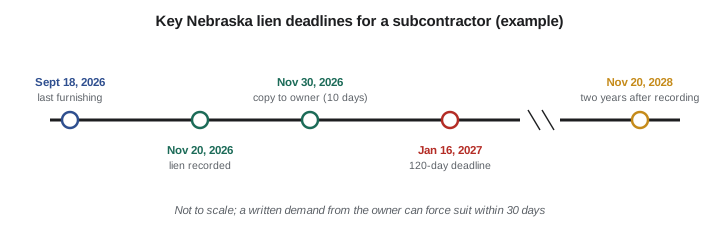
Section 52-137 requires a lien to be recorded within 120 days after the claimant's final furnishing of services or materials. A lien that is not recorded in time does not attach. Liens are recorded with the register of deeds in the county where the property is located, using a form that meets the act's content requirements. After recording, section 52-135 requires the claimant to send a copy of the recorded lien to the contracting owner within 10 days.
The act also has rules on notices of commencement, which an owner may record to set the priority of liens on a project, and on how liens relate to the date a notice of commencement lapses or is terminated. These rules mainly affect priority against lenders and buyers. A contractor working on a project with a recorded notice of commencement should have a lawyer review the timing of any lien.
from datetime import date, timedelta

last_furnished = date(2026, 9, 18)      # Platte Valley's last work at the Gibbon building
record_by = last_furnished + timedelta(days=120)
print("Last furnishing:      ", last_furnished)
print("Record lien by:       ", record_by)

recorded = date(2026, 11, 20)            # example recording date
print("Recorded on:          ", recorded, "(on time)" if recorded <= record_by else "(late)")
print("Copy to owner by:     ", recorded + timedelta(days=10))
print("Lien enforceable to: ", recorded.replace(year=recorded.year + 2))Last furnishing: 2026-09-18 Record lien by: 2027-01-16 Recorded on: 2026-11-20 (on time) Copy to owner by: 2026-11-30 Lien enforceable to: 2028-11-20
How long a lien lasts
Under section 52-140 a recorded lien remains enforceable for two years after recording. If a suit to enforce the lien is filed within that time, the lien continues while the suit is pending. An owner or other interested person can shorten the time by giving the claimant a written demand to start a suit. The lien then lapses unless, within 30 days after receiving the demand, the claimant files suit or records an affidavit that the contract price is not yet due.
A claimant who is paid must release the lien. A recorded lien clouds the owner's title, and leaving it in place after payment invites a claim against the contractor.
Public projects
Public property cannot be liened. On public construction, Nebraska law instead relies on payment bonds: the public owner requires the prime contractor to furnish a bond, and unpaid subcontractors and suppliers make claims against it. The bond statute has its own notice and suit deadlines, which are different from the lien deadlines and are strict. On any public job, such as the Willow Bend school addition, find out at the start who the surety is and what the bond claim deadlines are.
Lien waivers
General contractors and owners often ask for lien waivers with each payment. Nebraska does not prescribe a statutory waiver form, so waivers are governed by their own wording. Read each one. A waiver that releases all claims through a date, rather than only the amount being paid, can give up rights to unpaid change orders. Sign conditional waivers before payment clears and unconditional waivers only after it does.
Worked problem
The Gibbon building
Platte Valley contracted with Sandhill Builders, the general contractor, to wire a four-unit apartment building owned by an investor who does not live there. Last furnishing was September 18, 2026, and 38,400 dollars is unpaid. What are the key dates and is the owner a protected party?
Show solution
- The owner does not occupy the building as a residence, so the owner is not a protected party.
- The lien must be recorded within 120 days after September 18, 2026, that is, by January 16, 2027.
- After recording, a copy goes to the owner within 10 days.
- The lien lasts two years after recording, or less if the owner makes a written demand.
Answer: Record by January 16, 2027, send the copy within 10 days, and enforce within two years; the owner is not a protected party.
Worked problem
The homeowner's addition
Platte Valley is a subcontractor to a remodeler on an addition to a house in Elm Creek where the owners live. The prime contract is 90,000 dollars, and Platte Valley's subcontract is 14,000 dollars. The owners have paid the remodeler 60,000 dollars in good faith when they receive Platte Valley's notice of right to assert a lien. How much can Platte Valley's lien reach?
Show solution
- The owners occupy the house, so they are protected parties.
- Against them, Platte Valley's lien is limited to the lesser of its own unpaid amount and the unpaid prime contract balance when they received the notice.
- The unpaid prime balance at that moment is 90,000 minus 60,000, or 30,000 dollars.
- Platte Valley's own unpaid amount is 14,000 dollars, which is less.
Answer: Up to 14,000 dollars, because the unpaid prime balance of 30,000 dollars is larger; had the owners already paid in full, the lien could reach nothing.
Collecting before liening
A lien is leverage, not a goal. Before recording, Platte Valley sends a polite written reminder with the invoice and the contract terms, then a firmer letter stating that the company will protect its lien rights by a named date. Many payment problems end there. When they do not, the lien gives the company a secured claim against the property, which is far stronger than a bare invoice. Keep the tone businesslike throughout; the general contractor who is slow this month may be a good customer for years.
Common mistakes
MistakeWaiting until the 120 days are almost up to start.
InsteadPrepare the lien early; a late lien does not attach.
MistakeSkipping the notice of right to assert a lien on a homeowner's job.
InsteadAgainst a protected party the notice limits what the owner can pay away to the prime contractor.
MistakeTrying to lien a public school.
InsteadPublic property cannot be liened; claim against the payment bond.
MistakeSigning an unconditional waiver before the check clears.
InsteadUse conditional waivers until payment is final.
Summary and key terms
- The Nebraska Construction Lien Act, Neb. Rev. Stat. 52-125 to 52-159, governs construction liens.
- A lien must be recorded within 120 days after final furnishing, and a copy sent to the contracting owner within 10 days.
- A lien lasts two years after recording; a written demand can force suit within 30 days.
- Against a protected party, a subcontractor's lien is limited by what remains unpaid on the prime contract when the owner receives notice.
- Public projects use payment bonds instead of liens.
- Claimant
- A person who furnishes services or materials under a real estate improvement contract and may claim a lien.
- Contracting owner
- The owner who entered into the contract for the improvement.
- Protected party
- An individual improving residential real estate of up to four units that he or she occupies or intends to occupy.
- Right-to-lien notice
- The notice of right to assert a lien, an optional notice under section 52-135 telling the owner a claimant may lien and how much is unpaid.
- Final furnishing
- The last date the claimant provided services or materials under the contract, which starts the 120-day deadline.
Practice problems
Work each problem on paper first, then reveal the answer to check.
Within how many days after final furnishing must a Nebraska construction lien be recorded?
Show answer
120 days.
Who is a protected party under section 52-129?
Show answer
An individual improving residential real estate of no more than four dwelling units that he or she occupies or intends to occupy as a residence.
What replaces lien rights on a public project?
Show answer
A claim against the prime contractor's payment bond, under its own deadlines.
If last furnishing was September 18, 2026, by what date must the lien be recorded?
Show answer
January 16, 2027, which is 120 days later.
Lesson quiz · 5 questions
Score 60% or more to complete this lesson.
Create a free account to save your progress, take quizzes and earn a certificate.