
MELU-302 · Lesson 4 of 12 · 22 min
The exam format and the references allowed
▶ Video coming soon A video version of this lesson is on the way.
The week her approval arrived, Jenna sat at the kitchen table with the 2023 NEC, a pad of tabs and the PSI bulletin. Roger had warned her that the contractor exam was not a memory test. It is open book, he said, and that makes it a speed test. The people who fail usually know enough code; they just cannot find it fast enough. Before she placed a single tab, Jenna wanted to know exactly what the exam covered, how long it lasted, what score passed and which books she could bring.
This lesson describes the format of the Nebraska electrical contractor exam, the content areas, the passing score and the references allowed, then builds a pacing plan. The board's rules set the frame; PSI's current candidate bulletin fills in the details. Where the two differ, or where a detail is not in the rules, the bulletin in force on your test date governs.
What the board's rules say
The State Electrical Act requires a written exam based on the current National Electrical Code and electrical theory, and it says the exam is open book. The board's exam rule adds the structure. Exams may be given on computer by the board or a third-party administrator, or in person at locations the board names. The rule sets a minimum of 50 questions and a maximum time, and it requires a score of 75 to pass. The subject areas it lists are the National Electrical Code, basic electricity, the Nebraska State Electrical Act, blueprint reading, emergency circuits and fire alarm circuits.
The rule also allows a slide rule or a numerical, non-programmable calculator. A failed applicant must reapply, and a candidate who tested in person may ask to review a failed exam within ten days. Computer-based candidates receive a score report instead.
What the PSI bulletin adds
Since PSI gives the exam, its bulletin sets the practical details: the exact number of scored questions, any unscored pretest questions mixed in, the time allowed, the test center rules and the permitted references. Prep publishers in 2026 describe the contractor exam as roughly one hundred scored questions plus a small number of unscored ones, with several hours allowed, which is longer than the minimum in the board's rule. Treat those figures as a guide and use the bulletin's numbers for your own plan.
Questions are multiple choice and appear one at a time on screen. You can usually mark a question, skip it and return to it while time remains. Unscored pretest questions look exactly like scored ones, so answer every question as if it counts.
| Item | Source | What it says (summary) |
|---|---|---|
| Passing score | Board rule 9 | 75 |
| Minimum questions | Board rule 9 | At least 50 |
| Current question count and time | PSI bulletin | Check the bulletin; prep publishers describe about 100 scored questions |
| Open book | State Electrical Act | Yes, code book allowed |
| Calculator | Board rule 9 and bulletin | Numerical, non-programmable |
| Subjects | Board rule 9 | NEC, basic electricity, the act, blueprints, emergency and fire alarm circuits |
The content areas
The code dominates. Expect questions on general requirements and definitions, branch circuits and feeders, services, load calculations for dwellings and other occupancies, overcurrent protection, grounding and bonding, wiring methods and conductors, boxes and raceway fill, motors and air conditioning equipment, transformers, hazardous locations, health care and assembly occupancies, emergency and standby systems, and special equipment. The core courses MELU-101 to MELU-107 cover this material.
Basic electricity means Ohm's law, power, voltage drop, three-phase relationships and transformer ratios. Blueprint reading means reading symbols, schedules and one-line diagrams well enough to answer a question about a plan. Emergency circuits and fire alarm circuits are named separately in the rule, which is a hint to spend real time on the articles for emergency, legally required standby and optional standby systems, and on fire alarm systems.
The State Electrical Act is the one area the code book cannot answer. Questions may ask about license classes, apprentice supervision ratios, inspection requests, renewal and continuing education, exemptions and penalties. Lessons 1, 2, 6, 7 and 11 of this course cover those topics. Check the bulletin to see whether a copy of the act is supplied or allowed; if not, those questions must be answered from memory.
The references
The core reference is the 2023 NEC, the edition the board adopted for exams from August 1, 2024. Some bulletins also allow the NEC Handbook for the same edition, and prep book packages sold for Nebraska often include a pocket reference along with the code. Whether any book besides the NEC is allowed, and in what form, is decided only by the bulletin. Do not assume that a book sold in a prep package may come into the test center.
Bulletins typically allow highlighting and underlining and permanently attached index tabs, and forbid loose notes, handwritten formulas and pages added to the book. Some allow brief tab labels and nothing else. A book that breaks the rules may be taken away at check-in, which is far worse than having no tabs at all. If you buy a pre-tabbed or pre-highlighted book, check every page against the bulletin.
Tabbing for speed
Jenna tabbed the chapters first, then the articles she used most: definitions, branch circuits, feeders, services, overcurrent protection, grounding and bonding, conductors, raceway fill, motors, transformers, hazardous locations and emergency systems. She added a tab for the tables of conductor ampacity and properties, and one for the annex examples of load calculations. She highlighted article titles and section numbers rather than whole paragraphs, so the eye lands on the right place without reading a page of yellow.
Then she practiced finding things. Marisol read her questions aloud, and Jenna timed how long each lookup took. At first many took more than two minutes. After two weeks most took under a minute, because she had learned to go from the index to the article to the section without flipping aimlessly.
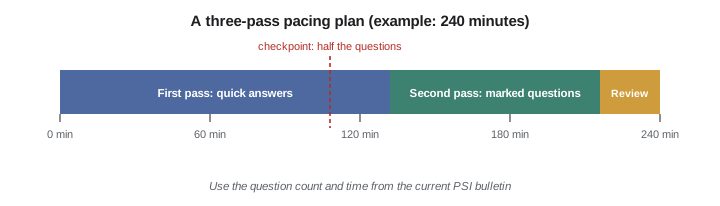
# Pacing plan: fill in the question count and minutes from the current PSI bulletin.
questions = 100        # example only
minutes = 240          # example only
first_pass_share = 0.55
second_pass_share = 0.35
review_share = 0.10

per_q = minutes / questions
print(f"Average time per question: {per_q:.1f} minutes")
for name, share in [("First pass (answer quick ones, mark the rest)", first_pass_share),
                    ("Second pass (marked questions)", second_pass_share),
                    ("Final review and blanks", review_share)]:
    print(f"{name:46} {minutes * share:5.0f} minutes")
print("Checkpoint: question", questions // 2, "by minute", round(minutes * 0.45))Average time per question: 2.4 minutes First pass (answer quick ones, mark the rest) 132 minutes Second pass (marked questions) 84 minutes Final review and blanks 24 minutes Checkpoint: question 50 by minute 108
A pacing plan
With an open book, the danger is spending ten minutes on a single hard question and leaving easy ones unanswered at the end. A three-pass plan prevents that. On the first pass, answer every question you can answer quickly from memory or with one lookup, and mark the rest. On the second pass, work the marked questions, longest lookups and calculations last. Keep the final block for review and for making sure no question is blank. Since an unanswered question cannot earn credit, a reasoned guess is always better than a blank.
Set checkpoints before the exam: a question number you want to pass by a certain minute. If you are behind at a checkpoint, speed up the first pass and mark more. Jenna wrote her checkpoints on a sticky note before each practice exam and checked them against the on-screen clock.
Calculators and arithmetic
Bring a calculator you know well, of a type the bulletin permits, with fresh batteries. Practice with that calculator so you do not fumble for the square root or the memory keys. Many calculation questions on the contractor exam are load calculations and voltage drop, which reward a consistent written method: write the formula, write the values, compute, then check the units and the size of the answer.
Reading the question
Many wrong answers on open-book exams come from reading the question too fast. Before you open the book, underline in your head the words that decide the answer: the occupancy (dwelling, commercial, hazardous), the type of conductor or equipment, whether the question asks for a minimum or a maximum, and whether it asks what is required or what is permitted. A question about the minimum size of a conductor has a different answer from one about the maximum overcurrent device for it, even though both send you to the same article.
Watch for questions that turn on a single exception. When the general rule seems too easy, read the exceptions under the section. Watch also for questions that mix units, such as a length in feet and a voltage drop limit expressed as a fraction of the supply voltage. And read every option before choosing; on many questions two options are close and only one matches the code's exact wording or value.
Practice exams
A timed practice exam is the best rehearsal. Take it with the same book, the same calculator and the same time limit you will have on test day, in a quiet room without breaks you would not get at the center. Then review every question, including the ones you got right, and record why each miss happened: you did not know the rule, you could not find it, you misread the question or you made an arithmetic slip. Lesson 12 turns those notes into a study plan.
Jenna took her first practice exam three weeks into study and scored 68. Her miss log showed that half the misses were lookups that took too long and were left for the end, and a quarter were questions on the act. Two weeks of lookup drills and a few evenings on the act brought her second practice score to 81.
| Kind of miss | What it means | What to do next |
|---|---|---|
| Did not know the rule | Content gap | Study the article, then do related questions |
| Could not find it in time | Navigation gap | Add a tab, practice index lookups |
| Misread the question | Reading habit | Slow down on key words before opening the book |
| Arithmetic or unit slip | Method gap | Write formula, values and units every time |
Worked problem
Choosing the reference
Jenna's practice question asks how many registered apprentices one licensee may supervise on a job. She reaches for the NEC. Is that the right book?
Show solution
- The question is about Nebraska licensing, not installation rules.
- The NEC does not set apprentice ratios; the State Electrical Act does.
- Section 81-2113 limits supervision to no more than three apprentices per licensee.
- If no copy of the act is allowed, she must know this from study.
Answer: No; the answer comes from the act: three apprentices per licensee.
Worked problem
Checking a pace
On a practice exam with 100 questions and 240 minutes, Jenna has answered 41 questions at minute 120. Her checkpoint was question 50 by minute 108. What should she do?
Show solution
- She is behind: at minute 120 she should be past question 50.
- Her remaining time is 120 minutes for 59 questions, about 2 minutes each.
- She should mark any question needing more than one lookup and move on.
- On the second pass she can return to the marked questions with the time saved.
Answer: Speed up the first pass by marking more questions, then use the second pass for the hard ones.
Common mistakes
MistakeBringing a prep-package book without checking the bulletin.
InsteadOnly books on the bulletin's reference list may come in, in the form it allows.
MistakeWriting formulas inside the code book cover.
InsteadHandwritten notes are typically prohibited and can get the book removed.
MistakeStudying only the code.
InsteadThe act, basic electricity, blueprints and emergency and fire alarm circuits are also tested.
MistakeLeaving questions blank.
InsteadA blank earns nothing; make a reasoned guess before time runs out.
Summary and key terms
- The board's rule requires a score of 75 and at least 50 questions; the PSI bulletin gives the current count and time.
- The exam is open book with the 2023 NEC; other references only as the bulletin allows.
- Subjects include the NEC, basic electricity, the State Electrical Act, blueprints, emergency circuits and fire alarm circuits.
- Tab and highlight within the bulletin's rules and practice lookups for speed.
- Use a three-pass pacing plan with checkpoints and never leave a blank.
- Open book
- An exam on which the candidate may consult the permitted references.
- Pretest question
- An unscored question mixed into the exam to test it for future use.
- Rule 9
- The board's exam rule setting the format, subjects and passing score.
- Checkpoint
- A target question number to reach by a set minute during the exam.
- Permitted reference
- A book listed in the PSI bulletin that may be used during the exam.
Practice problems
Work each problem on paper first, then reveal the answer to check.
What score passes the Nebraska electrical contractor exam under the board's rules?
Show answer
75.
Name three subject areas listed in the board's exam rule besides the NEC.
Show answer
Any three of basic electricity, the State Electrical Act, blueprint reading, emergency circuits and fire alarm circuits.
Who decides which reference books may be brought into the test center?
Show answer
The current PSI candidate bulletin.
After a practice exam, what four kinds of misses should a candidate sort?
Show answer
Did not know the rule, could not find it in time, misread the question, and arithmetic or unit slips.
Why answer an unscored pretest question carefully?
Show answer
Because pretest questions look exactly like scored ones, so the candidate cannot tell which is which.
Lesson quiz · 5 questions
Score 60% or more to complete this lesson.
Create a free account to save your progress, take quizzes and earn a certificate.